
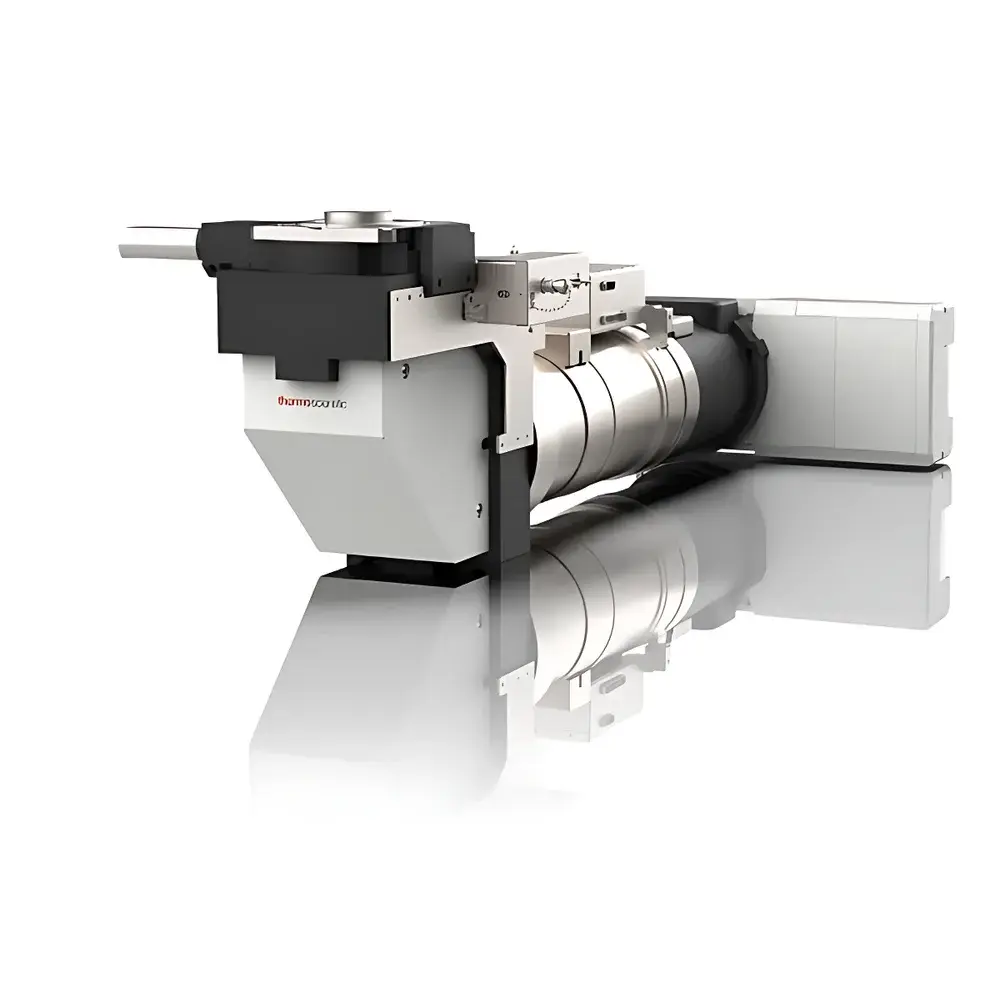
Thermo Scientific Selectris and Selectris X Imaging Filters
| Brand | Thermo Scientific |
|---|---|
| Origin | Netherlands |
| Model | Selectris / Selectris X |
| Price Range | USD 65,000 – 130,000 |
| Compatibility | Krios™ and Glacios™ Cryo-TEM Platforms |
| Detector Integration | Fully Compatible with Falcon™ 4 Direct Electron Detector |
| Energy Slit Width | <10 eV (Zero-Loss Filtering) |
| Application Focus | Cryo-EM Single-Particle Analysis (SPA) and Cryo-Electron Tomography (Cryo-ET) |
Overview
The Thermo Scientific Selectris and Selectris X Imaging Filters are high-performance, post-column energy filters engineered for transmission electron microscopy (TEM), specifically optimized for cryo-electron microscopy (cryo-EM) workflows. These filters operate on the principle of zero-loss energy filtering—selectively transmitting only elastically scattered electrons while removing inelastically scattered electrons that contribute to background noise and chromatic blur. By isolating the zero-loss peak with sub-10 eV energy slit width, the Selectris platform significantly improves signal-to-noise ratio (SNR), enhances image contrast, and enables higher-resolution structural determination—particularly critical under low-dose imaging conditions inherent to biological specimen preservation in vitreous ice. The Selectris X variant extends this capability with refined electron-optical design, reduced geometric and chromatic distortion, and tighter alignment stability—making it a foundational component for aberration-corrected cryo-EM configurations targeting true atomic-resolution reconstruction (≤1.8 Å) in single-particle analysis (SPA).
Key Features
- Zero-loss energy filtering with stable, reproducible <10 eV energy slit width—enabling consistent high-contrast imaging across large datasets.
- Fully integrated hardware and software architecture—seamlessly embedded within Thermo Scientific TEM control environments (including EPU and SerialEM-compatible acquisition pipelines).
- Robust mechanical and electro-optical design—engineered for unattended, long-duration data collection with minimal drift or alignment degradation.
- Optimized compatibility with Thermo Scientific Falcon™ 4 direct electron detector—leveraging high DQE, fast readout, and dose-fractionation capabilities for maximal information transfer.
- Dual-platform support—certified for use with both Krios™ G4 and Glacios™ cryo-TEM systems, including full alignment and calibration integration via AutoTEM™ software.
- Selectris X-specific enhancements: improved magnetic lens homogeneity, reduced beam-induced image shift, and enhanced energy dispersion linearity—critical for quantitative energy-filtered imaging and high-precision 3D reconstruction.
Sample Compatibility & Compliance
The Selectris and Selectris X filters are validated for use with standard cryo-EM specimen types, including thin vitrified monolayers (typical thickness: 30–80 nm) used in SPA and thicker lamellae (100–300 nm) prepared by cryo-focused ion beam (cryo-FIB) milling for cryo-electron tomography. Their zero-loss filtering performance remains effective across varying ice thicknesses and specimen densities without requiring recalibration. From a regulatory standpoint, the system complies with IEC 61000-6-3 (EMC emission standards) and meets CE marking requirements for laboratory instrumentation. While not a standalone medical device, its integration into GLP- and GMP-aligned structural biology workflows supports audit-ready data provenance when used with Thermo Scientific’s 21 CFR Part 11-compliant software modules (e.g., EPU v5.0+ with electronic signature and audit trail functionality).
Software & Data Management
Both Selectris and Selectris X are natively supported in Thermo Scientific’s EPU (Electron Microscopy Processing Unit) software suite and fully interoperable with third-party acquisition platforms such as SerialEM and UCSF Tomo. Filter alignment, energy offset calibration, and slit width adjustment are automated through instrument-level scripting interfaces. All filter parameters—including slit position, dispersion calibration, and real-time energy profile monitoring—are logged with timestamped metadata and embedded into MRC/EMDB-compliant image headers. Raw dose-fractionated movies acquired with the Falcon™ 4 detector retain full energy-filtering context, enabling downstream motion correction and CTF estimation tools (e.g., MotionCor2, CTFFIND4, RELION) to account for energy-dependent contrast modulation. Data provenance is preserved through HDF5-based acquisition logs synchronized with microscope control systems.
Applications
- High-resolution single-particle analysis (SPA) of membrane proteins, viral capsids, and ribonucleoprotein complexes—where enhanced contrast at low spatial frequencies accelerates particle picking and improves initial model bias.
- Cryo-electron tomography (cryo-ET) of cellular sections and intact organelles—benefiting from reduced chromatic aberration and improved Z-contrast in tilt-series reconstruction.
- Energy-filtered imaging (EFI) for elemental mapping in hybrid biological-inorganic systems (e.g., metalloproteins, nanocarriers), leveraging the Selectris X’s improved energy dispersion fidelity.
- Method development for dose-efficient data collection—especially relevant for radiation-sensitive specimens such as glycans, RNA-protein assemblies, and fragile macromolecular machines.
- Validation and benchmarking of aberration-corrected cryo-EM pipelines—where Selectris X serves as a reference-standard filtering module for assessing optical stability and resolution anisotropy.
FAQ
What is the primary advantage of zero-loss filtering in cryo-EM?
Zero-loss filtering removes inelastically scattered electrons that degrade image contrast and introduce chromatic blur—directly improving SNR, enhancing low-frequency contrast, and enabling higher-resolution reconstructions under low-dose constraints.
Can Selectris be used with non-Thermo TEM platforms?
No—Selectris and Selectris X are purpose-built for Thermo Scientific Krios™ and Glacios™ cryo-TEM systems, with mechanical, electrical, and software interfaces designed exclusively for these platforms.
Does Selectris X require additional aberration correctors to achieve atomic resolution?
Selectris X itself is not an aberration corrector, but its ultra-stable, low-distortion electron optics are essential for realizing the full potential of existing hardware correctors (e.g., CEOS hardware correctors) in SPA workflows targeting ≤1.8 Å resolution.
How does Selectris impact data processing workflow?
It simplifies early-stage processing by delivering higher-contrast micrographs—reducing reliance on aggressive denoising, improving auto-picking accuracy, and shortening the time required for consensus refinement cycles in RELION or cryoSPARC.
Is routine maintenance required for Selectris operation?
The system is sealed and vacuum-integrated; no user-serviceable parts exist. Annual calibration and alignment verification by certified Thermo Scientific Field Service Engineers are recommended to maintain <10 eV slit fidelity and positional reproducibility.




