
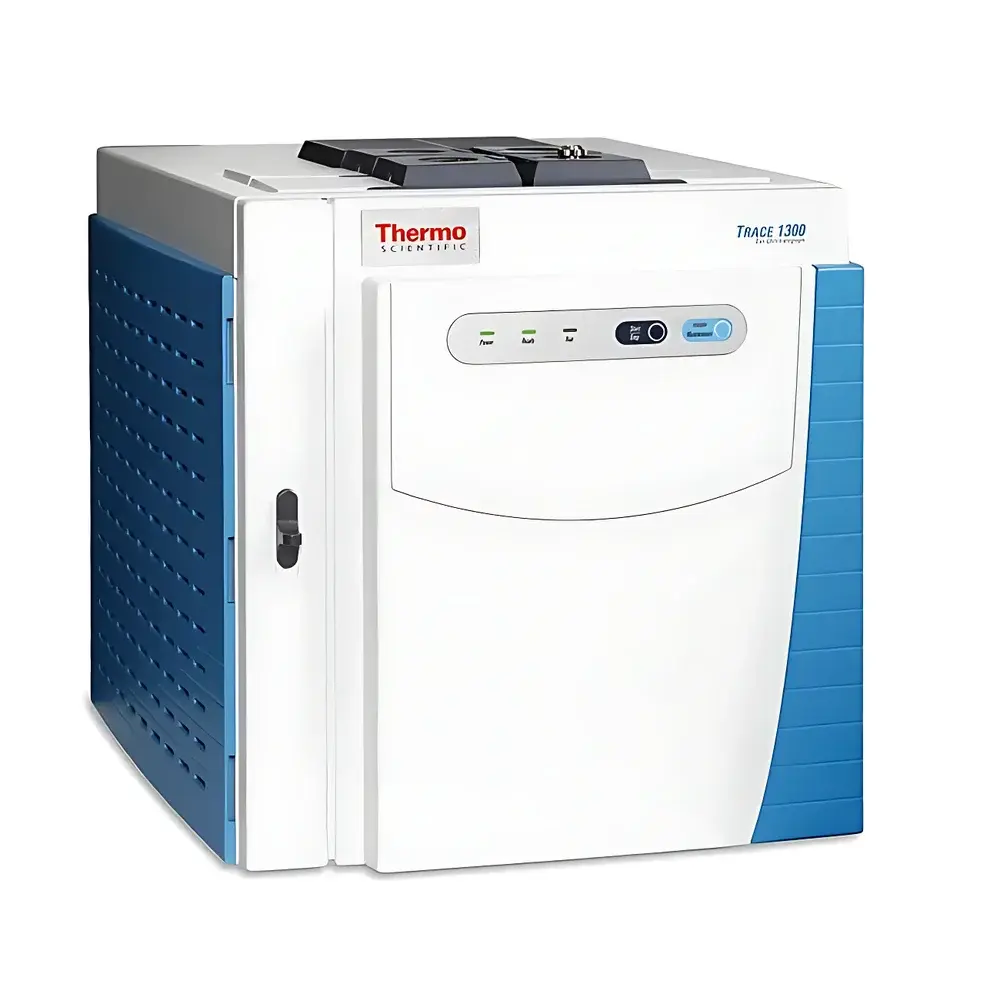
Thermo Scientific TRACE 1300 Series Gas Chromatograph
| Brand | Thermo Scientific |
|---|---|
| Origin | USA |
| Manufacturer Type | Authorized Distributor |
| Origin Category | Imported |
| Model | TRACE 1300 |
| Instrument Type | Laboratory Gas Chromatograph |
| Application Scope | General-Purpose |
| Pricing Range | USD 65,000 – 130,000 (FOB US Port) |
| Module Architecture | Plug-and-Play, User-Replaceable Inlet & Detector Modules |
| Compliance | Designed to support GLP/GMP workflows and 21 CFR Part 11–compliant data integrity requirements |
Overview
The Thermo Scientific TRACE 1300 Series Gas Chromatograph is a modular, laboratory-grade analytical platform engineered for high-throughput, method-robust gas chromatographic separation of volatile and semi-volatile organic compounds. Built upon a fundamental architecture grounded in precision pneumatic control and thermally stable column oven design, the system implements capillary column-based separation using carrier gas (He, H2, or N2) under controlled linear velocity conditions. Its core innovation lies in the patented, field-replaceable inlet and detector modules—each pre-aligned, factory-calibrated, and electrically authenticated via embedded EEPROM—enabling rapid reconfiguration between split/splitless, PTV, or cool-on-column injection modes, and between FID, TCD, ECD, or NPD detection configurations without requiring service engineer intervention. This modularity directly supports method transfer, instrument qualification (IQ/OQ/PQ), and multi-analyte workflow partitioning across shared laboratory environments.
Key Features
- Modular inlet and detector architecture with hot-swap capability—no tools or recalibration required for module replacement
- Integrated, temperature-stabilized column oven with dual-zone thermal control and active air circulation for ±0.1 °C isothermal stability
- Electronic pneumatic control (EPC) system with digital pressure/flow monitoring and closed-loop feedback—supporting both constant flow and constant pressure operation modes
- On-board GC controller with embedded Linux OS, 7-inch capacitive touchscreen interface, and local method storage (≥500 methods)
- Front-accessible consumables bay with RFID-tagged liner and septum inventory tracking
- Optional integration with Thermo Scientific Chromeleon™ CDS (Chromatography Data System) v7.3 or later for full 21 CFR Part 11 compliance, including electronic signatures, audit trail, and role-based access control
Sample Compatibility & Compliance
The TRACE 1300 accommodates standard 0.1–0.53 mm ID fused-silica capillary columns up to 60 m in length and 5 µm film thickness. It accepts liquid, gaseous, and headspace-derived samples via compatible autosamplers (e.g., TriPlus RSH). The platform meets essential regulatory expectations for routine QC laboratories: all firmware and hardware revisions are documented per ISO 9001 and ISO/IEC 17025 quality management systems; EPC performance is verified against ASTM D3612 Annex A2 (gas chromatographic calibration procedures); and when deployed with Chromeleon CDS, it satisfies FDA 21 CFR Part 11 requirements for electronic records and signatures—including immutable audit trails, user authentication, and data integrity validation protocols. Routine operation aligns with USP , EP 2.2.46, and ISO 17025 clause 5.9.1 for method validation traceability.
Software & Data Management
Chromeleon CDS serves as the primary acquisition, processing, and reporting engine—supporting real-time peak integration, retention time locking (RTL), and automated calibration curve generation. Raw data files (.RAW) are stored in vendor-neutral format compliant with ASTM E2524-22 (Standard Practice for Chromatographic Data Exchange). The system supports LIMS integration via ASTM E1578-compliant interfaces and provides configurable export templates for CSV, PDF, and XML outputs. Audit trail metadata includes operator ID, timestamp, parameter change history, and raw signal checksums—retained for ≥30 years per institutional retention policy. Local standalone operation is fully functional without network dependency; cloud backup and remote diagnostics require optional Thermo Connect subscription.
Applications
The TRACE 1300 is routinely deployed in pharmaceutical QC (residual solvent analysis per ICH Q2(R2)), environmental testing (EPA Method 8260D, 8021B), petrochemical hydrocarbon profiling (ASTM D5504, D6729), food safety (pesticide residue screening per EN 15662), and forensic toxicology (blood alcohol and volatile compound quantification). Its modular flexibility allows a single instrument to serve multiple validated SOPs—e.g., switching from an FID-based residual solvent assay to an ECD-based PCB congener analysis within 15 minutes—without compromising chromatographic reproducibility (RSD < 1.2% for retention time, < 2.5% for peak area across 50 injections).
FAQ
Can the TRACE 1300 be upgraded with new detector technologies after purchase?
Yes—detector modules are backward-compatible across firmware versions; newly released detectors (e.g., micro-ECD or low-noise FID) can be installed as field upgrades with no chassis modification.
Is method transfer supported between TRACE 1300 and legacy Thermo GC platforms?
Method parameters (oven ramp rates, inlet temperatures, detector settings) are exportable in ASCII format and manually translatable; Chromeleon’s Method Transfer Assistant provides automated scaling for retention time and peak width adjustments.
Does the system support unattended overnight operation?
Yes—integrated power-fail recovery, automatic shutdown sequencing, and event-triggered email/SNMP alerts ensure robust 24/7 operation in regulated environments.
What documentation is provided for IQ/OQ/PQ validation?
Thermo supplies a complete Validation Support Package (VSP), including URS template, FAT/SAT checklists, OQ test scripts aligned with ASTM E2656, and PQ protocol examples compliant with ISO/IEC 17025.
Are consumables such as liners and septa supplied with serialized lot traceability?
Yes—all Thermo-certified consumables include batch-specific CoA (Certificate of Analysis), shelf-life labeling, and traceability to manufacturing date and QC release data.





