
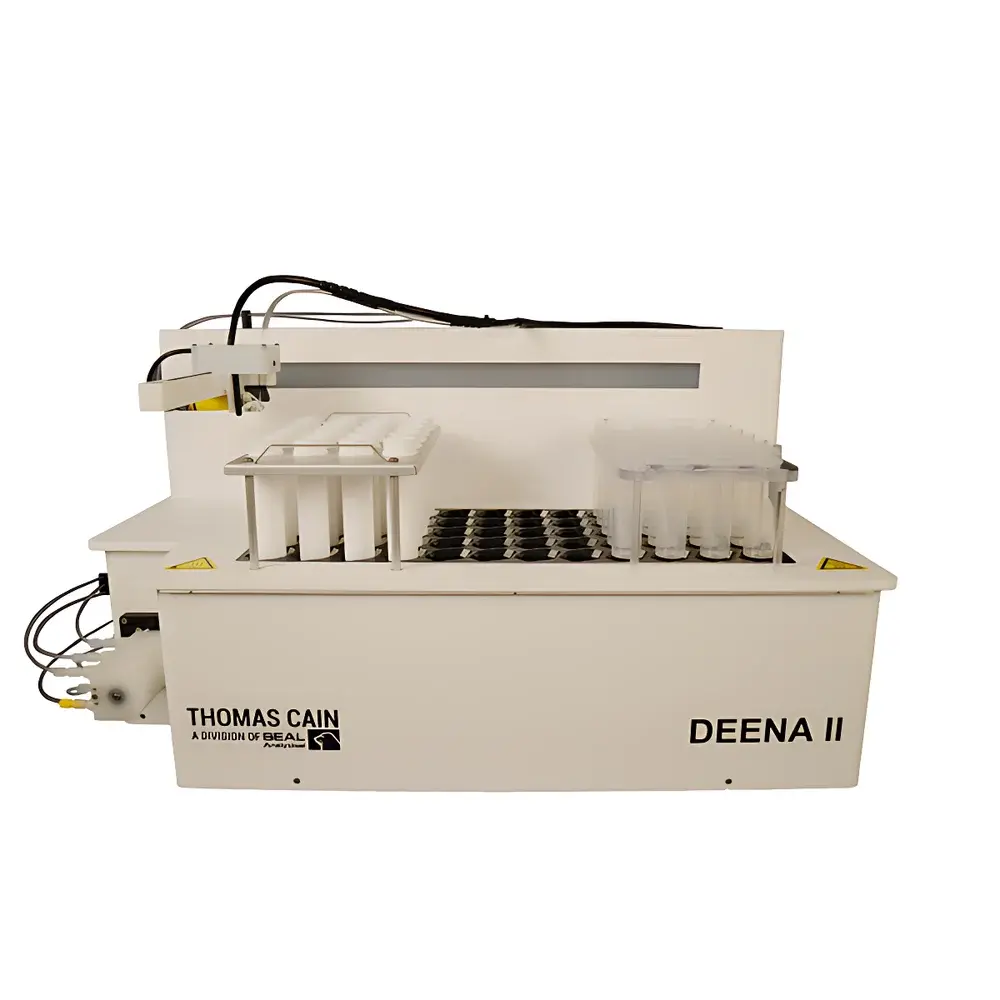
Thomas Cain DEENA Fully Automated Graphite Block Digestion and Sample Preparation System
| Brand | Thomas Cain |
|---|---|
| Origin | Imported |
| Manufacturer Type | Authorized Distributor |
| Instrument Type | Graphite Block Digestion System |
| Automation Level | Fully Automatic |
| Sample Capacity | 60 positions (50 mL) |
| Temperature Range | Ambient to 240 °C |
| Temperature Control Accuracy | ±0.1 °C |
| Heating Mechanism | PTFE-coated graphite block |
| Reagent Channels | 9 |
| Standard Solution Channels | 6 |
| Reagent Dispensing Precision | <0.025 mL or 1% |
| Reagent Delivery Speed | <4 mL/s |
| Final Volume Accuracy (50 mL) | <1% |
| Dimensions (H×W×D) | 44.5 × 80 × 49.5 cm |
| Interface | RS-232 or USB |
| Voltage | 120–240 V AC |
| Current Rating | 15 A |
| Colorimetric Endpoint Detection | Integrated optical sensor |
| Ultrasonic Micro-Volume Level Sensing | For precise final volume adjustment |
Overview
The Thomas Cain DEENA Fully Automated Graphite Block Digestion and Sample Preparation System is an engineered solution for high-throughput, trace-metal-focused sample digestion in environmental, food safety, and wastewater laboratories. It operates on the principle of controlled conductive heating via a thermally homogeneous, PTFE-coated graphite block—ensuring uniform thermal distribution across all 60 sample positions. Unlike open-vessel hot plates or microwave-assisted digestion systems, DEENA employs a closed-graphite-block architecture that minimizes acid fume dispersion while maintaining precise, programmable ramp-and-hold temperature profiles from ambient up to 240 °C. This enables reproducible decomposition of organic matrices (e.g., soils, sludges, biological tissues, and food composites) using HNO₃, HCl, HF, and H₂O₂—without compromising analyte recovery or introducing contamination. The system integrates robotic liquid handling, endpoint detection, volumetric standardization, and full digital audit trail generation—making it compliant with GLP and ISO/IEC 17025 documentation requirements for accredited testing laboratories.
Key Features
- Fully automated sample processing sequence: reagent addition, heating ramping, shaking, colorimetric oxidation endpoint detection, final volume adjustment (to 50 mL), and data logging—all executed without manual intervention.
- 60-position capacity with three removable 20-position PTFE-coated sample racks—designed for seamless transfer between DEENA, ICP-OES, ICP-MS, and AAS instruments.
- Nine independent reagent channels with high-precision peristaltic pumping (±0.025 mL or 1% accuracy); one channel is dedicated to aggressive oxidants (e.g., KMnO₄) to prevent cross-contamination.
- Six calibrated standard solution channels support automated internal standard addition, spike recovery assessment, and matrix-matched calibration preparation.
- PTFE-coated stainless steel chassis and graphite heating block provide long-term resistance to concentrated mineral acids and corrosive vapors.
- X-Y robotic arm with micro-stepper positioning ensures repeatable reagent delivery; ultrasonic micro-level sensors enable gravimetric-equivalent final volume adjustment at ±1% tolerance (50 mL).
- Optical color sensor monitors reaction progress in real time—automatically terminating oxidation steps upon reaching defined chromatic endpoints (e.g., MnO₄⁻ reduction or Cr(VI) conversion).
Sample Compatibility & Compliance
DEENA accommodates standard 50 mL borosilicate or quartz digestion tubes and supports diverse solid and semi-solid matrices—including EPA Method 3050B/3051A soils, AOAC 999.10 food digests, ISO 11466 sediments, and ASTM D5177 wastewater sludge. Its closed-block design meets OSHA and local ventilation code requirements when used with optional integrated fume extraction accessories. All operational parameters—including temperature setpoints, reagent volumes, dwell times, and sensor readings—are recorded with timestamps and user IDs, satisfying FDA 21 CFR Part 11 electronic record integrity criteria when paired with validated software configuration. System calibration reports—including temperature uniformity mapping, reagent delivery linearity, and volumetric accuracy verification—are generated per ISO/IEC 17025 Section 6.4.10.
Software & Data Management
The DEENA Control Suite provides a Windows-based interface with intuitive drag-and-drop method builder, supporting multi-step digestion protocols with conditional logic (e.g., “if color intensity > threshold, extend HNO₃ hold time by 5 min”). All methods are stored with version control, digital signatures, and change logs. Raw sensor data, instrument status flags, and alarm events are exported in CSV or XML format for LIMS integration. Audit trails include operator login/logout, parameter modifications, and error recovery actions—retained for ≥12 months as required under GLP Annex 11 and EU GMP Annex 11. Remote diagnostics and firmware updates are supported via secure HTTPS connection.
Applications
DEENA is routinely deployed in regulatory monitoring labs performing routine heavy metal analysis (As, Cd, Cr, Cu, Ni, Pb, Zn, Hg) in accordance with US EPA SW-846 Methods 3050B, 3051A, and 3052; China’s HJ 491–2019 and HJ 680–2013; and EU EN 13656. It delivers consistent recoveries (>95%) for certified reference materials (e.g., NIST SRM 2710a, GBW 07401) across soil, agricultural products, municipal biosolids, and industrial effluents. Its low-temperature capability (ambient–240 °C) makes it especially suitable for mercury stabilization and arsenic speciation workflows where volatile loss must be minimized.
FAQ
What sample tube formats are compatible with DEENA?
Standard 50 mL digestion tubes made of borosilicate glass, quartz, or PTFE-lined variants—up to 150 mm height and 30 mm outer diameter.
Does DEENA support method validation per ISO/IEC 17025?
Yes—full traceability of calibration certificates, temperature uniformity reports, reagent delivery verification, and software validation documentation are provided with each installation.
Can DEENA integrate with laboratory information management systems (LIMS)?
Yes—via configurable CSV/XML export and optional OPC UA or REST API modules for bidirectional data exchange.
Is HF digestion supported safely?
Yes—when used with HF-rated PTFE digestion tubes and the dedicated oxidant channel isolated from other reagents; full acid compatibility documentation is included in the Safety Manual.
What maintenance intervals are recommended?
Quarterly verification of temperature uniformity, biannual re-calibration of reagent pumps, and annual optical sensor validation—per the manufacturer’s Preventive Maintenance Schedule (PMS-DEENA-Rev.3).



