
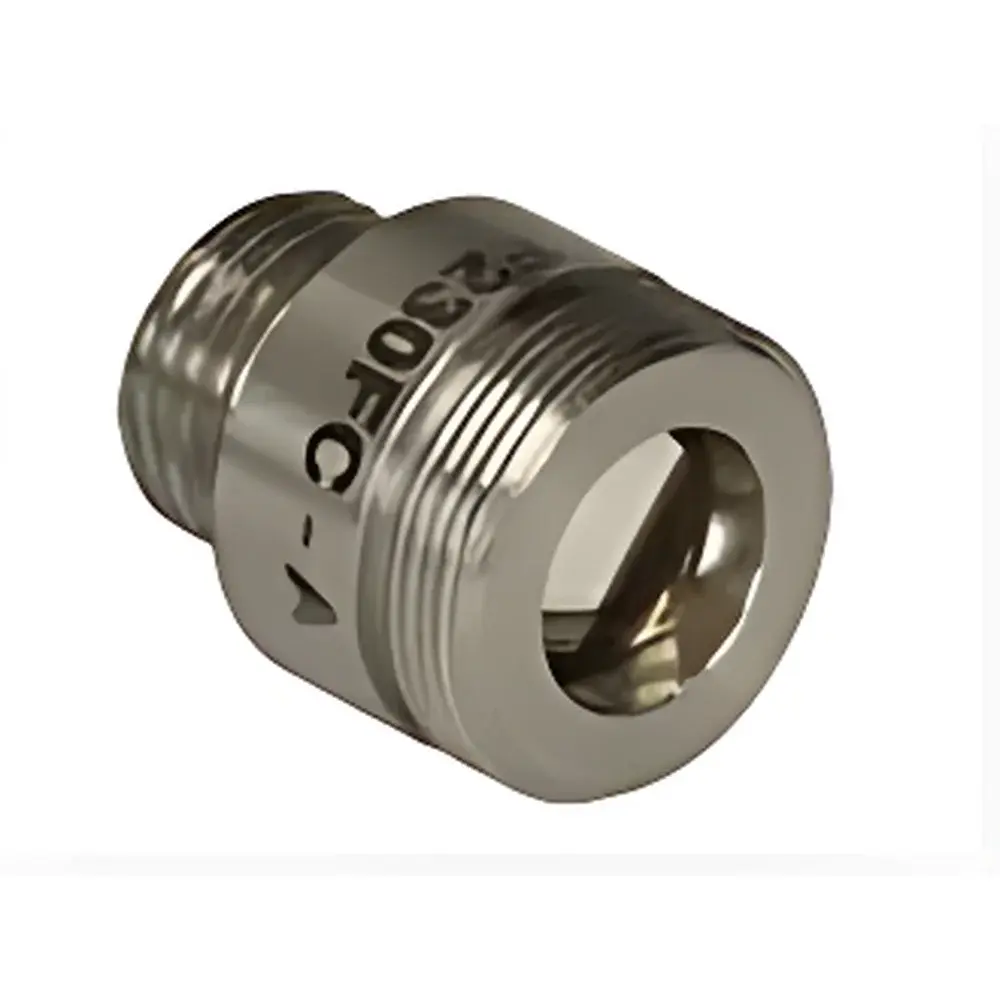
Thorlabs NewOpto Aspheric Collimating Lens Series
| Brand | Thorlabs |
|---|---|
| Origin | USA |
| Model | NewOpto |
| Wavelength Range | 405 nm to 2000 nm |
| AR Coating Options | 395–415 nm, 350–700 nm, 600–1050 nm, 1050–1075 nm, 1050–1620 nm, 1.8–2.4 µm |
| Lens Diameter | 0.7–3.6 mm |
| Numerical Aperture (NA) | 0.15–0.60 |
| Focal Length | 4.02–18.75 mm |
| Connector Types | FC/PC, FC/APC, SMA |
| Compliance | RoHS, ISO 9001-certified manufacturing |
Overview
The Thorlabs NewOpto Aspheric Collimating Lens Series is a precision-engineered family of fiber-coupled collimators designed for high-efficiency beam shaping in free-space optical systems. These lenses utilize monolithic aspheric surfaces to minimize spherical aberration and deliver diffraction-limited performance across a broad spectral range—from deep violet (405 nm) to mid-infrared (2000 nm). Each collimator is optimized for use with single-mode optical fibers, enabling accurate collimation or focusing of Gaussian beams with minimal wavefront distortion. The design follows the fundamental principle of paraxial ray optics combined with rigorous non-paraxial ray tracing to ensure consistent beam divergence control and spatial mode fidelity—critical for applications such as interferometry, spectroscopy, laser cavity alignment, and quantum optics experiments.
Key Features
- Aspheric lens geometry fabricated via precision diamond turning and polished to λ/10 surface accuracy for minimal wavefront error
- Multi-band anti-reflection (AR) coatings applied via ion-assisted e-beam deposition, achieving <0.25% average reflectance per surface across specified wavelength bands
- Hermetically sealed, stainless-steel housings with kinematic mounting interfaces compatible with standard optomechanical breadboards and translation stages
- Pre-aligned and factory-tested collimation performance verified using automated M² and beam profiler measurements (ISO 11146 compliant)
- Thermal stability engineered for operation from –10 °C to +50 °C; focal shift ≤ ±0.02% per °C over the full temperature range
- Interchangeable connector options (FC/PC, FC/APC, SMA) with repeatability <±1 µm axial position tolerance after mating cycles
Sample Compatibility & Compliance
This collimator series is validated for use with standard single-mode fibers including SMF-28, HI1060, PM980, and SM2000, supporting mode field diameters from 3.3 µm (at 405 nm) to 10.4 µm (at 2000 nm). All units comply with IEC 61300-2-2 (fiber optic connector durability), IEC 61300-2-3 (vibration resistance), and MIL-STD-810G for mechanical shock. Manufacturing adheres to ISO 9001:2015 quality management standards. While not FDA-regulated, the devices meet general requirements for Class 1 laser product integration under IEC 60825-1:2014, and support GLP/GMP traceability when used within validated optical subsystems.
Software & Data Management
No embedded firmware or proprietary software is required for operation—these are passive optical components. However, performance data sheets include full Zemax-compatible .ZMX files and ray-trace models for system-level simulation in OpticStudio, CODE V, or MATLAB-based optical design workflows. Each unit ships with a unique serial number and calibration report documenting measured collimation angle (full divergence <1.5 mrad at 1/e² intensity), transmitted wavefront error (RMS <0.05λ at design wavelength), and insertion loss (<0.3 dB typical at 1550 nm). Audit trails for production test records are retained per ISO 17025 guidelines for laboratory accreditation purposes.
Applications
- Free-space coupling between single-mode fibers and external cavity diode lasers (ECDLs), Ti:sapphire oscillators, or quantum dot emitters
- Beam conditioning in confocal microscopy, optical coherence tomography (OCT), and stimulated Raman scattering (SRS) setups
- Fiber-to-fiber interconnects in photonic integrated circuit (PIC) testing environments requiring low back-reflection and polarization-maintaining alignment
- Optical trapping and atom cooling experiments where precise Gaussian beam propagation and minimal pointing instability are essential
- Calibration references in metrology labs performing ISO 11146-compliant beam parameter measurements
FAQ
Are these collimators suitable for high-power laser applications?
Yes—when operated within specified average power limits (≤500 mW for visible/NIR models; ≤1 W for 1064 nm and 1550 nm variants), and with appropriate beam diameter matching to avoid localized thermal lensing. Damage threshold data is available upon request.
Can I specify custom AR coating bands or focal lengths?
Custom configurations—including extended AR ranges (e.g., 1200–1700 nm), hybrid coatings for dual-wavelength operation, or focal lengths outside the standard catalog—are available through Thorlabs’ OEM services with lead times of 8–12 weeks.
Do you provide polarization-dependent specifications?
All models maintain polarization extinction ratio (PER) >20 dB when used with polarization-maintaining (PM) fiber pigtails; PER degradation due to lens birefringence is <0.5 dB across the operating temperature range.
What is the maximum allowable angular misalignment before beam clipping occurs?
For optimal performance, angular tilt should be limited to 10% and increases far-field divergence asymmetry.
Is there documentation supporting traceable calibration to NIST standards?
While the collimators themselves are not calibrated artifacts, all test instrumentation used in final verification (e.g., beam profilers, autocorrelators, interferometers) is NIST-traceable, and calibration certificates are included with each shipment.




