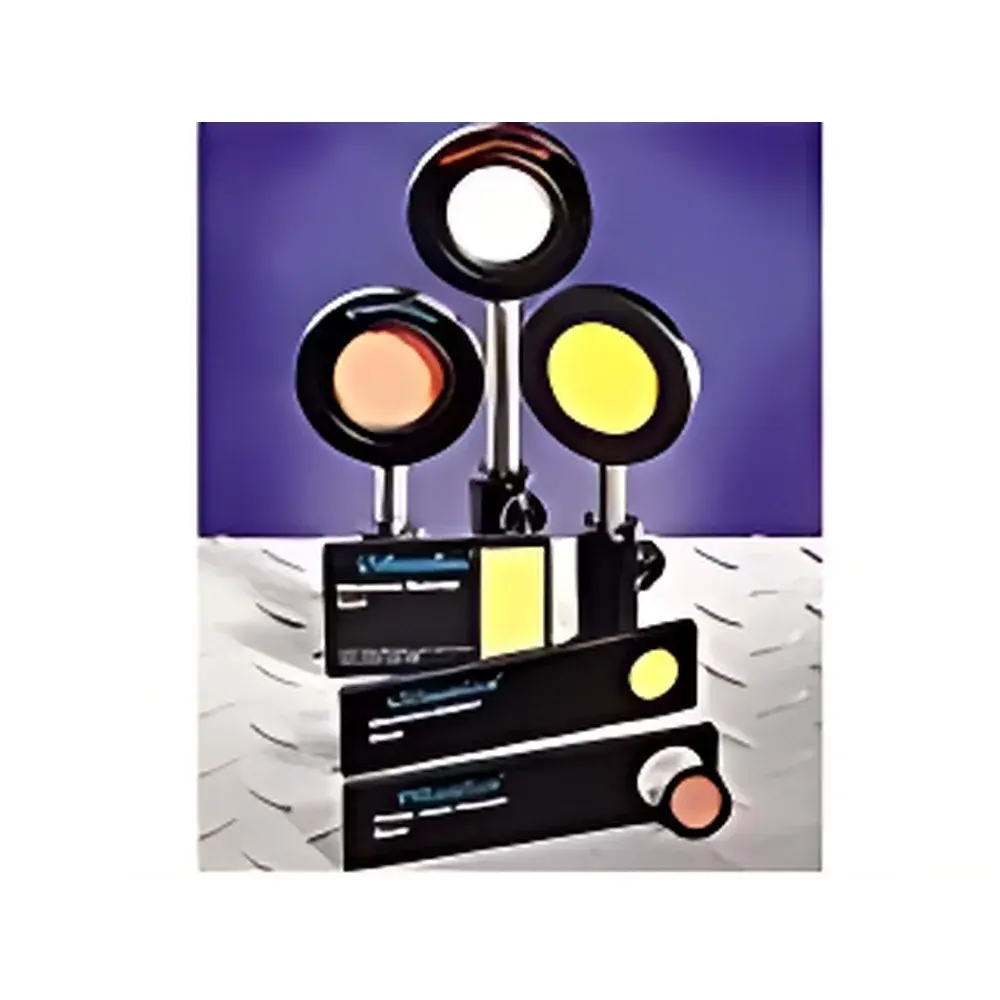
Thorlabs NewOpto Laser Viewing Card
| Brand | Thorlabs |
|---|---|
| Origin | USA |
| Manufacturer Type | Authorized Distributor |
| Origin Category | Imported |
| Model | NewOpto |
| Price | Upon Request |
| Wavelength Detection Range | 250–1590 nm |
| Minimum Detectable Irradiance | <1 nW/cm² |
| Active Area Dimensions | Multiple Options (17 mm, 31.8×54 mm, 19.0×38.1 mm, 35 mm, 42×23 mm) |
| Visible Emission Color | Wavelength-Dependent (e.g., blue ~400 nm, green ~550 nm, yellow ~580 nm, orange/red ~655–673 nm, broadband 490–750 nm) |
Overview
The Thorlabs NewOpto Laser Viewing Card is a passive, non-electronic optical diagnostic tool engineered for real-time visualization of invisible laser beams across ultraviolet (UV), visible (VIS), and near-infrared (NIR) spectral regions. Unlike thermal or camera-based detection methods, this card operates on photoluminescent conversion: incident photons excite proprietary phosphor or fluorescent materials embedded in the card substrate, which then re-emit visible light at longer wavelengths—enabling direct spatial observation of beam profiles, alignment verification, and mode structure assessment without requiring external power, optics, or image processing. Its design complies with fundamental safety principles for Class 3B and Class 4 laser environments, eliminating specular reflection hazards associated with mirrored surfaces while maintaining high angular acceptance and low background fluorescence.
Key Features
- Multi-band spectral sensitivity: Select models cover discrete or broad wavelength ranges from 250 nm (deep UV) to 1590 nm (extended NIR), supporting common laser sources including excimer, He-Cd, diode-pumped solid-state (DPSS), fiber, and quantum cascade lasers.
- Sub-nanowatt irradiance threshold: Capable of visualizing beams with irradiance as low as <1 nW/cm² under ambient-darkened conditions—ideal for alignment of low-power pilot beams or attenuated diagnostic paths.
- Zero-power operation: No batteries, cables, or drivers required; fully passive and intrinsically safe in electrically sensitive or explosive atmospheres.
- Dual-use geometry: Optimized for both transmission (backlit inspection) and reflective (front-surface viewing) configurations without performance degradation.
- High spatial fidelity: Uniform active layers preserve beam shape integrity with minimal diffusion or halo artifacts—critical for M² measurements, cavity alignment, and wavefront analysis prep.
- Multiple form factors: Available in standardized dimensions (e.g., 31.8 × 54 mm, 42 × 23 mm) and compact circular formats (17 mm, 35 mm diameter) to accommodate breadboard mounts, kinematic holders, and OEM integration.
Sample Compatibility & Compliance
The NewOpto series is compatible with continuous-wave (CW) and pulsed laser sources operating within specified wavelength bands. Each card variant is calibrated for peak quantum efficiency at designated excitation windows (e.g., VRC2: 400–640 nm & 800–1700 nm; NT55-292: 790–840 nm, 870–1070 nm, 1550 nm). Cards are RoHS-compliant and manufactured under controlled cleanroom conditions to ensure batch-to-batch consistency in emission chromaticity and intensity linearity. While not certified to ISO/IEC 17025 for metrological traceability, their response characteristics align with ANSI Z136.1 (2022) guidelines for auxiliary alignment tools used in laser safety programs. No calibration certificate is supplied, as performance is inherently stable over time and unaffected by typical laboratory temperature/humidity fluctuations (15–30 °C, 30–70% RH).
Software & Data Management
The Thorlabs NewOpto Laser Viewing Card requires no software interface, firmware updates, or driver installation. It generates no digital output, metadata, or audit trail—making it suitable for environments where electromagnetic interference (EMI) must be minimized or where IT security policies restrict connected peripherals. For documentation purposes, users may capture qualitative images using standard DSLR or scientific CMOS cameras; Thorlabs provides recommended exposure settings and white-balance presets in its online application notes (e.g., “Imaging Low-Power Laser Beams Using Phosphor Cards”). Integration into GLP/GMP workflows is supported via user-defined SOPs referencing card lot numbers and model-specific spectral response curves available in the product datasheet.
Applications
- Laser cavity alignment and resonator optimization in ultrafast and CW oscillator setups
- Beam profiling pre-validation prior to scanning slit or CCD-based measurement systems
- Teaching laboratories: Visual demonstration of diffraction, interference, and polarization effects
- Fiber coupling verification and mode field diameter estimation in single-mode and multimode fiber systems
- Alignment of free-space optical parametric oscillators (OPOs) and difference frequency generation (DFG) stages
- Field-deployable diagnostics for telecom-grade 1310/1550 nm sources and pump lasers in EDFA modules
- Safety officer verification of beam path containment and interlock validation during facility audits
FAQ
Can the card be used with pulsed lasers?
Yes—provided pulse energy and repetition rate remain within the card’s thermal damage threshold (typically <10 mJ/cm² per pulse for nanosecond pulses; consult individual model datasheets for fluence limits).
Does exposure to ambient light degrade performance?
No. The phosphors exhibit negligible photobleaching under normal lab lighting; however, prolonged direct sunlight exposure (>8 hours) may cause slight chromatic shift in long-term storage.
Is the emission color consistent across batches?
Yes. Thorlabs controls emission spectra through tight tolerances on dopant concentration and host matrix composition; spectral half-width and peak wavelength are documented per production lot.
Can the card be cleaned if contaminated?
Use only dry, lint-free optical wipes (e.g., Thorlabs LP1) or compressed air; solvents, alcohols, or acetone will dissolve the active layer.
Are NIST-traceable calibration reports available?
No—these cards are qualitative visualization aids, not quantitative radiometric instruments. For irradiance measurement, pair with a calibrated photodiode sensor (e.g., Thorlabs S120VC) or thermopile detector.