
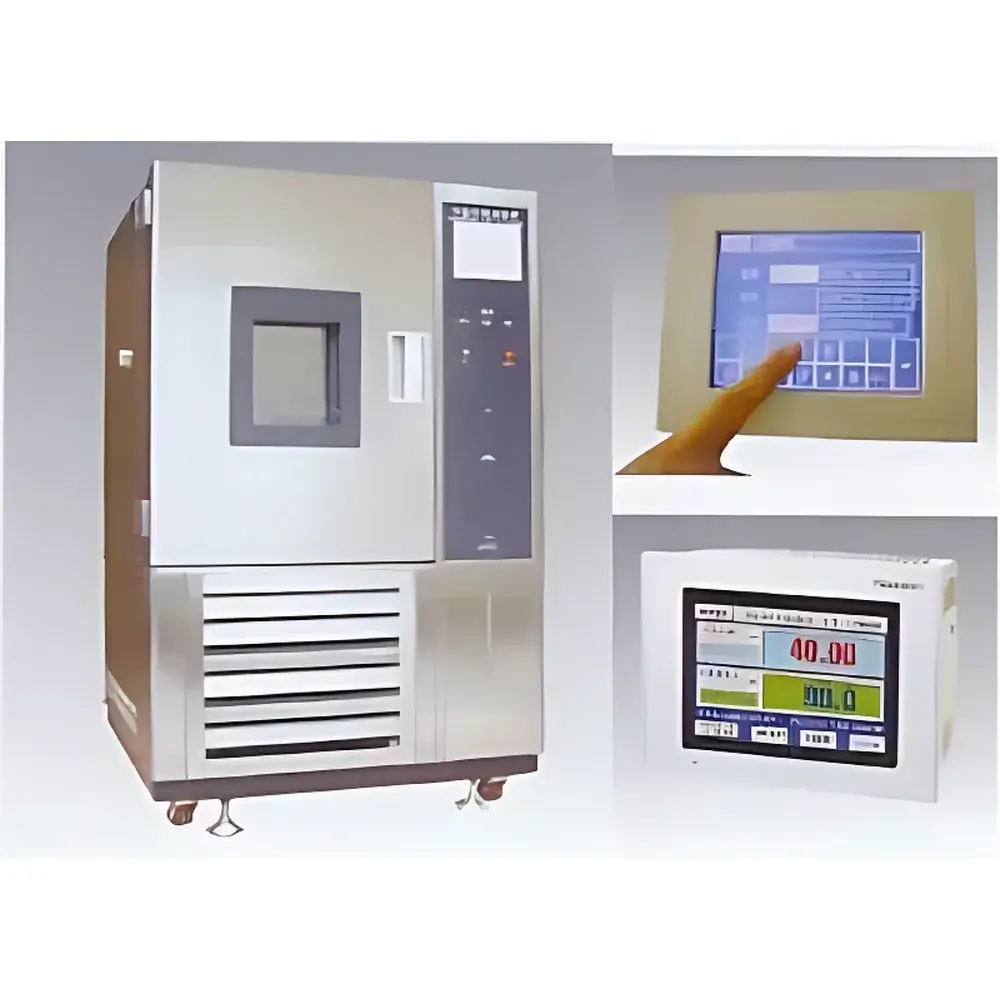
THV Series Combined Temperature-Humidity-Vibration Environmental Test Chamber
| Origin | Guangdong, China |
|---|---|
| Manufacturer Type | Authorized Distributor |
| Origin Category | Domestic (China) |
| Model Range | THV-1000 |
| Temperature Range | -70°C to +100°C |
| Humidity Range | 30–98% RH |
| Temperature Uniformity | ≤2°C |
| Temperature Fluctuation | ±0.5°C |
| Temperature Deviation | ±2°C |
| Humidity Uniformity | ±2/−3% RH (≥75% RH) |
| Internal Dimensions | 1000 × 1000 × 1000 mm |
| Static Load Capacity | 50 kg |
| Air Velocity | 1.0–3.0 m/s (VFD-controlled) |
| Power Supply | 380 V, 50 Hz, 3-phase 5-wire |
| Total Power | 36 kW |
| Compliance Standards | GB 10586–1989, GB 10592–1989, GJB 150.16–1986 |
Overview
The THV Series Combined Temperature-Humidity-Vibration Environmental Test Chamber is an integrated reliability validation platform engineered for simultaneous multi-stress testing of electronic components, aerospace subsystems, automotive ECUs, and high-reliability industrial assemblies. Unlike sequential single-stress chambers, the THV system executes synchronized thermal cycling, humidity exposure, and mechanical vibration—mimicking real-world operational stress profiles in a single test cycle. Its core architecture integrates three independent yet co-controlled environmental domains: a precision temperature-humidity chamber compliant with IEC 60068-2-1/2/14/30, and a dynamically coupled electrodynamic or servo-hydraulic vibration table (user-selectable per application requirements). The chamber employs a dual-refrigeration circuit with cascade low-temperature staging (-70°C capability), stainless steel humidification system with PID-controlled steam generation, and a forced-air convection system featuring variable-frequency drive (VFD) fans to ensure uniform airflow distribution (1.0–3.0 m/s) across the full test volume. All subsystems operate under a unified control logic governed by a CE-compliant programmable touchscreen controller with audit-trail logging.
Key Features
- Triple-axis synchronized stress application: independent yet time-aligned control of temperature, relative humidity, and mechanical vibration
- High-fidelity climate control: ±0.5°C temperature fluctuation, ±2°C deviation, and ±2/−3% RH uniformity (at ≥75% RH) verified per GB/T 2423.3–2013 and IEC 60068-2-78
- Robust mechanical integration: reinforced structural frame designed to isolate vibration energy from chamber walls; optional vibration table mounting interface compliant with ISO 10816-1 for displacement, velocity, and acceleration monitoring
- Fail-safe protection suite: over-temperature, over-humidity, refrigerant pressure, motor overload, and door interlock sensors with on-screen fault diagnostics and automatic shutdown
- Optical observation system: double-glazed vacuum-insulated viewing window with anti-frost heating elements enabling unobstructed visual inspection during active test cycles
- Modular service architecture: front-accessible compressor banks, removable humidifier tank, and tool-free panel removal for field maintenance
Sample Compatibility & Compliance
The THV-1000 accommodates static loads up to 50 kg distributed across its 1 m³ test volume (1000 × 1000 × 1000 mm internal dimensions), with standardized 50 mm diameter cable/port access through insulated feedthroughs. It supports DUTs ranging from PCB-level modules to full rack-mounted avionics units. Chamber materials comply with RoHS Directive 2011/65/EU: interior surfaces are electropolished SUS304 stainless steel; insulation uses closed-cell polyurethane foam (λ = 0.022 W/m·K); and structural framing meets EN 10025-2 S355JR mechanical specifications. The system satisfies regulatory requirements for environmental stress screening (ESS) per GJB 1032A–2012 and MIL-STD-810H Method 514.7 (vibration), Method 502.7 (low temperature), and Method 507.6 (humidity). Full traceability is maintained via GLP/GMP-compatible event logging—including timestamped setpoint changes, alarm triggers, and sensor readings—with optional 21 CFR Part 11 compliance achievable via validated PC-based software add-on.
Software & Data Management
The embedded controller features a 10.4-inch resistive touchscreen running a deterministic real-time OS with support for up to 120 programmable test profiles (each with 1200 segments) and 999 loop iterations. All parameters—including temperature ramp rates (0.5–10°C/min), humidity transition slopes (1–5% RH/min), and vibration spectral density profiles—are adjustable with sub-second resolution. RS485/RS232 and Ethernet interfaces enable remote supervision using vendor-supplied LabView-compatible SCADA drivers or third-party platforms (e.g., National Instruments TestStand). Raw data export is supported in CSV and XML formats; trend visualization includes overlay plots of chamber conditions versus vibration spectra. Optional audit trail functionality records user logins, parameter modifications, and emergency stops with digital signature verification—meeting FDA 21 CFR Part 11 Annex 11 requirements when deployed with qualified IT infrastructure.
Applications
This chamber is routinely deployed in qualification testing for: aerospace flight hardware undergoing DO-160G Section 25 (temperature/humidity/vibration combined stress), automotive ADAS controllers per ISO 16750-4, medical device sterilization packaging per ISO 11607-1 accelerated aging protocols, and semiconductor package reliability per JEDEC JESD22-A104F (thermal cycling) and JESD22-A108G (biased HAST). It also serves as a primary tool for HALT/HASS development where rapid identification of design margin limits requires simultaneous multi-stress excitation. Universities and national labs utilize the THV platform for fundamental research on polymer creep-fatigue interactions under hygrothermal loading and piezoelectric actuator degradation mechanisms.
FAQ
What vibration systems are compatible with the THV chamber?
Electrodynamic shakers (5–10 kN force capacity, 2–2500 Hz bandwidth) and servo-hydraulic exciters (up to 100 kN, DC–500 Hz) can be integrated via ISO 13373-1-compliant mounting interfaces. Custom payload adapters and slip-table configurations are available upon request.
Does the system support automated test sequencing across multiple stress domains?
Yes—the controller natively supports conditional branching (e.g., “hold at 85°C/85% RH until leakage current exceeds threshold, then initiate 10 g RMS random vibration for 30 minutes”) without external scripting.
How is humidity calibrated and verified?
Chamber humidity sensors are traceable to NIM (National Institute of Metrology, China) standards. Calibration is performed using chilled-mirror hygrometry (Dew Point Generator DP-100) and verified annually per ISO/IEC 17025 accredited procedures.
Can the THV chamber operate in standalone mode without PC connectivity?
Absolutely—all test execution, data logging, and alarm handling occur autonomously within the embedded controller. PC connectivity is optional for archival, reporting, or supervisory control.
What documentation is provided for regulatory submissions?
Factory acceptance test (FAT) reports, IQ/OQ protocols, uncertainty budgets for all critical sensors, and a complete traceable component bill-of-materials (BOM) are included with each shipment.



