
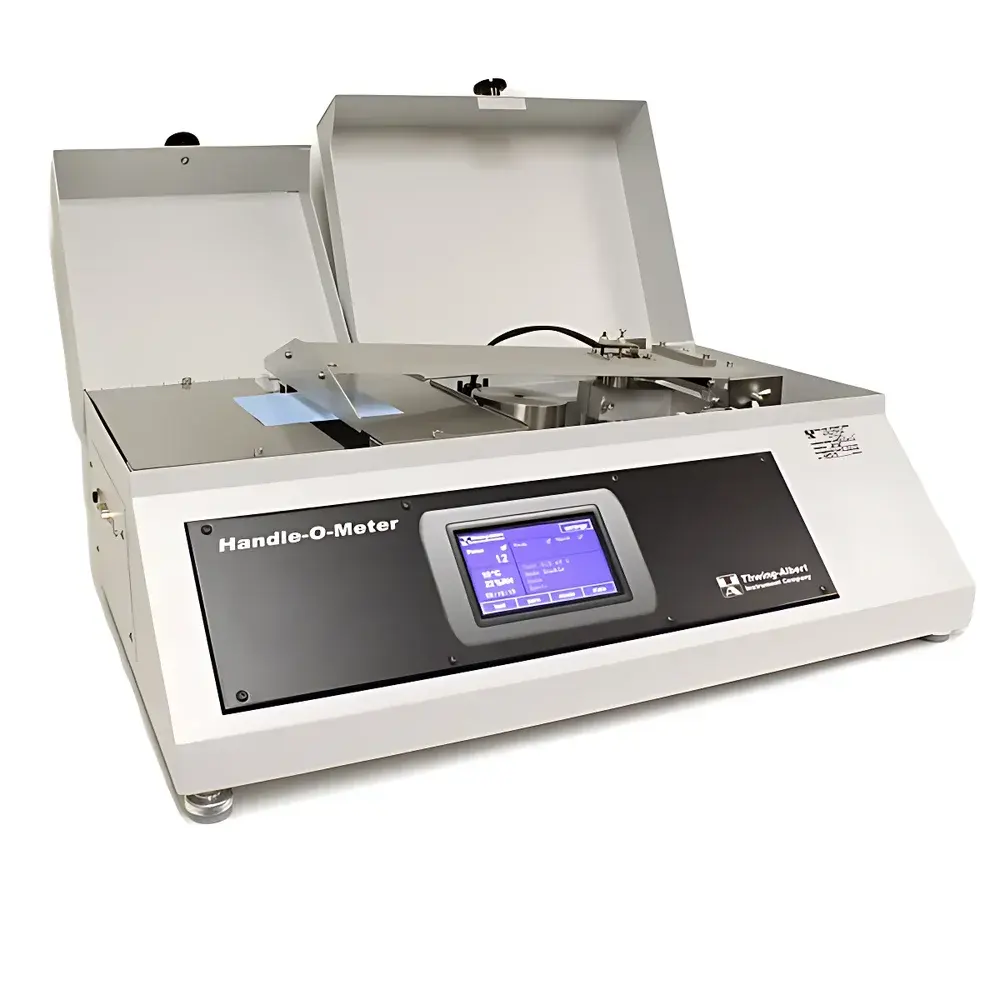
Thwing-Albert HOM Handle-O-Meter Softness Tester
| Brand | Thwing-Albert |
|---|---|
| Origin | USA |
| Model | HOM |
| Maximum Test Force | 1000 g |
| Frequency Range | 50/60 Hz |
| Host Weight | 22.2 kg |
| Measurement Range | 0–100 g / 0–1000 g |
| Resolution | 0.1 g |
| Adjustable Slit Widths | 5, 10, 20 mm and 1/4 in |
| Display | 2 × 40-character LCD |
| Power Supply | 220 V ±10%, 50 Hz |
| Sample Size | 203.3 mm × 203.2 mm |
| Dimensions (L×W×H) | 304.8 × 254.0 × 317.5 mm |
Overview
The Thwing-Albert HOM Handle-O-Meter is a precision mechanical instrument engineered for the objective quantification of softness, stiffness, and surface resistance—collectively termed “handle”—in flexible sheet materials. It operates on the principle of controlled bending resistance measurement: a standardized pressure bar applies defined force to a specimen clamped across an adjustable slit, while a linear variable differential transformer (LVDT) transduces the resulting deflection resistance into a calibrated analog signal. This method captures the combined influence of tensile modulus, thickness compliance, surface friction, and micro-roughness—parameters that directly correlate with human tactile perception during handling, dispensing, or application. Unlike subjective panel evaluation, the HOM delivers repeatable, operator-independent data traceable to internationally recognized physical test standards. Its design adheres to fundamental mechanical metrology principles—lever-arm geometry, calibrated mass loading, and contact-force linearity—ensuring high reproducibility across laboratories and production shifts.
Key Features
- Two interchangeable pressure bars (100 g and 1000 g) for optimized sensitivity across low-stiffness (e.g., facial tissues) and high-resistance (e.g., industrial nonwovens) materials
- Four precisely machined slit widths (5 mm, 10 mm, 20 mm, and 1/4 inch) enabling method-specific configuration per ASTM, TAPPI, or IST protocols
- High-resolution LVDT sensor with 0.1 g measurement resolution and full-scale ranges of 0–100 g and 0–1000 g
- Dual-mode operation: single-point peak resistance capture or multi-directional analysis (MD/CD, front/back) with automatic statistical aggregation (mean, SD, min/max)
- Integrated touchscreen interface with real-time waveform visualization of resistance vs. displacement profile
- Onboard memory for individual test results and batch-level data logging; RS-232 serial port for external data acquisition and LIMS integration
- Self-calibrating zero function with mechanical and electronic drift compensation
- Robust aluminum alloy chassis and precision-ground stainless steel slit assembly ensuring long-term dimensional stability
Sample Compatibility & Compliance
The HOM is validated for use with planar, non-rigid substrates exhibiting thicknesses from 0.05 mm to 2.5 mm and grammage up to 800 g/m². Typical applications include airlaid and spunbond nonwovens, sanitary napkin coverstocks, facial tissues, medical packaging films, disposable wipes, and coated papers. All operational procedures conform to ASTM D2923-95 (Standard Test Method for Stiffness of Thin, Flexible Materials), TAPPI T 498 cm-85 (Softness of Tissue Paper), and IST 90-3 (95) (Handle-O-Meter Stiffness Testing of Nonwovens). Instrument design supports GLP-compliant environments: audit trails are maintained via timestamped result export, and calibration records—including pressure bar mass verification and LVDT linearity checks—align with ISO/IEC 17025 requirements for testing laboratories. While not FDA 21 CFR Part 11–certified out-of-the-box, the RS-232 interface permits integration with validated third-party data management systems meeting regulated industry documentation standards.
Software & Data Management
The HOM operates autonomously via embedded firmware without external PC dependency. All measurement logic, statistical computation, and display rendering occur onboard. Test parameters—including slit width, pressure bar selection, sample orientation flag (MD/CD, front/back), and number of repetitions—are stored in non-volatile memory. Each test record includes raw peak force value, time stamp, operator ID (manually entered), and mode identifier. Data export via RS-232 follows ASCII-delimited format compatible with spreadsheet software, SPC platforms, and laboratory information management systems (LIMS). No proprietary drivers or closed-format binaries are used; output is human-readable and script-parsable. Firmware updates are delivered via USB-to-serial adapter and require no factory recalibration—only user-performed functional verification using certified reference weights and slit gauges.
Applications
- Quality control of tissue paper softness in converting facilities, supporting real-time process adjustments in creping and embossing lines
- Raw material qualification for hygiene product manufacturers evaluating nonwoven coverstock handle consistency across supplier batches
- R&D screening of polymer film additives (e.g., slip agents, plasticizers) affecting perceived flexibility and drape behavior
- Regulatory submission support for medical device packaging where tactile feedback influences user compliance (e.g., peelable pouches)
- Correlation studies between HOM-derived softness values and consumer panel scores in sensory labs
- Failure analysis of laminated structures exhibiting delamination-induced stiffness anomalies
FAQ
What physical property does the Handle-O-Meter actually measure?
It measures the maximum resistive force (in grams-force) required to bend a standardized specimen through a fixed slit under a defined pressure bar load—quantifying composite handle characteristics including bending stiffness, surface drag, and edge compliance.
Can the HOM be used for three-dimensional or curved samples?
No. The instrument requires flat, planar specimens of uniform thickness and rigidity within its specified range; curvature or localized deformation invalidates the lever-arm mechanics and LVDT response linearity.
Is calibration traceable to NIST or other national metrology institutes?
Yes. Thwing-Albert provides optional NIST-traceable calibration certificates for both pressure bar masses and LVDT output linearity, performed annually or per internal QA schedule.
How does slit width selection affect test results?
Slit width directly governs bending moment arm length and thus measured resistance magnitude; narrower slits increase sensitivity for low-stiffness materials but may induce edge buckling in thicker substrates—hence standard methods prescribe specific widths for each material class.
Does the instrument comply with ISO 5628 or ISO 2431?
No. ISO 5628 addresses paper stiffness via cantilever method, and ISO 2431 covers coating viscosity; the HOM implements its own mechanically distinct protocol aligned with ASTM/TAPPI/IST standards, not ISO-defined methods.



