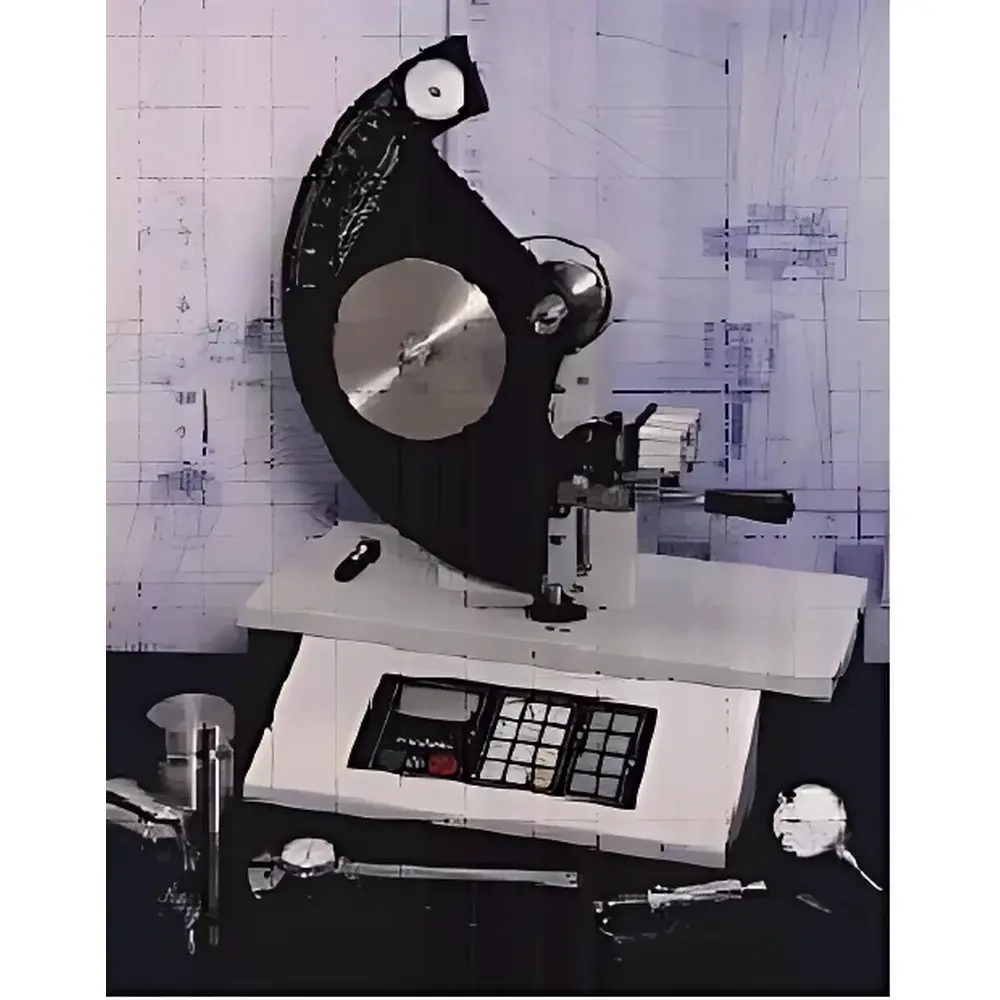
Thwing-Albert ProTear Elmendorf Electronic Tear Tester
| Brand | Thwing-Albert |
|---|---|
| Origin | USA |
| Model | ProTear |
| Measurement Principle | Elmendorf Pendulum Tear Method |
| Compliance Standards | ASTM D1922, D1424, D295, D751 |
| Display | 4-line × 16-character LCD, multi-angle viewing |
| Accuracy | ±0.2% of pendulum capacity |
| Sample ID Input | 13-character alphanumeric |
| Data Storage | Up to 99 test results |
| Statistical Functions | Mean, Std. Deviation, Min/Max, Variance |
| Units | gf, lbf, mN, % of pendulum capacity |
| Fixture | Pneumatically actuated clamping |
| Pendulum Release | Pneumatic |
| Power Supply | 220–230 V ±10%, 50 Hz |
| Power Consumption | ≤10 W |
| Dimensions (L×W×D) | 578 × 483 × 398 mm |
| Operating Temp. | 10–50 °C |
| Storage Temp. | −25–70 °C |
| Sample Compatibility | Paper, board, film, foil, nonwovens, coated fabrics, packaging laminates |
Overview
The Thwing-Albert ProTear Elmendorf Electronic Tear Tester is a precision-engineered instrument designed for the quantitative determination of tear resistance in flexible sheet materials using the standardized Elmendorf pendulum method. Rooted in over 75 years of expertise in pendulum-based tear measurement, this system implements a rigorously validated mechanical principle: energy loss during controlled tearing of a pre-notched specimen is measured via calibrated pendulum deflection, directly correlating to material resistance. Unlike manual or semi-automated variants, the ProTear integrates fully pneumatic sample clamping and release mechanisms, eliminating operator-induced variability in fixture engagement and tear initiation. Its architecture conforms to the physical basis defined in ISO 1974 and ASTM D1922—where tear force is derived from the difference between initial and residual pendulum potential energy—and delivers traceable, repeatable results essential for QC laboratories operating under GLP or GMP frameworks.
Key Features
- Pneumatic clamping system with independent horizontal adjustment (X/Y axis) ensures uniform specimen alignment and eliminates edge slippage across heterogeneous substrates such as corrugated board, metallized films, or multi-layer laminates.
- Dual-mode pendulum calibration verification: real-time digital balance feedback confirms pendulum zero stability prior to each test cycle, enhancing long-term metrological integrity.
- Configurable unit output: direct switching among gram-force (gf), millinewtons (mN), pound-force (lbf), and normalized % of full-scale pendulum capacity—enabling cross-laboratory data harmonization without post-processing.
- Onboard statistical engine computes mean, standard deviation, variance, minimum/maximum values, and coefficient of variation for up to 99 stored tests—supporting internal process capability analysis (e.g., Cp/Cpk) per ISO 22514.
- 13-character alphanumeric sample ID field supports integration into LIMS environments where batch traceability, material grade, grammage, and fiber orientation must be preserved alongside raw tear values.
- RS-232 serial interface and parallel printer port comply with legacy industrial automation protocols; optional USB-to-serial adapters enable connectivity to modern QA databases without firmware modification.
Sample Compatibility & Compliance
The ProTear accommodates specimens ranging from lightweight tissue (≤20 g/m²) to heavy-duty kraft linerboard (≥400 g/m²), including coated papers, polyethylene films, aluminum foils, spunbond polypropylene nonwovens, and pressure-sensitive adhesive tapes. Its adjustable anvil geometry and programmable clamping pressure prevent crushing of low-density substrates while maintaining sufficient grip on high-modulus films. All operational parameters—including notch depth tolerance (±0.1 mm), specimen width (63 mm per ISO 1974), and pendulum arc angle (104° ± 0.5°)—are mechanically constrained to meet dimensional requirements specified in ASTM D1922 Annex A1 and TAPPI T414 Section 6.2. The instrument’s measurement uncertainty budget has been validated against NIST-traceable reference standards, satisfying audit requirements for FDA 21 CFR Part 11–compliant environments when paired with electronic signature-enabled software.
Software & Data Management
While the ProTear operates autonomously via its embedded microcontroller, its RS-232 interface enables bidirectional communication with third-party laboratory information management systems (LIMS) or custom SPC dashboards. Test logs export in ASCII-delimited format (CSV-compatible), containing timestamp, sample ID, thickness input, machine direction (MD/X), cross direction (CD/Y), layer count, raw deflection angle, computed tear force, and statistical metadata. Audit trails—when enabled through external software—are time-stamped, immutable, and include user login context, parameter changes, and result modifications—fulfilling ALCOA+ principles for data integrity. Firmware updates are delivered via secure FTP with SHA-256 checksum validation, ensuring version control across global manufacturing sites.
Applications
This tester serves critical quality assurance functions across packaging R&D and production: evaluating seal integrity of heat-sealed pouches, quantifying delamination resistance in extrusion-coated paperboard, verifying tear propagation thresholds in medical device pouches (per ISO 11607-2), assessing directional anisotropy in oriented polypropylene films, and validating consistency of recycled fiber blends in corrugated medium. In regulatory submissions, ProTear-generated datasets support claims under EU Directive 94/62/EC (packaging waste) and ASTM D8196 (sustainable packaging performance). Academic users apply its high-reproducibility output for structure-property modeling of fibril network failure in nanocellulose composites.
FAQ
What standards does the ProTear explicitly support?
ASTM D1922, D1424, D295, D751; TAPPI T414, T496; ISO 1974; DIN 53862, 53128; BS 4253, 4468; NF 003-011; SCAN P-11.
Can the instrument measure both machine-direction (MD) and cross-direction (CD) tear in a single setup?
Yes—specimen orientation is manually indexed via engraved directional markers on the anvil base; no recalibration is required between MD and CD tests.
Is calibration traceable to national metrology institutes?
Pendulum calibration weights are supplied with NIST-traceable certificates; angular displacement sensors are factory-verified against laser interferometry standards.
Does the ProTear require annual recalibration by authorized service personnel?
Per ISO/IEC 17025:2017 Clause 6.5.2, users may perform intermediate verification using certified reference specimens; full calibration is recommended every 12 months or after 5,000 test cycles.
How is environmental conditioning addressed during testing?
The instrument itself does not control ambient RH or temperature; however, its operating range (10–50 °C) permits integration into climate-controlled test rooms compliant with ISO 187 and TAPPI T402.