
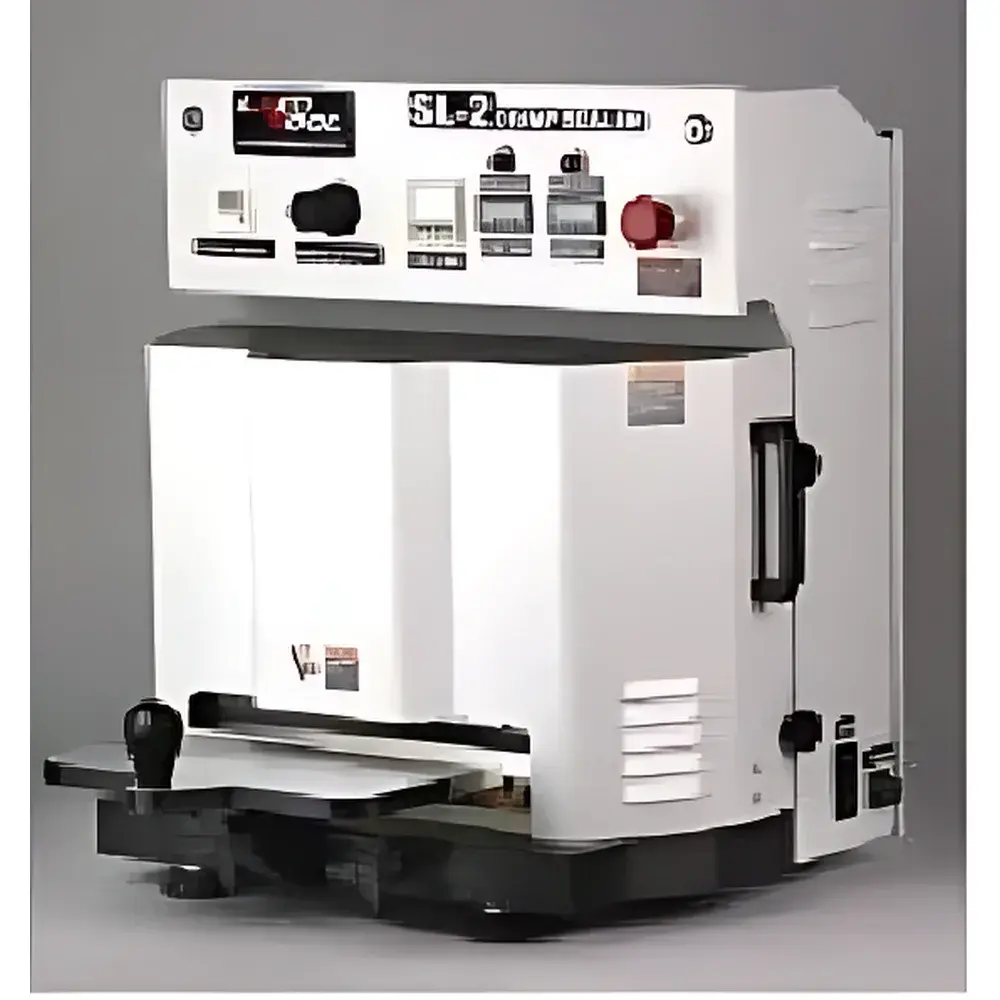
Thwing-Albert SL-2 Digital Heat Sealing Tester
| Brand | Thwing-Albert |
|---|---|
| Origin | USA |
| Model | SL-2 |
| Sealing Temperature Range | Ambient to 400 °C |
| Temperature Resolution | ±0.1 °C |
| Temperature Accuracy | ±0.15 °C |
| Temperature Control Stability | ±0.2 °C |
| Sealing Pressure Range | 5–700 psi (34.5–4830 kPa) |
| Pressure Resolution | 1 psi (7 kPa) |
| Sealing Time Range | 200 ms–99 s (with 10 ms resolution at low load |
| Time Accuracy | ±25 ms |
| Time Repeatability | ±50 ms |
| Jaw Length | Up to 304.8 mm (12 in) |
| Jaw Width | 6.35–25.4 mm (0.25–1.00 in) |
| Jaw Surface Options | Flat, Grooved, Custom or Standard Geometric Profiles |
| Power Supply | 230 V / 50 Hz |
| Compressed Air Requirement | 80–120 psi (recommended: 90 psi) |
| Dimensions (W×D×H) | 584.2 × 400 × 620 mm |
| Weight | 72.5 kg |
Overview
The Thwing-Albert SL-2 Digital Heat Sealing Tester is a precision-engineered instrument designed for quantitative evaluation of heat seal integrity in flexible packaging materials. It operates on the fundamental principle of controlled thermal compression—applying calibrated temperature, pressure, and dwell time to replicate industrial sealing conditions under laboratory-grade repeatability. Unlike analog or semi-automated sealers, the SL-2 employs independent dual-zone thermal control for upper and lower jaws, enabling precise thermal profiling across the entire seal interface. This architecture ensures uniform heat distribution and eliminates edge-effect deviations common in single-heater systems—critical for validating seal performance in laminates, foils, pouches, and medical device packaging where barrier integrity directly impacts shelf life and regulatory compliance.
Key Features
- Dual independent jaw temperature control with ±0.2 °C stability and ±0.15 °C absolute accuracy—validated per ASTM F2054 and ISO 11607-2 calibration protocols
- Digital pressure actuation with real-time display and 1 psi (7 kPa) resolution across a 5–700 psi range, compatible with both low-force polymer films and high-strength aluminum-laminated structures
- High-resolution timing system offering 10 ms resolution at sub-second durations and ±25 ms measurement accuracy—essential for characterizing rapid-seal thermoplastics such as PE, PP, and EVOH-based coextrusions
- Modular jaw configuration supporting flat, grooved, or custom-profiled surfaces (including ASTM-standard 0.25 in and 1.00 in widths), enabling correlation with production-scale sealing bar geometries
- Integrated foot pedal activation and dual redundant safety interlocks compliant with IEC 61000-6-2 and EN 60204-1 requirements for operator protection during repetitive testing cycles
- Optional automated sample loading carousel for unattended batch testing—designed to support GLP-compliant validation workflows in pharmaceutical and medical packaging QC laboratories
Sample Compatibility & Compliance
The SL-2 accommodates a broad spectrum of packaging substrates including polyethylene (PE), polypropylene (PP), polyester (PET), aluminum foil laminates, Tyvek®-based sterile barrier systems, and multilayer coextruded structures used in food, pharmaceutical, and diagnostic packaging. Its jaw width adjustability (6.35–25.4 mm) and maximum 304.8 mm sealing length permit evaluation of both narrow-format peel seals and wide-area continuous seals. The instrument meets key international standards for seal quality assessment, including ASTM F88 (Seal Strength), ASTM F2054 (Inflation Test), ISO 11607-2 (Packaging for Terminally Sterilized Medical Devices), and FDA 21 CFR Part 11-ready data capture when paired with Thwing-Albert’s certified software suite. All thermal and mechanical calibrations are traceable to NIST standards via documented calibration certificates provided with each unit.
Software & Data Management
When interfaced with Thwing-Albert’s proprietary SealTest™ software (v4.2+), the SL-2 supports full audit-trail functionality compliant with 21 CFR Part 11 requirements—including electronic signatures, user access levels, and immutable timestamped test records. Data export is supported in CSV, PDF, and XML formats for integration into LIMS or ERP systems. The software enables method-based test sequencing, statistical process control (SPC) charting, and comparative analysis across multiple seal parameter sets (e.g., DoE matrices varying temperature/pressure/time). All raw sensor data—including real-time thermocouple readings, pressure transducer outputs, and actuation timestamps—are logged at 100 Hz sampling rate to ensure forensic-level reproducibility for internal audits or regulatory inspections.
Applications
- Optimization of sealing parameters during packaging line qualification and process validation (IQ/OQ/PQ)
- Accelerated aging studies correlating seal integrity with storage conditions and shelf-life predictions
- Root cause analysis of seal failures—including cold seals, channel leaks, and adhesive migration effects
- Comparative evaluation of alternative sealant layers or substrate modifications in R&D environments
- Regulatory submission support for FDA 510(k), MDR Annex II, or Health Canada Class II device dossiers requiring empirical seal strength evidence
- Supplier qualification testing against contractual seal performance specifications (e.g., minimum burst strength, peel initiation force)
FAQ
What calibration standards does the SL-2 comply with?
The SL-2 adheres to ASTM E220, ISO/IEC 17025, and NIST-traceable calibration practices. Temperature sensors are verified using certified reference thermometers; pressure transducers are calibrated against deadweight testers.
Is compressed air required for operation?
Yes—consistent pneumatic actuation requires regulated compressed air between 80–120 psi (90 psi recommended) to ensure repeatable pressure delivery across the full 5–700 psi range.
Can the SL-2 be integrated into an automated packaging line validation protocol?
Absolutely—the instrument supports RS-232 and Ethernet communication protocols, enabling direct integration with SCADA systems and MES platforms for real-time parameter logging and SPC dashboarding.
Does the SL-2 support IQ/OQ documentation packages?
Yes—Thwing-Albert provides vendor-qualified IQ/OQ templates aligned with ISO 13485 and GMP Annex 15 requirements, including installation verification checklists, operational boundary testing, and uncertainty budget analysis.
How is thermal uniformity across the jaw surface verified?
Jaw surface mapping is performed using a 9-point thermocouple grid per ASTM F1884, with acceptance criteria requiring ≤±0.3 °C deviation across the active sealing zone at any setpoint between 100–350 °C.
Related Products




