
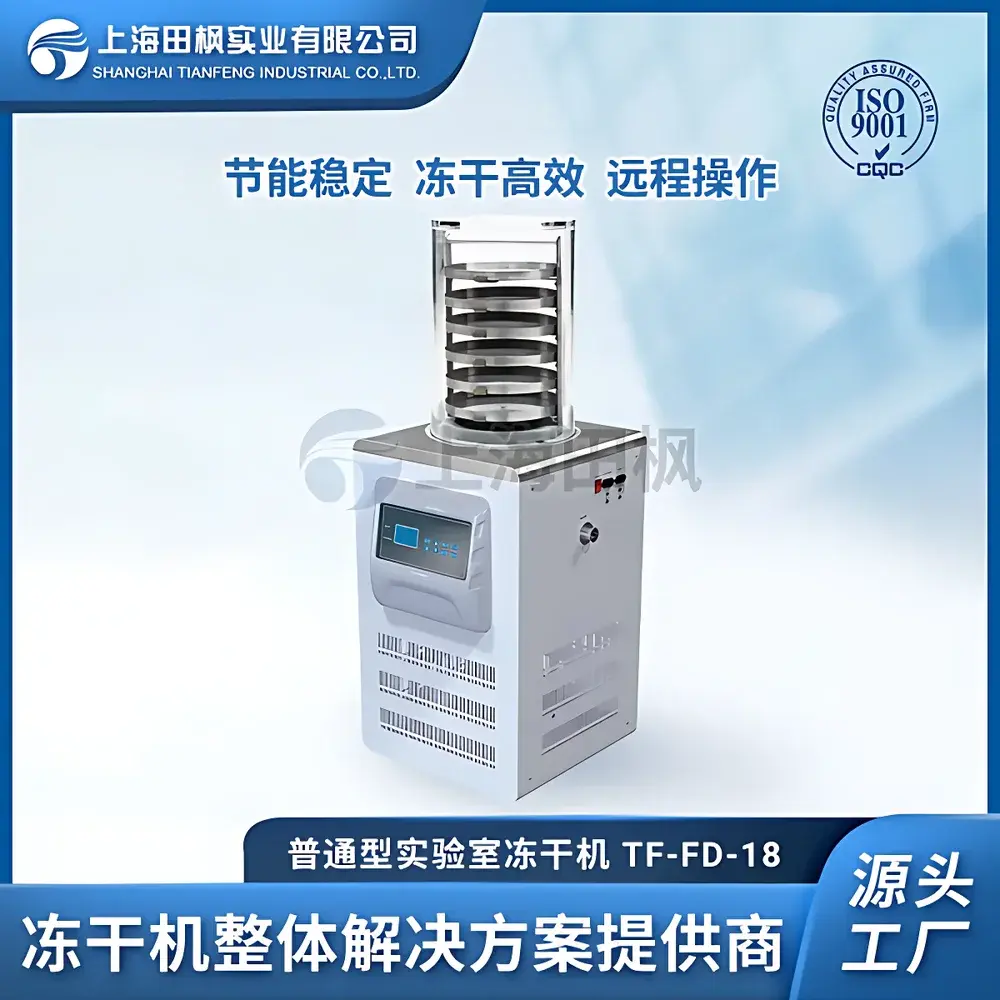
Tianfeng FD-18 Benchtop Laboratory Freeze Dryer
| Brand | Tianfeng |
|---|---|
| Origin | Shanghai, China |
| Manufacturer Type | Direct Manufacturer |
| Instrument Type | Standard Shelf-Type Freeze Dryer |
| Application | Laboratory-Scale Lyophilization |
| Lyophilization Area | 0.18 m² |
| Ultimate Vacuum (Empty Chamber) | <10 Pa |
| Condenser Temperature | <−50 °C |
| Ice Capacity | 6 kg/24 h |
| Dimensions (W×D×H) | 550 mm × 550 mm × 960 mm |
| Power Supply | 220 V, 50 Hz |
| Power Consumption | 1500 W |
| Sample Tray | Φ240 mm × 4 layers |
| Cooling Method | Air-Cooled |
| Refrigeration System | Imported Hermetic Dual-Stage Compressor |
| Display | LED Digital Readouts for Condenser Temp & Chamber Vacuum |
| Control Interface | Touch-Sensitive Soft Keys |
| Drying Chamber | Transparent Bell Jar (Natural Convection Heating) |
| Construction | Stainless Steel Condenser & Platform |
| Compliance | Designed for GLP-aligned workflows |
Overview
The Tianfeng FD-18 Benchtop Laboratory Freeze Dryer is a compact, air-cooled, shelf-type lyophilization system engineered for precise, reproducible freeze-drying of biological, pharmaceutical, and analytical samples in research laboratories and pilot-scale development environments. It operates on the fundamental principle of sublimation—removing water from frozen samples under deep vacuum while maintaining product integrity through controlled thermal input. The system employs a hermetically sealed dual-stage refrigeration unit to achieve condenser temperatures below −50 °C, enabling efficient capture of water vapor and supporting stable primary drying across diverse sample matrices. Its 0.18 m² shelf area accommodates up to four Φ240 mm stainless steel trays, making it suitable for batch processing of vials, Petri dishes, or bulk specimens without requiring external pre-freezing equipment. Designed for operational transparency and procedural fidelity, the FD-18 integrates real-time digital monitoring of both chamber vacuum (<10 Pa at no-load) and condenser temperature—critical parameters for defining drying endpoints and ensuring batch consistency.
Key Features
- Air-cooled, maintenance-optimized refrigeration architecture eliminates dependency on external water cooling systems, reducing installation complexity and facility footprint.
- LED digital displays provide simultaneous, high-resolution readouts of condenser temperature and chamber vacuum pressure—enabling immediate verification of process readiness and drying progress.
- Intuitive touch-sensitive soft-key interface allows rapid configuration of operating modes, vacuum ramp rates, and shutdown sequences without menu nesting or firmware navigation delays.
- Transparent bell-jar drying chamber facilitates visual monitoring of ice sublimation, cake formation, and potential collapse events—supporting empirical process optimization and training applications.
- Adjustable stainless steel shelf assembly permits customizable tray spacing and layer count, accommodating variable container heights and heterogeneous sample loads.
- Full stainless steel construction (condenser, platform, and internal surfaces) ensures corrosion resistance, ease of decontamination, and compliance with laboratory hygiene standards including ISO 14644 cleanroom compatibility assessments.
Sample Compatibility & Compliance
The FD-18 supports lyophilization of aqueous solutions, protein formulations, microbial cultures, tissue homogenates, and polymer-based suspensions. Its −50 °C condenser and 6 kg/24 h ice capacity ensure reliable performance with moderately volatile excipients and low-to-moderate total solids content (≤25 wt%). While not rated for high-concentration organic solvent systems (e.g., >10% acetone or ethanol), it maintains structural stability during extended cycles typical of vaccine stabilizer development or enzyme preservation studies. The system’s vacuum integrity and thermal repeatability align with foundational requirements for GLP documentation and support IQ/OQ protocols per ASTM F2476–23 (Standard Guide for Validation of Freeze Drying Processes). Though not inherently 21 CFR Part 11 compliant, its analog control architecture permits integration with external audit-trail-capable data loggers meeting FDA-regulated environment specifications.
Software & Data Management
The FD-18 operates via embedded microcontroller logic with non-volatile parameter storage—retaining user-defined vacuum setpoints and cycle durations across power cycles. While the base model does not include onboard PC connectivity or graphical curve logging, its analog voltage outputs (0–5 V for vacuum and temperature) are compatible with third-party DAQ systems such as National Instruments CompactDAQ or LabVIEW-based acquisition platforms. This enables time-stamped recording of critical process variables for retrospective analysis, deviation investigation, and regulatory submission packages. Optional RS-485 Modbus RTU interface kits (sold separately) allow integration into centralized lab automation networks for remote status polling and alarm forwarding.
Applications
- Stabilization of thermolabile biologics—including monoclonal antibodies, plasmid DNA, and live-attenuated viral vectors—prior to long-term storage or transport.
- Preparation of calibration standards and reference materials for clinical chemistry and environmental testing laboratories.
- Routine dehydration of microbiological specimens (e.g., bacterial pellets, fungal spores) for strain banking and phylogenetic archiving.
- Processing of botanical extracts and nutraceutical powders where oxidative degradation must be minimized during moisture removal.
- Development of lyophilized assay reagents used in ELISA, lateral flow, and PCR-based diagnostics.
- Academic teaching labs conducting hands-on instruction in mass transfer kinetics, phase behavior, and formulation science principles.
FAQ
What is the maximum sample volume this unit can process per cycle?
With four Φ240 mm trays and an average loading depth of 10 mm, the FD-18 accommodates approximately 1.8 L of aqueous solution—assuming 10% solids content and full utilization of available surface area.
Does the system support in-chamber pre-freezing?
No. The FD-18 requires samples to be pre-frozen externally (e.g., using a −80 °C ultra-low temperature freezer) prior to loading. It is not an in-situ freezing model.
Can the vacuum pump be upgraded for faster pump-down times?
Yes. The unit uses standard KF-25 vacuum flanges and is compatible with scroll, diaphragm, or two-stage rotary vane pumps delivering ≤0.1 Pa ultimate vacuum—provided oil mist filtration is installed to protect the condenser.
Is routine maintenance required for the refrigeration system?
Annual inspection of condenser coil cleanliness and refrigerant charge verification is recommended. No oil changes or compressor servicing are needed under normal operation due to the sealed-compressor design.
How is leak detection performed during qualification?
A helium mass spectrometer leak test (per ASTM E493) is advised during initial IQ. The system’s vacuum chamber and condenser housing are tested at 1 × 10⁻³ mbar·L/s sensitivity to confirm integrity prior to first-use validation.



