
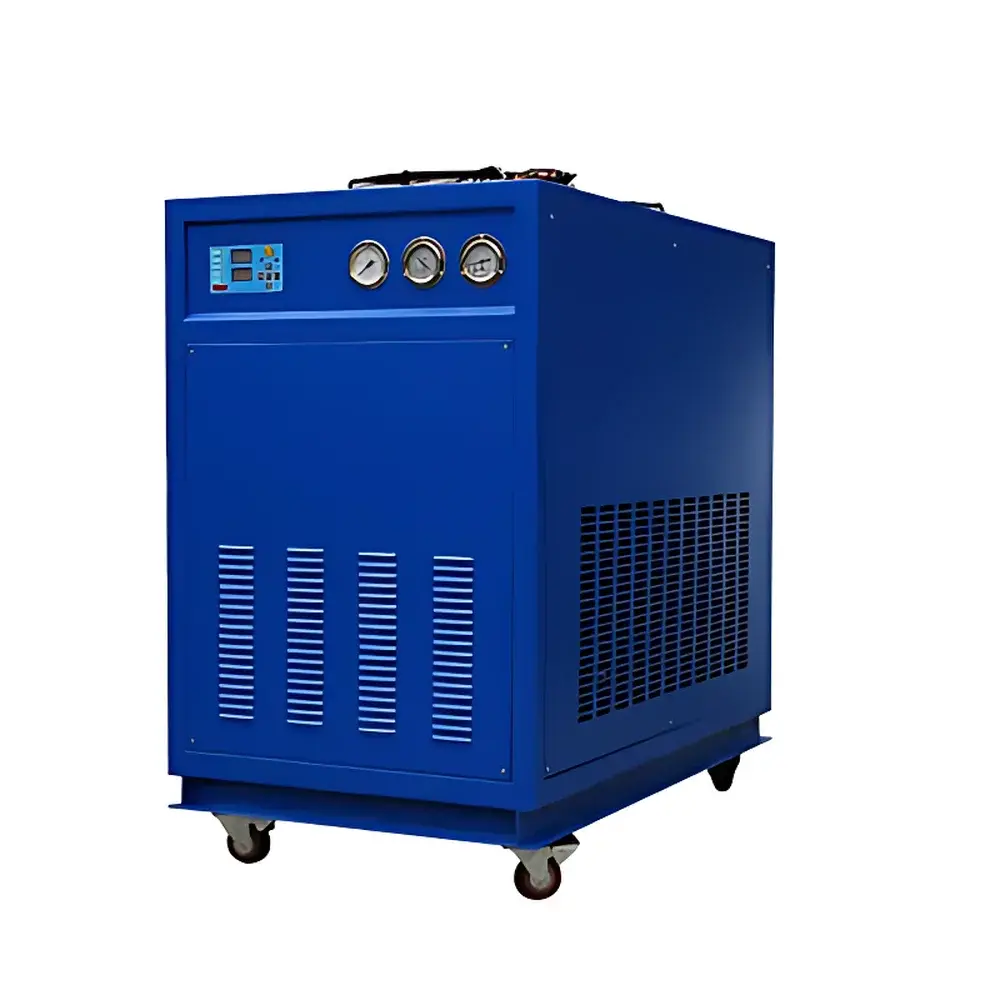
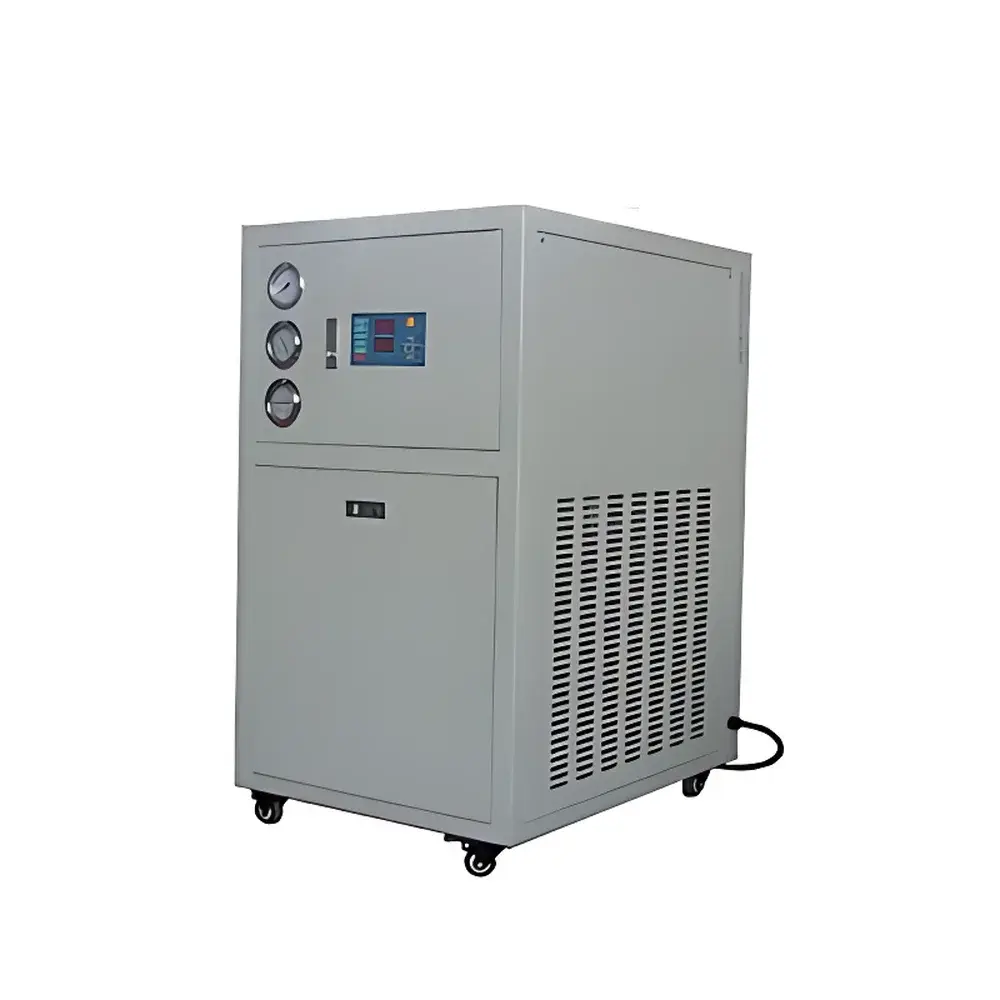
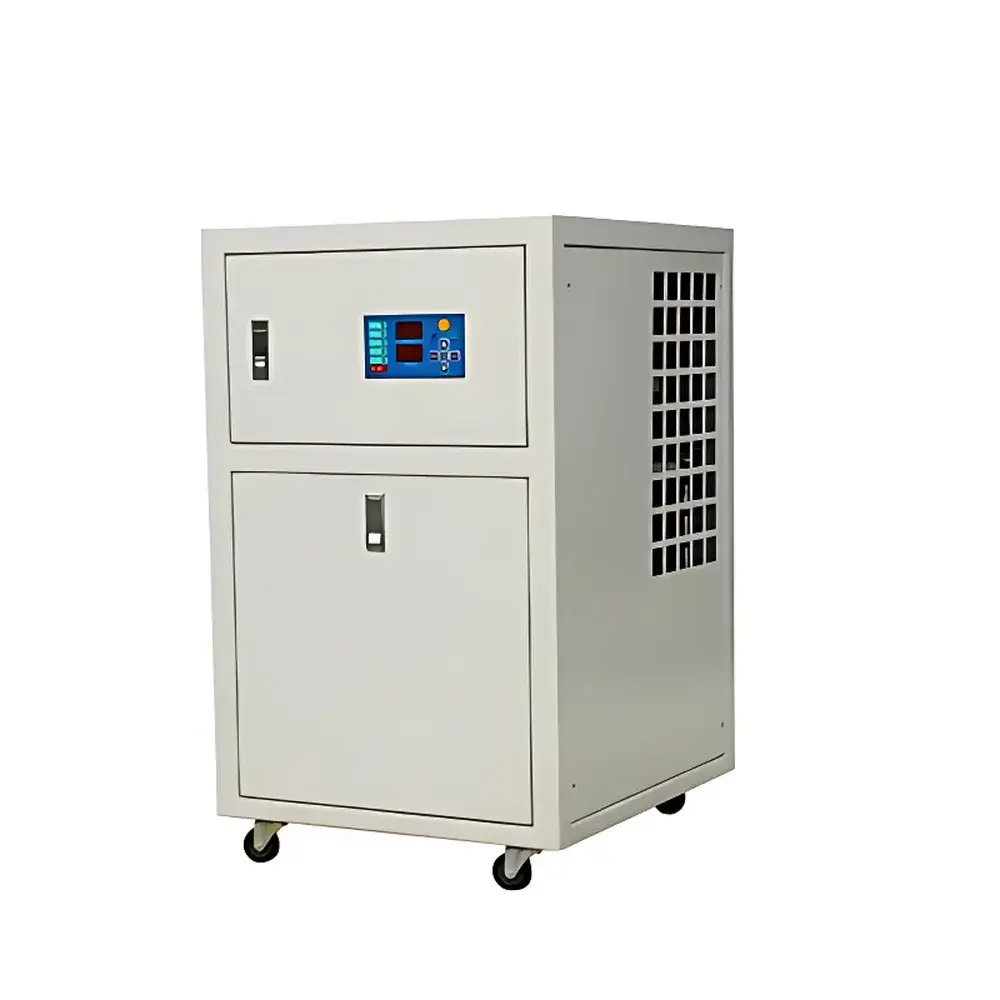
Tianfeng LS-10KW Open-Circuit Circulating Chiller
| Brand | Tianfeng |
|---|---|
| Origin | Shanghai, China |
| Manufacturer Type | Direct Manufacturer |
| Equipment Type | Integrated Circulating Chiller |
| Cooling Method | Water-Cooled |
| Temperature Control Range | 5–30 °C (adjustable setpoint) |
| Refrigeration Capacity | 18 kW @ ΔT = 5 °C (inlet 12 °C / outlet 7 °C) |
| Temperature Stability | ±0.3 °C |
| Circulating Pump Pressure | 0–2 kgf/cm² |
| Circulating Flow Rate | 0–60 L/min |
| Reservoir Volume | 180 L |
| Power Input | 6.41 kW |
| Electrical Supply | 220 V, 50 Hz |
| Dimensions (L×W×H) | 1350 × 800 × 1500 mm |
| Safety Protections | Compressor overheat, overcurrent, high/low pressure, and overtemperature safeguards |
| Construction | Stainless steel reservoir and pump |
| Noise Level | ≤72 dB(A) |
| Compressor | High-efficiency scroll type |
| Expansion Valve & Solenoid Valve | Imported (Italy/Germany) |
| Controller | Industrial-grade digital PID controller (optional RKC Japan) |
| Electrical Components | Siemens / Schneider / Omron |
Overview
The Tianfeng LS-10KW Open-Circuit Circulating Chiller is an engineered thermal management solution designed for continuous, stable cooling of heat-generating laboratory and industrial equipment. Unlike closed-loop chillers with sealed refrigerant circuits only, this open-circuit system circulates deionized or treated water through external instrumentation—providing direct, controllable heat extraction from critical components such as laser sources, plasma generators, X-ray tubes, electron optics, and high-speed spindles. Its thermodynamic architecture integrates a high-efficiency scroll compressor, precision expansion valves, and a stainless-steel reservoir to maintain consistent coolant temperature under variable thermal loads. The unit operates within a regulated setpoint range of 5–30 °C, with typical application conditions defined per ISO 5149 and AHRI Standard 550/590 for liquid-cooled process chillers. It is not intended for cryogenic operation or sub-ambient refrigeration but optimized for precision temperature maintenance in ambient-stable environments where thermal drift must remain below ±0.3 °C.
Key Features
- Integrated design with compact footprint (1350 × 800 × 1500 mm) suitable for laboratory floor placement or integration into equipment skids.
- Stainless steel reservoir (180 L capacity) and pump housing ensure corrosion resistance and long-term compatibility with deionized water, glycol-water mixtures (up to 30%), and low-conductivity coolants used in analytical instrumentation.
- Digital PID temperature controller with real-time display, adjustable setpoint resolution of 0.1 °C, and programmable ramp-soak profiles for controlled thermal conditioning.
- Variable-speed circulation pump delivering 0–60 L/min flow at 0–2 kgf/cm² pressure—configurable to match pressure drop requirements of connected devices (e.g., ICP-MS coolant loops, SEM cooling jackets).
- Comprehensive safety architecture: dual-pressure switch monitoring, compressor discharge temperature sensing, phase-loss protection, and automatic shutdown with fault-code indication.
- Low-noise operation (<72 dB[A]) achieved via acoustic insulation, vibration-dampened mounting, and optimized airflow management—critical for shared lab spaces and noise-sensitive applications.
- Pre-wired industrial control interface supporting 4–20 mA analog output for remote temperature monitoring and dry-contact alarm signals for integration into facility SCADA or LIMS systems.
Sample Compatibility & Compliance
The LS-10KW chiller is compatible with a broad spectrum of laboratory instrumentation requiring stable coolant supply—including graphite furnace atomic absorption spectrometers (GFAAS), inductively coupled plasma optical emission spectrometers (ICP-OES), inductively coupled plasma mass spectrometers (ICP-MS), X-ray fluorescence (XRF) analyzers, X-ray diffractometers (XRD), scanning electron microscopes (SEM), and transmission electron microscopes (TEM). Its open-circuit configuration allows direct connection to OEM coolant inlets without intermediary heat exchangers—minimizing thermal lag and pressure loss. The system complies with CE marking requirements for electrical safety (EN 61000-6-3, EN 61000-6-4) and meets ISO 9001:2015 quality management standards. While not certified to FDA 21 CFR Part 11, its controller supports audit-trail-capable logging when paired with optional data acquisition modules—facilitating GLP-compliant operation in regulated QC/QA labs.
Software & Data Management
The embedded controller provides local setpoint adjustment, real-time temperature readout, and status diagnostics via a backlit LCD interface. For advanced integration, the chiller supports Modbus RTU (RS-485) communication protocol, enabling bidirectional control and telemetry exchange with laboratory information management systems (LIMS), building automation controllers (BACnet/IP), or custom SCADA platforms. Optional data-logging firmware permits timestamped storage of inlet/outlet temperatures, pump status, compressor run hours, and alarm history on removable microSD cards—supporting traceability requirements under ISO/IEC 17025 Clause 7.7. No proprietary cloud platform or vendor-locked software is required; all communication parameters are user-configurable without firmware modification.
Applications
This chiller serves as a primary thermal regulation system across multiple domains: In analytical laboratories, it stabilizes plasma torch temperatures in ICP instruments, maintains vacuum chamber wall temperatures in surface analysis tools, and cools X-ray tube anodes to prevent thermal cracking. In materials science facilities, it regulates coolant flow to laser ablation systems and electron beam welders. Within pharmaceutical manufacturing, it supports jacketed reactor temperature control during lyophilization pre-cooling stages and maintains consistent bath temperatures for dissolution testers (USP ). In mechanical testing labs, it controls hydraulic oil temperature in universal testing machines to reduce viscosity-induced measurement drift. Its open-circuit architecture also enables use in electroplating lines, ultrasonic cleaning tanks, and polymer processing equipment—where precise thermal management directly impacts coating uniformity, cleaning efficacy, and part dimensional stability.
FAQ
What is the maximum allowable return water temperature?
The unit is rated for continuous operation with return water temperatures up to 40 °C. Exceeding this threshold may trigger high-temperature alarms and reduce compressor service life due to elevated condensing pressures.
Can the chiller operate with ethylene glycol solutions?
Yes—up to 30% by volume glycol/water mixture is supported. Viscosity increase must be accounted for in pump head calculations; consult the performance curve for adjusted flow/pressure characteristics.
Is remote monitoring capability built-in?
Standard RS-485 Modbus RTU interface is included. Ethernet or Wi-Fi connectivity requires an external protocol converter; no native TCP/IP stack is embedded.
Does the system support 24/7 unattended operation?
Yes—designed for continuous duty cycle with redundant safety interlocks, self-diagnostic routines, and automatic recovery from transient power interruptions.
What maintenance intervals are recommended?
Compressor oil inspection every 6,000 operating hours; condenser coil cleaning quarterly in dusty environments; coolant conductivity and pH verification biweekly in GMP-critical applications.



