
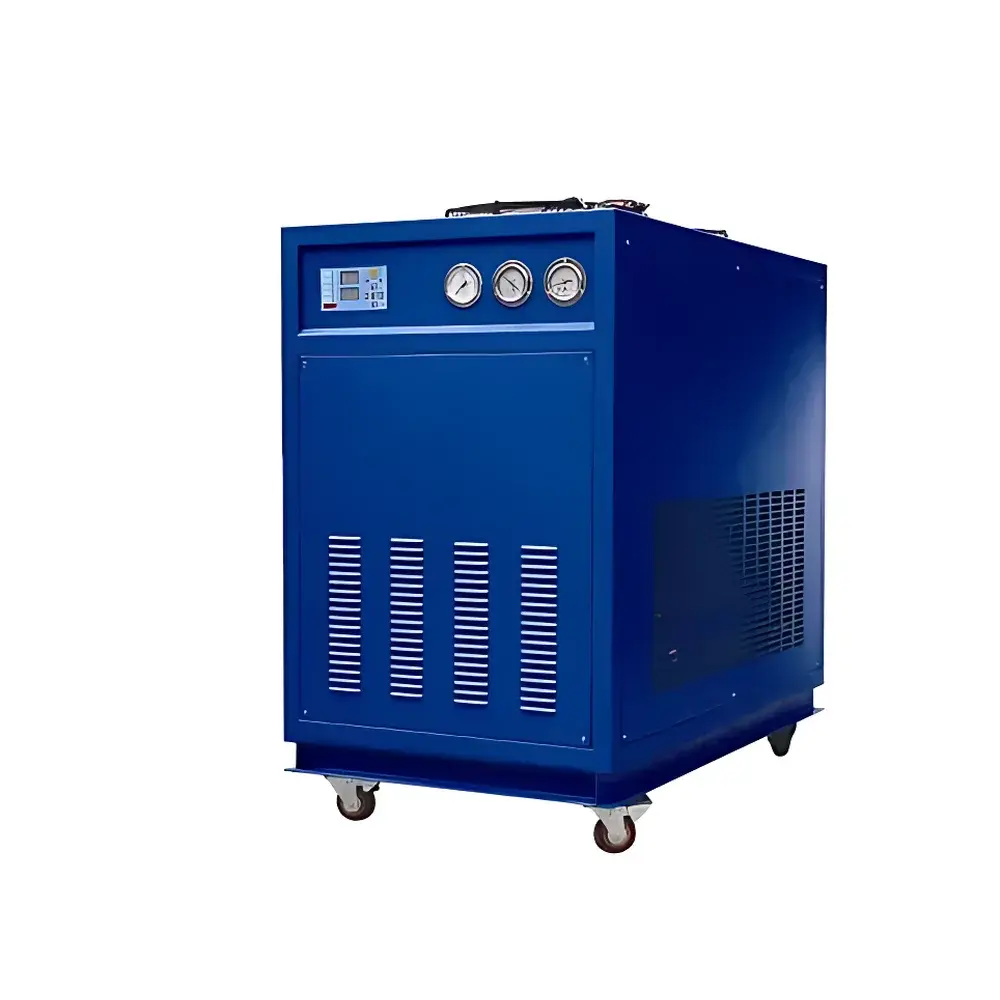
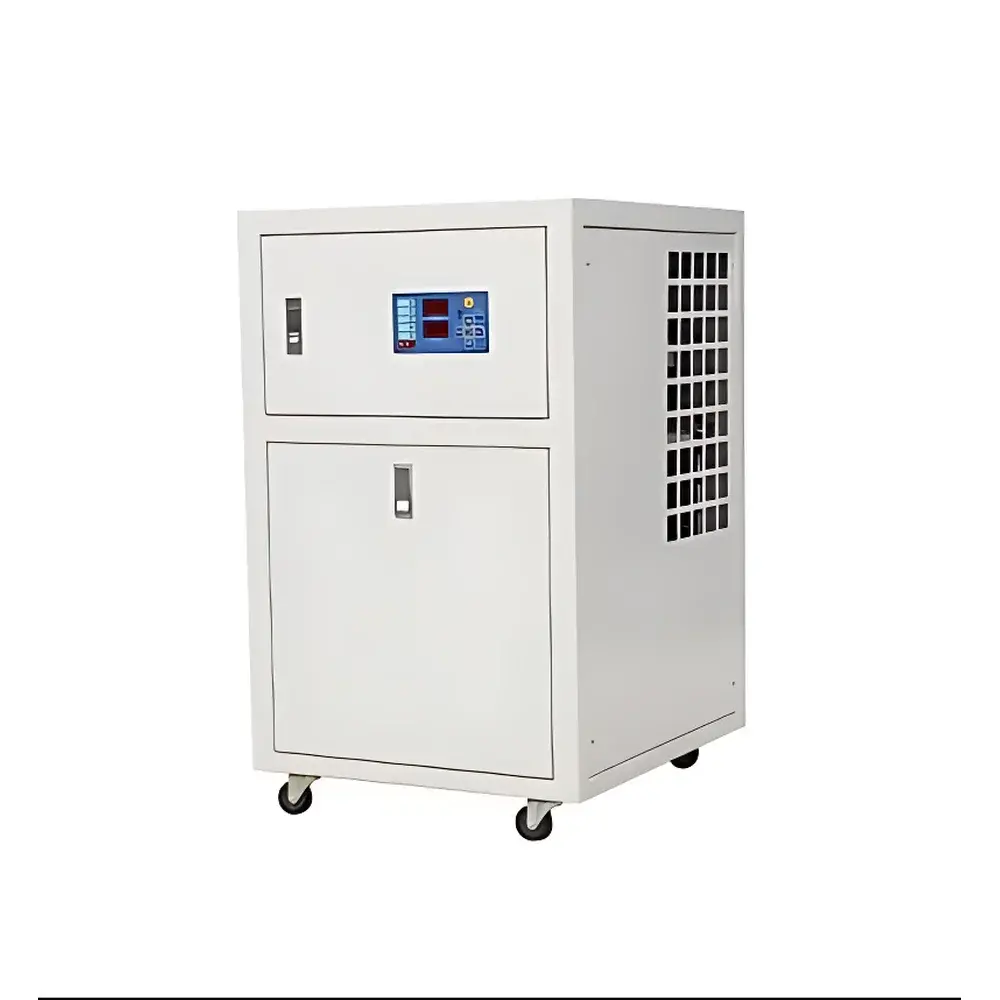
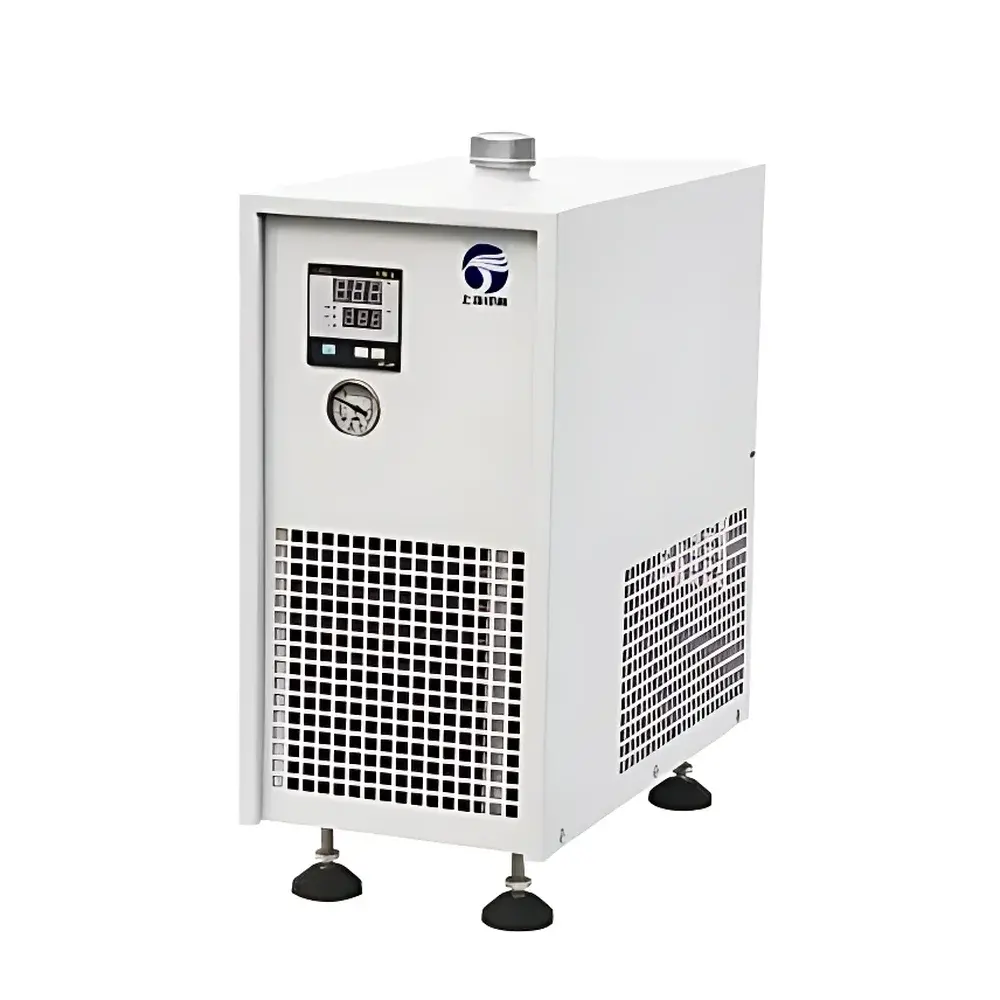
Tianfeng LS-12HP Integrated Circulating Chiller
| Brand | Tianfeng |
|---|---|
| Origin | Shanghai, China |
| Manufacturer Type | Direct Manufacturer |
| Product Category | Domestic |
| Model | Tianfeng LS-12HP |
| Instrument Type | Integrated Unit |
| Cooling Method | Water-Cooled |
| Temperature Control Range | 5–30 °C (Freezing Water Outlet: 3–8 °C) |
| Refrigeration Capacity | 37.2 kW (31,992 kcal/h) |
| Temperature Stability | ±0.3 °C |
| Circulating Pump Pressure | 14 m H₂O |
| Circulating Pump Flow Rate | 2 m³/h (33.3 L/min) |
| Reservoir Volume | 260 L |
| Operating Mode | Constant-Temperature & Intelligent Adaptive Control |
| Power Supply | 380 V (L1/L2/L3/N/PE), 50 Hz |
| Refrigerant | R22 |
| Compressor | Hermetic Scroll Type (10.32 kW) |
| Condenser | High-Efficiency Copper Tube + Aluminum Fin with Low-Noise External Rotor Fan (Cooling Airflow: 12,000 m³/h) |
| Evaporator | Immersed Coil in Stainless Steel Reservoir |
| Pump | Stainless Steel, 0.37 kW |
| Dimensions (L×W×H) | 1610 × 900 × 1850 mm |
| Safety Protections | Compressor Overheat, Overcurrent, High/Low Pressure, Overtemperature, Phase Sequence & Phase Loss |
Overview
The Tianfeng LS-12HP Integrated Circulating Chiller is an industrial-grade, water-cooled temperature control system engineered for precision thermal management of laboratory and production equipment requiring stable, continuous coolant delivery. It operates on the vapor-compression refrigeration cycle, utilizing a hermetic scroll compressor and R22 refrigerant to achieve consistent heat extraction from process fluids. Designed for integration with high-heat-load instrumentation—including graphite furnace atomic absorption spectrometers (GFAAS), inductively coupled plasma optical emission spectrometers (ICP-OES), ICP-mass spectrometers (ICP-MS), X-ray fluorescence (XRF) and X-ray diffraction (XRD) systems, scanning electron microscopes (SEM), and transmission electron microscopes (TEM)—the chiller maintains process fluid temperatures within a tightly regulated range of 5–30 °C, with outlet stability of ±0.3 °C under steady-state conditions. Its compact monoblock architecture eliminates external piping complexity while supporting long-term unattended operation in controlled laboratory environments.
Key Features
- Hermetic scroll compressor (10.32 kW) delivering high volumetric efficiency, low vibration, and extended service life under continuous duty cycles.
- Stainless steel reservoir (260 L capacity) and pump housing resistant to corrosion from deionized water, glycol-water mixtures, and common laboratory coolants.
- Dual operating modes: constant-temperature mode for fixed-point stabilization; intelligent adaptive mode dynamically modulates refrigerant flow and pump speed in response to real-time load fluctuations.
- Digital PID temperature controller with high-resolution display (0.1 °C resolution), configurable setpoint ramping, and programmable alarm thresholds.
- Comprehensive safety architecture including compressor overheat protection, high/low pressure cutouts, phase sequence monitoring, overcurrent interruption, and overtemperature shutdown.
- Low-noise condensing unit featuring optimized airflow design (12,000 m³/h) and external rotor fan—acoustic pressure level ≤72 dB(A) at 1 m distance.
- Modular electrical cabinet with certified components from Siemens, Schneider Electric, and Omron ensuring compliance with IEC 61000-6-2 (EMC immunity) and IEC 60204-1 (safety of machinery).
Sample Compatibility & Compliance
The LS-12HP is compatible with all standard laboratory cooling interfaces requiring 33.3 L/min flow at 14 m head pressure and inlet/outlet temperature differentials up to 5 °C (e.g., 12 °C in / 7 °C out). It supports coolant formulations compliant with ASTM D1384 (corrosion testing of engine coolants) and meets ISO 9001:2000 quality system requirements for design, manufacturing, and post-sale service. While not intrinsically rated for hazardous locations, its construction adheres to EN 61000-6-3 emission limits and UL 61010-1 safety standards for laboratory equipment. For regulated environments (e.g., GLP/GMP labs), optional audit-trail-capable controllers (e.g., RKC FP93) may be integrated to support 21 CFR Part 11 data integrity requirements upon customer specification.
Software & Data Management
The standard control interface provides local setpoint adjustment, real-time temperature readout, flow status indication, and fault code logging accessible via front-panel keypad and LCD. Optional RS-485 Modbus RTU communication enables integration into centralized building management systems (BMS) or laboratory information management systems (LIMS). Logged parameters—including reservoir temperature, compressor run time, pressure differentials, and alarm history—are timestamped and retainable for ≥30 days. Firmware updates are performed via secure USB interface; no cloud connectivity or remote access functionality is embedded, preserving network isolation per IT security best practices in research facilities.
Applications
- Thermal stabilization of high-power laser sources (e.g., CO₂, fiber, and ultrafast lasers), vacuum deposition chambers, and RF generators where thermal drift compromises beam alignment or coating uniformity.
- Cooling of analytical instrument components: X-ray tube anodes (XRF/XRD), plasma torches (ICP), graphite furnaces (AAS), and electron column assemblies (SEM/TEM) to maintain spectral resolution and detector quantum efficiency.
- Process temperature control in materials synthesis labs: cryo-milling precooling, solvent recrystallization baths, and polymer rheology test fixtures requiring precise thermal boundary conditions.
- Support of semiconductor metrology tools—including ellipsometers, AFM stages, and wafer probers—where sub-degree thermal stability minimizes measurement drift during nanoscale characterization.
- Integration with pharmaceutical R&D infrastructure for controlled-temperature dissolution testing, lyophilizer condenser cooling, and bioreactor jacket temperature regulation.
FAQ
What is the maximum allowable return water temperature for continuous operation?
The unit is rated for sustained operation with return coolant temperatures ≤40 °C. Exceeding this threshold accelerates compressor oil degradation and reduces refrigerant condensation efficiency; prolonged exposure above 45 °C may trigger high-pressure lockout.
Can the chiller operate with 30% ethylene glycol/water mixture?
Yes—the stainless steel reservoir, pump, and evaporator coil are compatible with glycol concentrations up to 40% by volume. Flow rate and refrigeration capacity must be derated per ASHRAE Handbook Fundamentals Chapter 21 guidelines for mixed-fluid thermophysical properties.
Is the LS-12HP suitable for cleanroom environments?
It meets ISO Class 8 (Class 100,000) particulate emission limits when installed with appropriate air filtration and vibration isolation. The absence of internal oil mist generation and sealed refrigerant circuit minimize contamination risk.
Does the unit include a built-in flow meter?
No—flow verification requires external inline turbine or ultrasonic flow sensors calibrated to ISO 4064. The onboard pressure transducer provides differential head indication only.
What maintenance intervals are recommended for laboratory use?
Compressor oil analysis every 2,000 operating hours; condenser coil cleaning quarterly; refrigerant charge verification annually; and full system performance validation (per ISO 5149-2) biannually in GxP-regulated settings.



