
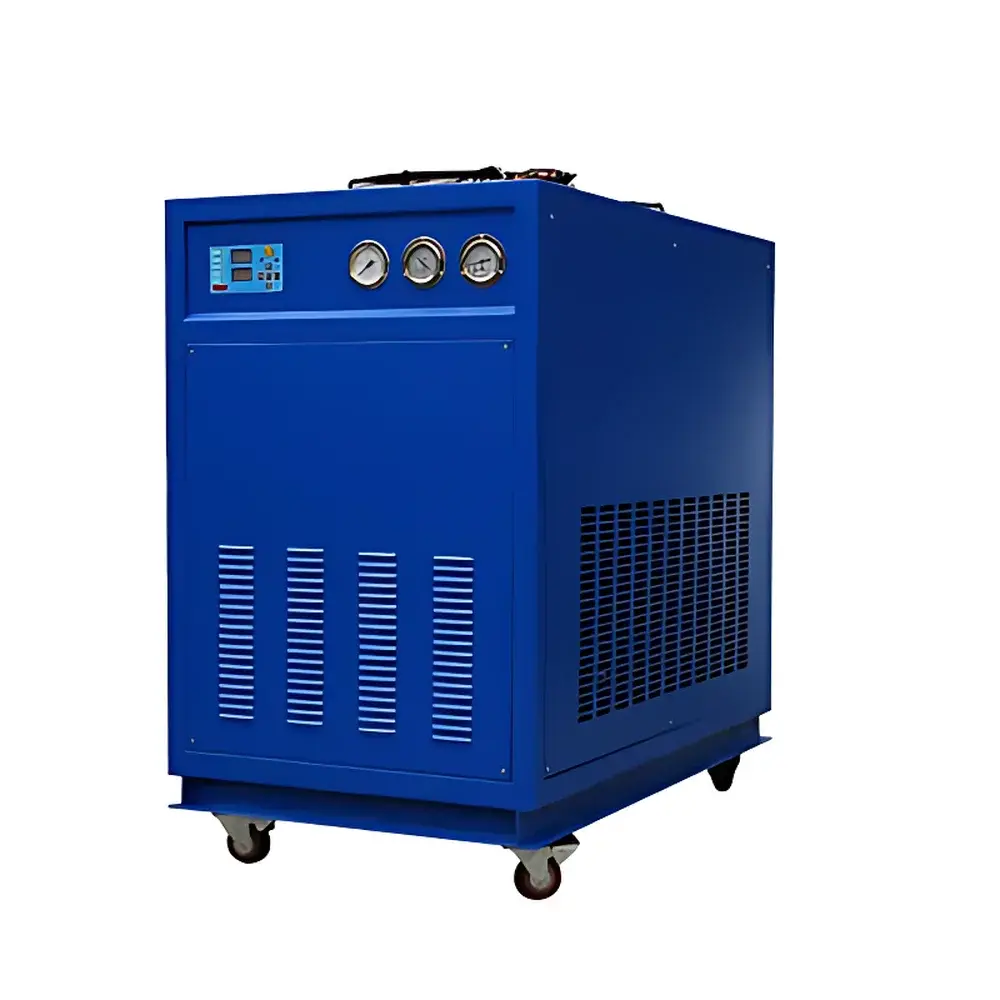
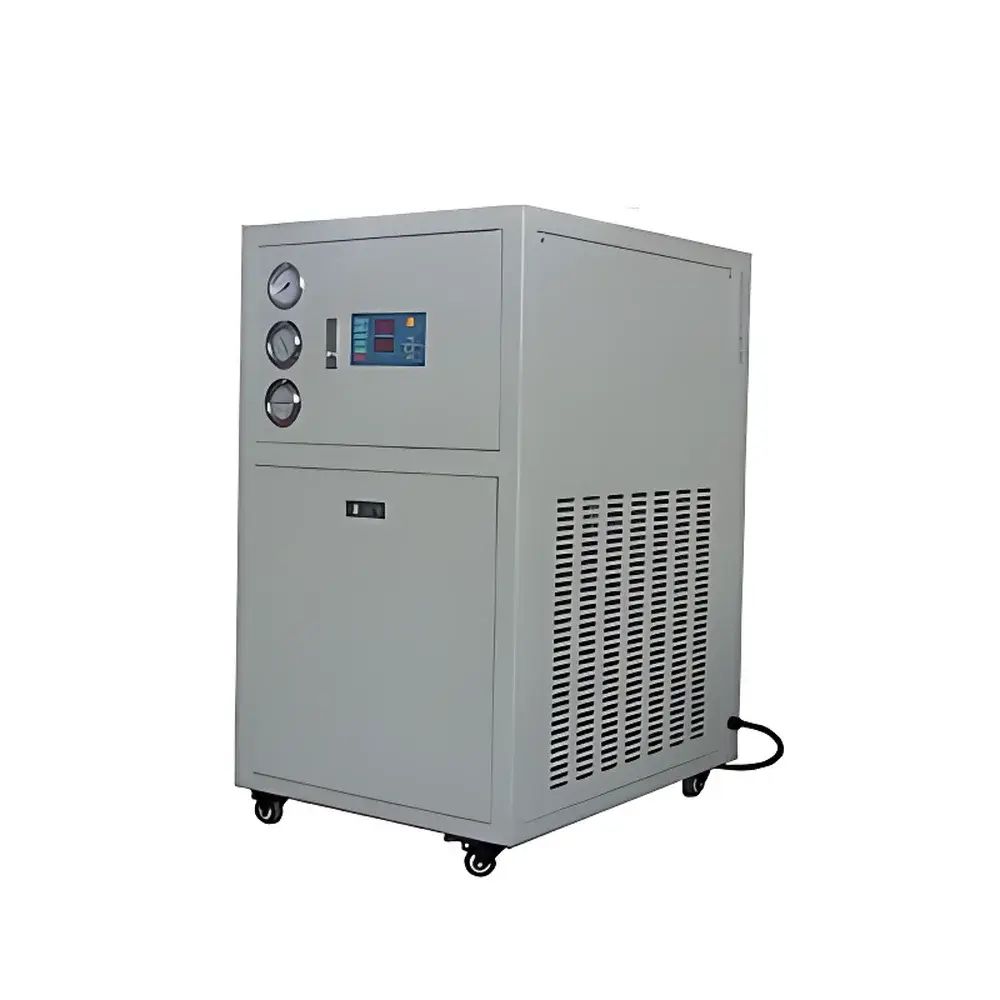
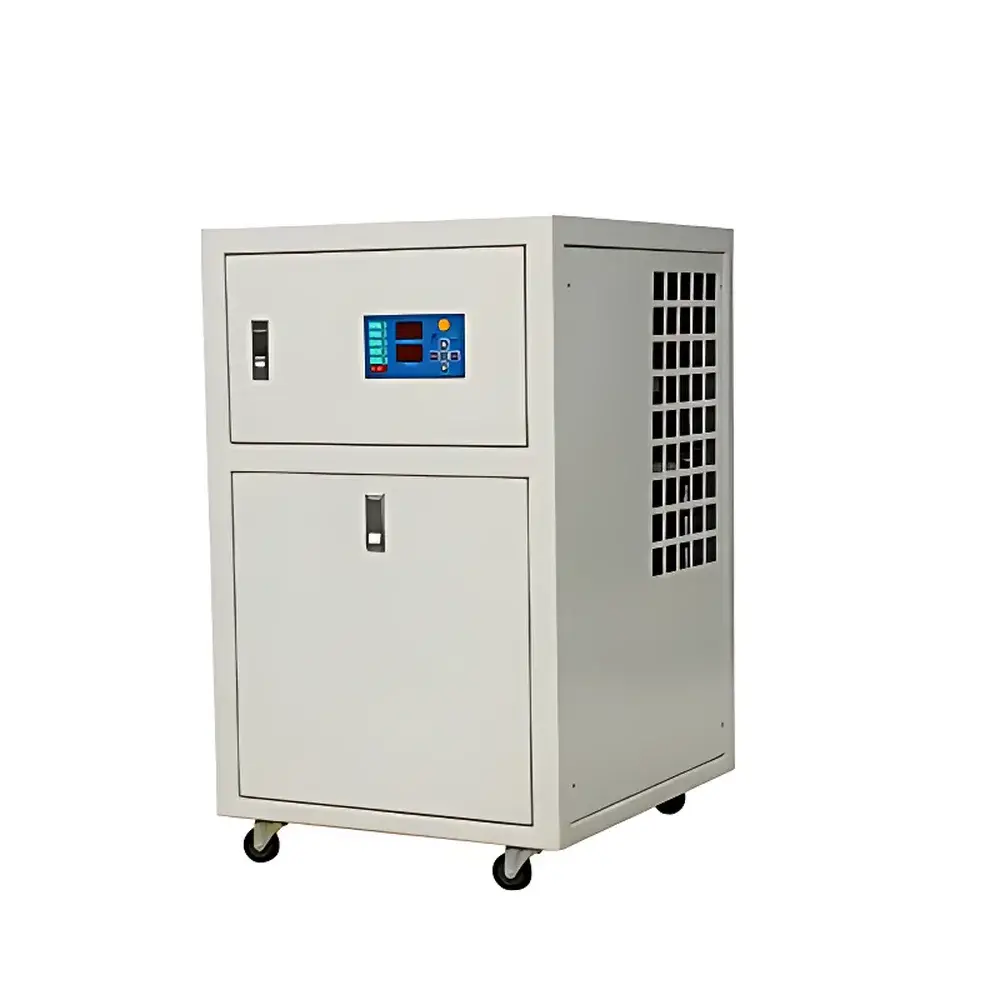
Tianfeng LS-15KW Air-Cooled Circulating Chiller
| Brand | Tianfeng |
|---|---|
| Origin | Shanghai, China |
| Manufacturer Type | Direct Manufacturer |
| Instrument Type | Integrated Air-Cooled Circulating Chiller |
| Cooling Method | Air-Cooled |
| Rated Refrigeration Capacity | 15 kW |
| Water Tank Volume | 110 L |
| Circulating Pump Flow Rate | 0–60 L/min |
| Circulating Pump Pressure | 0–2 kgf/cm² |
| Power Consumption | 6.2 kW |
| Temperature Stability | ±0.3 °C (typical at steady state) |
| Operating Temperature Range | 5–30 °C (chilled water outlet) |
| Power Supply | 220 V, 50 Hz |
| Dimensions (L×W×H) | 1350 × 750 × 1445 mm |
| Safety Protections | Compressor overheat protection, high/low pressure cut-off, overcurrent protection, overtemperature alarm |
| Construction | Stainless steel water tank and pump, vortex compressor, imported expansion valve & solenoid valve (Italy/Germany), RKC temperature controller optional |
| Certifications | ISO 9001:2000 compliant |
Overview
The Tianfeng LS-15KW Air-Cooled Circulating Chiller is an integrated, precision-engineered thermal management system designed for continuous, stable cooling of heat-generating laboratory and industrial equipment. Unlike water-cooled chillers requiring external cooling towers or facility water loops, this unit employs forced-air condensation—making it ideal for laboratories with limited infrastructure, mobile setups, or locations where water supply or drainage is constrained. Its core thermodynamic architecture follows the vapor-compression refrigeration cycle, utilizing a high-efficiency scroll compressor, thermostatic expansion valve, and copper-aluminum finned condenser to deliver consistent heat extraction from process fluid (typically deionized water or 30% ethylene glycol/water mixture). The chiller maintains setpoint temperature via PID-controlled circulation of chilled fluid through external equipment—such as ICP-OES plasma sources, XRD goniometers, SEM electron column housings, or laser diode mounts—thereby preventing thermal drift, suppressing component degradation, and ensuring measurement repeatability across extended operational cycles.
Key Features
- Integrated air-cooled design eliminates dependency on facility water lines or cooling towers—ideal for modular labs and cleanroom-adjacent installations.
- Vortex-type scroll compressor ensures low vibration, extended service life, and stable refrigerant mass flow under variable load conditions.
- Stainless steel insulated reservoir (110 L capacity) with level sensor and corrosion-resistant circulation pump (0–60 L/min, 0–2 kgf/cm² max head).
- Digital PID temperature controller with ±0.3 °C typical stability (measured at outlet port under steady-state 15 kW load, 7/12 °C ΔT); optional RKC controller available for enhanced traceability.
- Comprehensive safety suite: high/low refrigerant pressure monitoring, compressor winding overtemperature cutoff, phase-loss detection, and real-time fault code display.
- Front-panel LCD interface displays real-time outlet temperature, setpoint, pump status, and active alarms; supports manual setpoint adjustment and mode switching (constant-temp vs. intelligent adaptive control).
- Electrical components sourced from Siemens, Schneider Electric, and Omron—certified to IEC 60204-1 for industrial machinery safety.
- Acoustically optimized enclosure achieves ≤72 dB(A) at 1 m—compliant with ISO 3744 for laboratory ambient noise constraints.
Sample Compatibility & Compliance
This chiller is compatible with any laboratory instrument requiring closed-loop liquid cooling within the 5–30 °C operating range and ≤60 L/min flow demand. It has been validated for use with atomic spectroscopy systems (GF-AAS graphite furnace blocks, ICP-MS nebulizer chambers), structural analysis platforms (XRD theta-2theta stages, TEM column chillers), and high-power optical subsystems (CO₂ laser resonators, ultrafast amplifier pump diodes). All wetted materials—including tubing, pump head, and heat exchanger surfaces—are electropolished 316 stainless steel or EPDM-sealed to prevent leaching and support GLP-compliant operation. The unit conforms to ISO 9001:2000 quality management requirements and meets CE marking criteria per EN 61000-6-3 (EMC emission) and EN 61000-6-2 (immunity). While not FDA 21 CFR Part 11–validated out-of-the-box, its controller supports audit-trail-capable data logging when paired with optional RS485/Modbus RTU or Ethernet/IP interfaces—facilitating integration into GMP-aligned QC environments.
Software & Data Management
The standard controller provides local setpoint programming, runtime logging (last 100 events), and password-protected parameter access. For networked lab environments, optional communication modules enable remote monitoring and control via TCP/IP or Modbus RTU protocols. Logged parameters include outlet temperature, compressor run time, fault history, and pump duty cycle—exportable in CSV format for LIMS ingestion. When configured with RKC’s FP93 controller, the system supports electronic signature-enabled setpoint changes, user-level access tiers (operator/engineer/admin), and timestamped event records compliant with ALCOA+ principles. No proprietary cloud platform is required; all data remains on-premise unless explicitly routed to institutional SCADA or LabVantage systems.
Applications
- Atomic Spectroscopy: Stabilizes graphite furnace temperatures in GF-AAS; cools RF generator coolant loops in ICP-OES/ICP-MS to maintain plasma impedance consistency.
- Materials Characterization: Maintains thermal equilibrium in XRD goniometer bearings and detector Peltier elements; prevents thermal lensing in SEM/TEM electron optics columns.
- Laser Systems: Removes waste heat from DPSS laser crystals, fiber amplifier diodes, and CO₂ laser RF power supplies—critical for wavelength stability and beam pointing reproducibility.
- Pharmaceutical QC: Cools HPLC column ovens and dissolution apparatus baths per USP thermal uniformity requirements.
- Electron Microscopy: Supplies regulated coolant to STEM detector cryo-shields and stage cooling jackets to minimize thermal drift during nanoscale imaging.
- Industrial R&D: Supports thermal cycling validation of battery electrolytes, polymer rheology cells, and semiconductor wafer probing stations.
FAQ
What is the maximum allowable return water temperature?
The unit is rated for inlet water temperatures up to 40 °C. Sustained return temperatures above this threshold increase condensing pressure, reduce compressor efficiency, and accelerate oil degradation—potentially triggering high-pressure cutout. For optimal longevity, maintain return temperature ≤35 °C.
Can this chiller operate continuously for 24/7 laboratory use?
Yes. Designed for unattended operation, it includes redundant safety interlocks, thermal overload protection, and a maintenance-interval timer. Field data from multi-year deployments in academic core facilities confirm >99.2% uptime under nominal 15 kW load.
Is glycol mixture compatible with the internal circuit?
The system supports up to 30% ethylene glycol/water mixtures without modification. Propylene glycol is also acceptable but requires verification of viscosity impact on pump NPSH margin at minimum operating temperature.
Does the chiller meet noise requirements for ISO Class 5 cleanrooms?
At 72 dB(A) @ 1 m, it exceeds typical cleanroom HVAC noise limits. We recommend installation in an adjacent mechanical room with flexible coolant line routing—or specify acoustic enclosure options (available upon request) to achieve ≤55 dB(A) at operator position.
What calibration documentation is provided?
Each unit ships with a factory calibration certificate traceable to NIM (National Institute of Metrology, China) standards, covering temperature sensor accuracy (±0.2 °C at 20 °C), flow meter linearity (±2% FS), and pressure transducer hysteresis (<0.5% FS). Third-party ISO/IEC 17025 calibration is available as an add-on service.



