
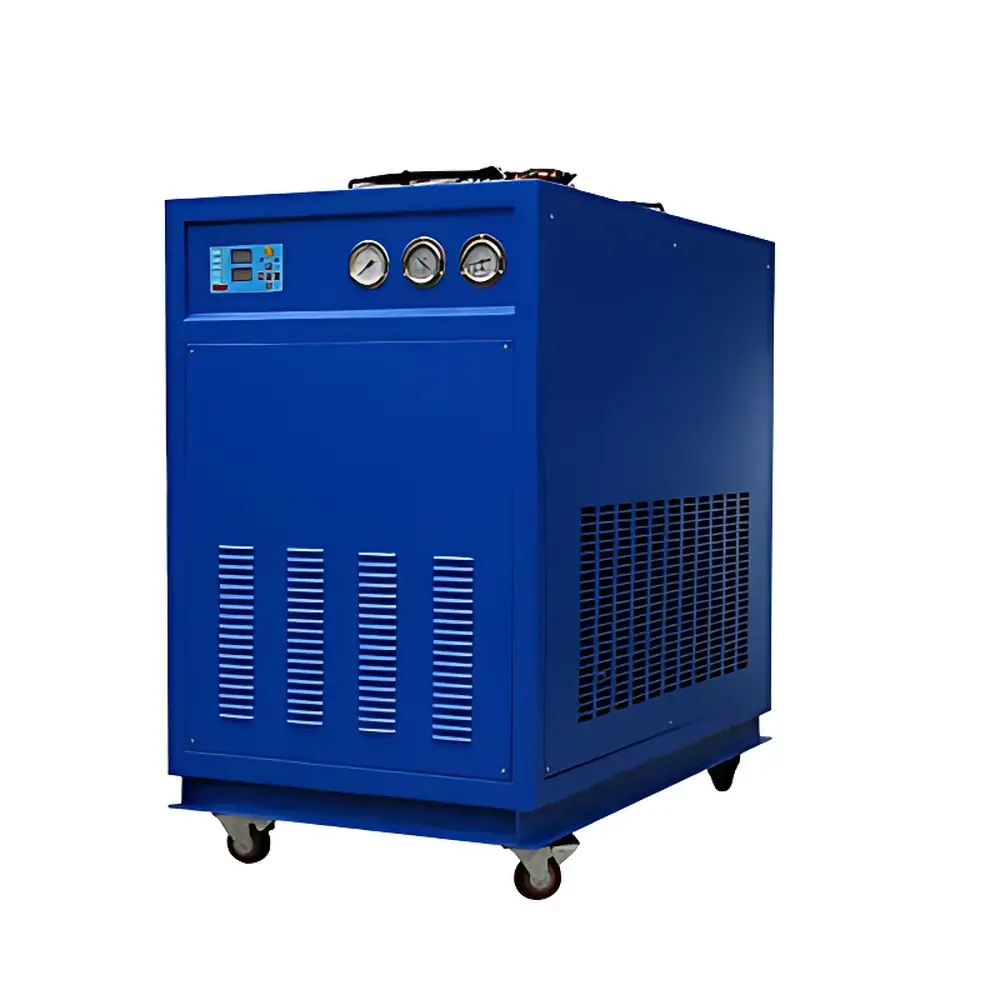
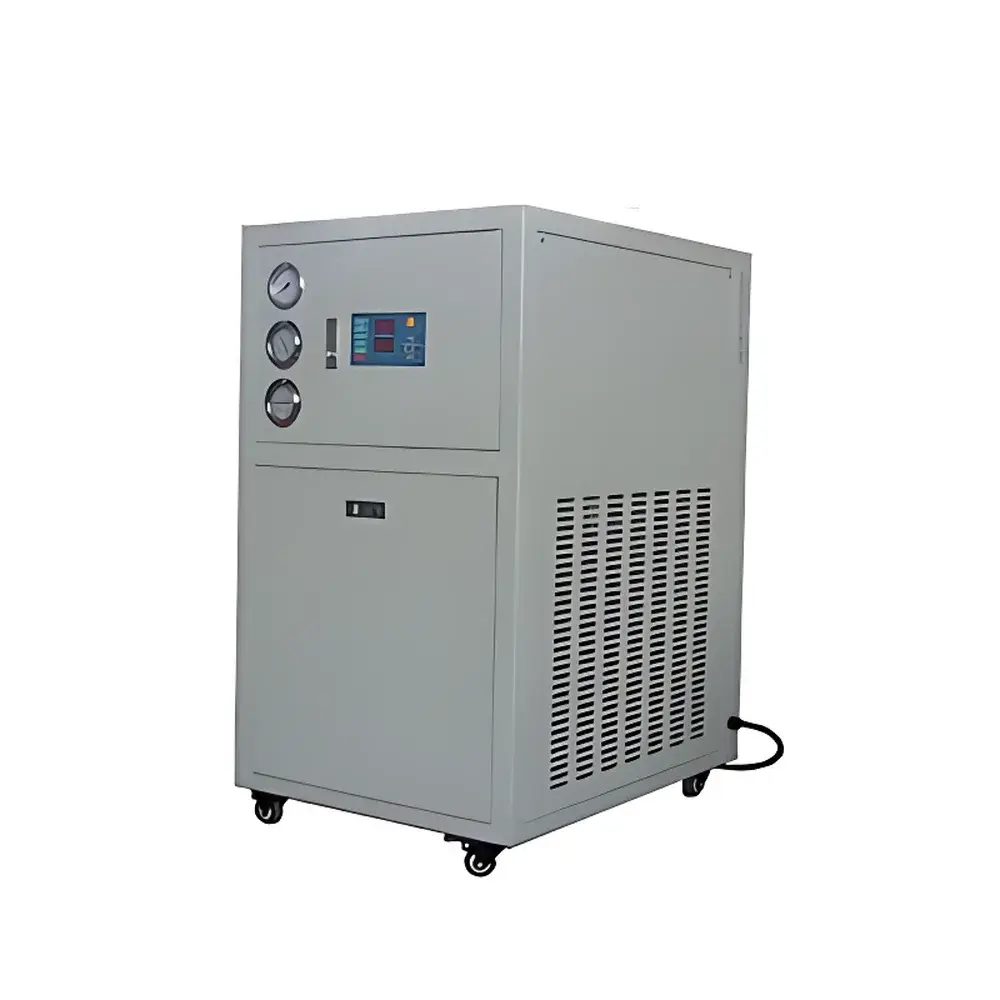
Tianfeng LS-18KW Integrated Circulating Chiller
| Brand | Tianfeng |
|---|---|
| Origin | Shanghai, China |
| Manufacturer Type | Direct Manufacturer |
| Product Category | Domestic |
| Model | Tianfeng-LS-18KW |
| Instrument Type | Integrated Unit |
| Cooling Method | Water-Cooled |
| Temperature Control Range | 0–40 °C |
| Refrigeration Capacity | 300–9000 W |
| Temperature Stability | ±0.1 °C |
| Circulating Pump Pressure | 2.0 bar |
| Circulating Flow Rate | 38 L/min |
| Reservoir Volume | 5–550 L |
| Operating Mode | Continuous |
| Rated Refrigeration Output | 18 kW |
| Water Outlet Pressure | 0–2 kgf/cm² |
| Power Consumption | 6.41 kW |
| Reservoir Capacity | 180 L |
| Dimensions (L×W×H) | 1350 × 800 × 1500 mm |
| Power Supply | 220 V, 50 Hz |
| Safety Protections | Compressor Overheat Protection, Overcurrent Protection, High/Low Pressure Switches, Overtemperature Cut-off |
| Construction | Stainless Steel Reservoir & Pump |
| Compressor Type | Scroll Compressor |
| Temperature Controller | Domestic High-Precision PID Controller (Optional RKC Japan Unit) |
| Key Components | Imported Expansion Valves & Solenoid Valves (Italy/Germany), Siemens/Schneider/Omron Electrical Components |
| Noise Level | Low |
| Compliance | ISO 9001:2000 Certified |
Overview
The Tianfeng LS-18KW Integrated Circulating Chiller is a precision-engineered water-cooled thermal management system designed for stable, continuous cooling of high-heat-load laboratory and industrial equipment. Based on vapor-compression refrigeration thermodynamics, it employs a scroll compressor—selected for its mechanical robustness, low vibration, and high volumetric efficiency—to maintain tightly regulated coolant temperatures across demanding operational cycles. The unit operates within a nominal control range of 0–40 °C with a stability of ±0.1 °C, making it suitable for applications requiring strict thermal consistency, including analytical instrumentation cooling, laser source thermal stabilization, and vacuum system heat load dissipation. Its integrated architecture eliminates external piping complexity while supporting uninterrupted 24/7 operation under full load—critical for unattended lab environments and production-critical machinery.
Key Features
- High-stability temperature control via dual-stage PID algorithm with real-time feedback from platinum RTD sensors (Pt100) mounted at both inlet and outlet ports
- Stainless steel reservoir (180 L capacity) and corrosion-resistant centrifugal pump rated for 38 L/min flow at up to 2.0 bar pressure—ensuring long-term reliability in deionized or inhibited coolant loops
- Comprehensive safety architecture: electronic high/low pressure switches, compressor winding overheat detection, phase-loss monitoring, and automatic shutdown with fault-code display
- Digital operator interface with backlit LCD showing setpoint, actual temperature, flow status, and alarm history—supports manual setpoint adjustment and mode selection (constant-temp or intelligent adaptive control)
- Optimized refrigerant circuit incorporating imported thermostatic expansion valves (TEVs) and solenoid valves (Italy/Germany origin) for precise refrigerant metering and rapid response to load transients
- Electrical system built with UL-listed components from Siemens, Schneider, and Omron—compliant with IEC 61000-4 EMC immunity standards and IP54-rated enclosure protection
- Low-noise design (<65 dB(A) at 1 m) achieved through acoustic insulation, anti-vibration compressor mounts, and laminar-flow fan ducting
Sample Compatibility & Compliance
This chiller is engineered to support a broad spectrum of laboratory and industrial thermal loads—including graphite furnace atomic absorption spectrometers (GFAAS), inductively coupled plasma optical emission spectrometers (ICP-OES), ICP-mass spectrometers (ICP-MS), X-ray fluorescence (XRF) and X-ray diffraction (XRD) systems, scanning and transmission electron microscopes (SEM/TEM), and high-power laser platforms (e.g., fiber, CO₂, and ultrafast amplifiers). Its 0–40 °C operating envelope aligns with manufacturer-specified coolant inlet requirements for most OEM analytical instruments. The system meets ISO 9001:2000 quality management standards and supports GLP/GMP-aligned operation through configurable event logging, user-accessible calibration records, and optional audit-trail-capable controllers compatible with FDA 21 CFR Part 11 data integrity principles when paired with validated software interfaces.
Software & Data Management
While the base model features a stand-alone digital controller with local parameter setting and alarm indication, optional RS485 Modbus RTU or Ethernet TCP/IP communication modules enable integration into centralized facility monitoring systems (e.g., LabVantage, DeltaV, or custom SCADA). Logged parameters—including runtime hours, compressor cycles, temperature deviation history, and fault timestamps—are exportable via USB or serial dump for preventive maintenance scheduling and regulatory documentation. Firmware updates are performed offline using certified configuration tools; no cloud connectivity or remote vendor access is embedded by default—ensuring data sovereignty and network security compliance per institutional IT policies.
Applications
- Laboratory Instrument Cooling: Thermal stabilization of plasma sources, X-ray tubes, detector cryo-stages, and high-voltage power supplies where ambient fluctuations would otherwise degrade signal-to-noise ratio or measurement repeatability
- Laser Systems: Maintaining diode-pumped solid-state (DPSS) and fiber laser diode junction temperatures within ±0.05 °C to prevent wavelength drift and mode instability
- Materials Characterization: Sustaining constant sample stage temperatures during in-situ SEM/TEM experiments or synchrotron beamline sample cooling stages
- Industrial Process Support: Mold temperature control in polymer analysis rheometry, hydraulic oil cooling in precision metrology fixtures, and dielectric fluid conditioning in high-frequency plasma etch tools
- Pharmaceutical & Biotech: Controlled cooling of fermentation bioreactors, chromatography column ovens, and lyophilizer condenser plates in cGMP environments
FAQ
What is the maximum allowable return water temperature for continuous operation?
For optimal compressor longevity and system efficiency, the recommended maximum return water temperature is 40 °C. Exceeding this threshold increases discharge pressure and oil degradation risk—particularly under sustained high-load conditions.
Can this chiller be integrated with existing building management systems (BMS)?
Yes—via optional Modbus RTU (RS485) or BACnet/IP (Ethernet) communication modules, enabling real-time monitoring of temperature, flow, and alarm status within enterprise-level HVAC or lab infrastructure platforms.
Is the stainless steel reservoir compatible with deionized (DI) water and glycol-water mixtures?
The 304 stainless steel tank and wetted pump components are fully compatible with DI water, 20–30% ethylene or propylene glycol solutions, and common corrosion-inhibited coolants meeting ASTM D1384 specifications.
Does the unit support remote start/stop and setpoint adjustment?
Remote digital I/O terminals allow dry-contact start/stop signaling; analog 0–10 V or 4–20 mA inputs support external setpoint modulation—configurable via service menu without firmware modification.
What maintenance intervals are recommended for laboratory-grade reliability?
Compressor oil and filter replacement every 8,000 operating hours; annual inspection of refrigerant charge integrity, electrical connections, and sensor calibration traceability against NIST-traceable references.



