
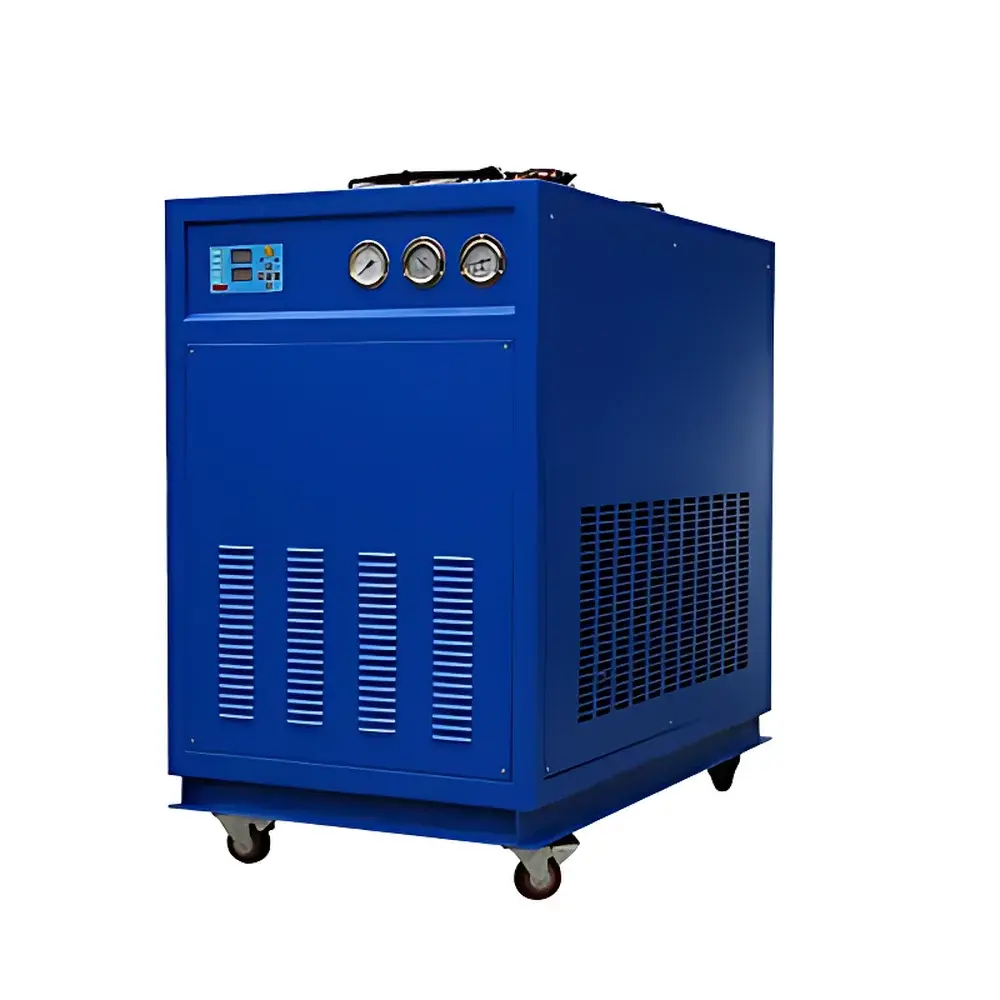
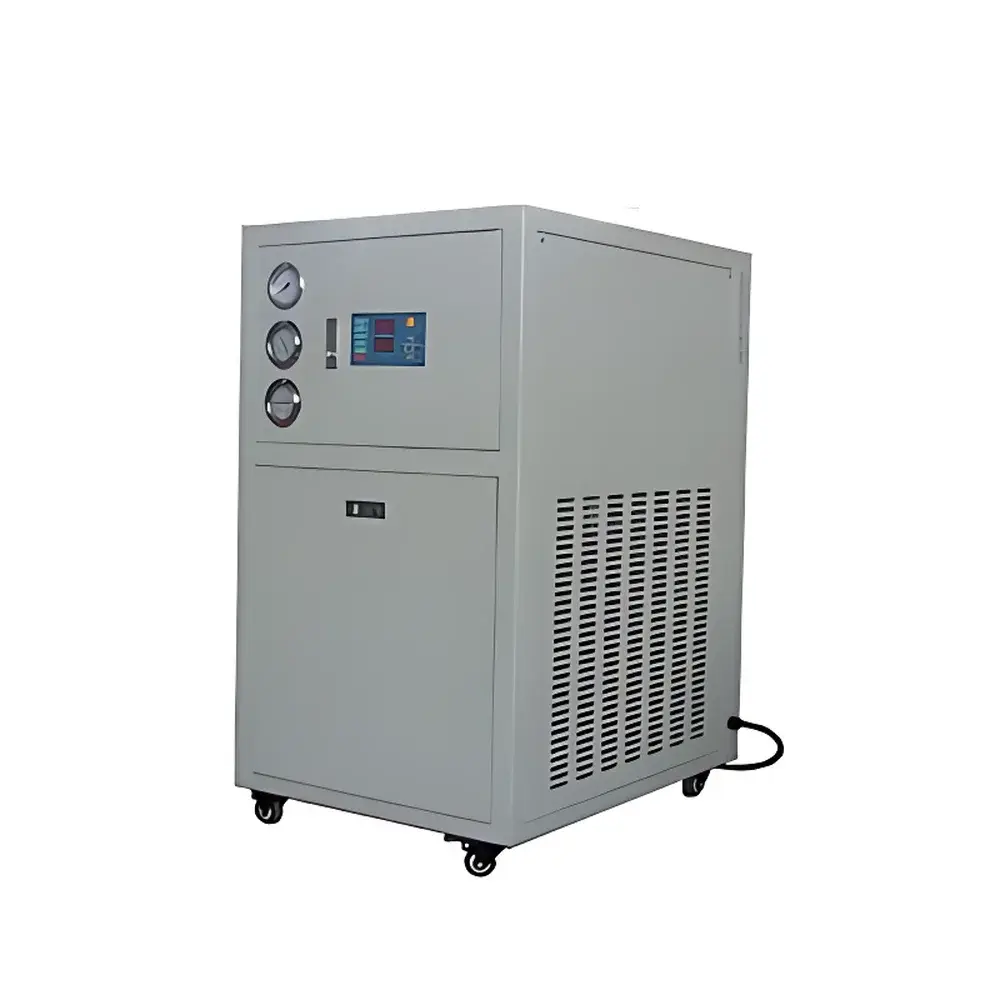
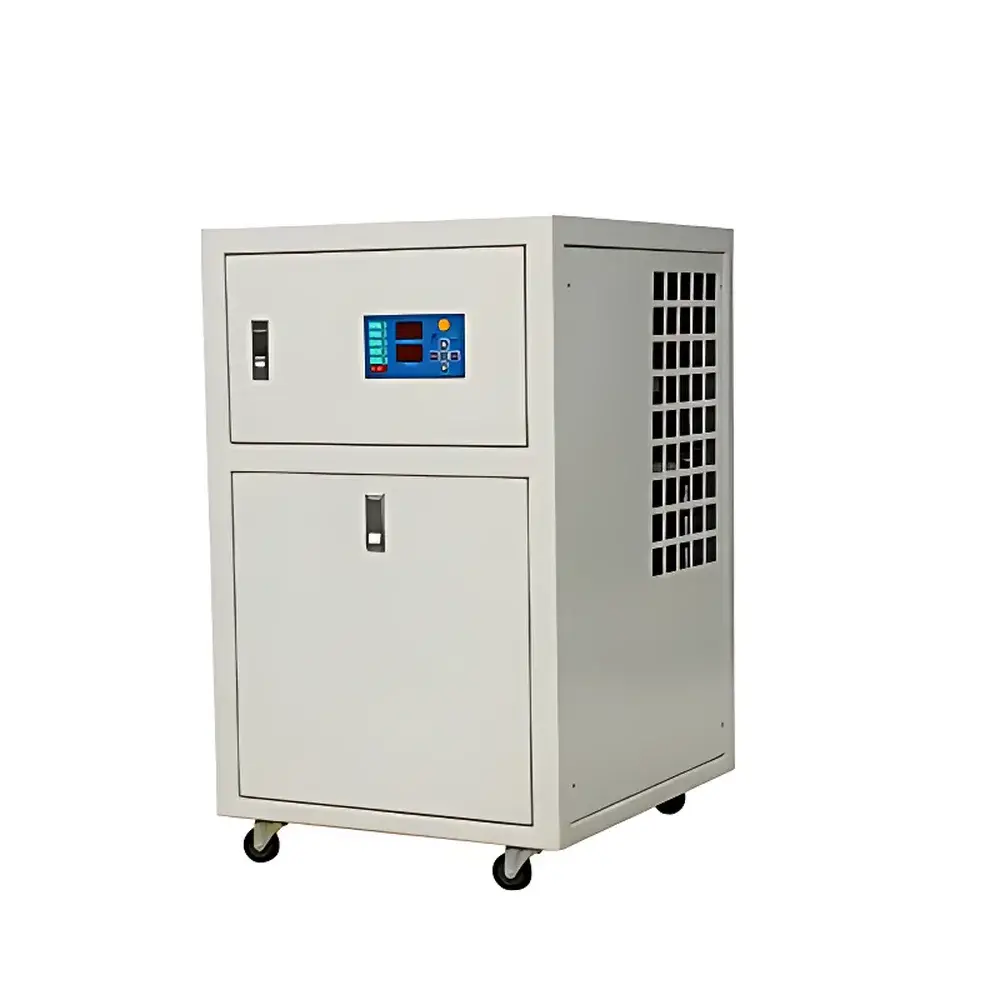
Tianfeng LS-20KW Integrated Circulating Chiller
| Brand | Tianfeng |
|---|---|
| Origin | Shanghai, China |
| Manufacturer Type | Direct Manufacturer |
| Instrument Type | Integrated Circulating Chiller |
| Cooling Method | Water-Cooled |
| Refrigeration Capacity | 20 kW |
| Power Input | 7.15 kW |
| Water Tank Volume | 180 L |
| Flow Rate | 0–60 L/min |
| Discharge Pressure | 0–2 kgf/cm² |
| Temperature Stability | ±0.3°C (typical, at setpoint 20°C) |
| Operating Temperature Range | 5–30°C (chilled water outlet) |
| Dimensions (L×W×H) | 1350 × 800 × 1580 mm |
| Power Supply | 220 V, 50 Hz |
| Safety Protections | Compressor overheat protection, overcurrent protection, high/low pressure cutoff, overtemperature alarm |
| Construction | Stainless steel tank and pump |
| Compressor | Scroll-type, imported high-efficiency unit |
| Control System | Digital PID temperature controller (standard Chinese OEM |
| Certifications | ISO 9001:2000 certified design and manufacturing |
Overview
The Tianfeng LS-20KW Integrated Circulating Chiller is a precision-engineered refrigeration system designed for continuous, stable thermal management of heat-generating components in high-performance laboratory and industrial equipment. It operates on a closed-loop vapor-compression refrigeration cycle, utilizing a scroll compressor, thermostatic expansion valve, and copper-aluminum finned condenser to deliver consistent cooling capacity across variable thermal loads. Unlike ambient-air-cooled units, this water-cooled chiller achieves superior thermal stability and energy efficiency by rejecting heat via an external cooling water circuit—making it especially suitable for environments where ambient air temperature fluctuates or space for ventilation is limited. Its primary function is to maintain the chilled water outlet temperature within a tightly controlled range (5–30°C), with typical temperature stability of ±0.3°C at steady-state operation—critical for applications demanding reproducible thermal conditions, such as analytical instrumentation, vacuum systems, and high-speed rotating machinery.
Key Features
- Integrated compact architecture: All major components—including scroll compressor, condenser, evaporator, stainless steel reservoir, magnetic-drive circulation pump, and PID-based digital controller—are housed in a single, floor-standing enclosure (1350 × 800 × 1580 mm), minimizing footprint and simplifying installation.
- High-reliability refrigeration train: Equipped with an imported scroll compressor, internationally sourced thermostatic expansion valves (Italy/Germany), and electromagnetic valves ensuring long-term operational integrity under continuous duty cycles.
- Precision temperature control: Standard digital PID controller delivers responsive, oscillation-free regulation; optional RKC (Japan) controller available for enhanced repeatability and data logging compatibility.
- Corrosion-resistant fluid path: 180 L stainless steel water tank and fully stainless wet-end pump prevent scaling, microbial growth, and electrolytic degradation—essential for extended service life with deionized or inhibited coolant solutions.
- Comprehensive safety architecture: Real-time monitoring of compressor discharge temperature, refrigerant pressure (high/low), motor current, and water temperature enables automatic shutdown and fault-code output upon deviation from safe operating parameters.
- Flexible hydraulic performance: Adjustable flow rate (0–60 L/min) and discharge pressure (0–2 kgf/cm²) accommodate diverse equipment requirements—from low-pressure spectrometer chill loops to high-head laser cavity cooling circuits.
Sample Compatibility & Compliance
The LS-20KW chiller is compatible with a broad spectrum of laboratory and production-grade instruments requiring precise, uninterrupted coolant delivery. Validated integration includes graphite furnace atomic absorption spectrometers (GFAAS), inductively coupled plasma optical emission spectrometers (ICP-OES), ICP-mass spectrometers (ICP-MS), X-ray fluorescence (XRF) and X-ray diffraction (XRD) systems, scanning and transmission electron microscopes (SEM/TEM), and high-power CO₂/fiber laser workstations. Its design adheres to ISO 9001:2000 quality management standards throughout development, manufacturing, and final testing. While not FDA 21 CFR Part 11–certified out-of-the-box, its digital controller supports audit-trail-ready configurations when paired with compliant SCADA or LIMS interfaces—enabling alignment with GLP and GMP laboratory environments where traceable temperature records are mandated.
Software & Data Management
The standard control interface provides local setpoint adjustment, real-time display of inlet/outlet water temperature, flow status, and fault diagnostics via a backlit LCD panel. For integration into centralized lab infrastructure, analog 4–20 mA outputs (temperature and flow) and digital RS-485 Modbus RTU communication are available as factory options—enabling seamless connection to building management systems (BMS), supervisory control and data acquisition (SCADA) platforms, or custom Python/LabVIEW-based monitoring suites. Optional data-logging modules support time-stamped storage of temperature profiles, runtime hours, and alarm events on internal SD cards—facilitating compliance reporting and predictive maintenance scheduling.
Applications
This chiller serves dual-purpose roles across research and industrial settings. In analytical laboratories, it stabilizes detector and source temperatures in spectroscopic and diffraction systems—reducing thermal drift in spectral baselines and improving signal-to-noise ratios. In materials science facilities, it cools electron beam columns and X-ray optics to mitigate thermal lensing and mechanical creep. Within manufacturing environments, it regulates die temperature in injection molding machines—enhancing part surface finish, dimensional accuracy, and cycle time consistency. It also maintains hydraulic oil temperature in CNC machining centers and coordinate measuring machines (CMMs), directly contributing to geometric measurement repeatability per ISO 10360 and ASME B89 standards. Additional validated uses include semiconductor wafer processing chill plates, vacuum chamber shrouds, and cryogenic sample prep stations.
FAQ
What is the recommended maximum return water temperature?
For optimal compressor longevity and refrigerant cycle efficiency, the return water temperature should not exceed 40°C. Sustained inlet temperatures above this threshold increase condensing pressure and accelerate lubricant breakdown.
Can this chiller operate continuously for 24/7 laboratory use?
Yes. The LS-20KW is rated for continuous-duty operation with built-in thermal overload protection, redundant pressure safeties, and corrosion-resistant fluid pathways—validated for unattended 7×24 operation in ISO Class 5–7 cleanroom-adjacent labs.
Is deionized water required for laboratory applications?
While tap water may be used temporarily, deionized or inhibited glycol-water mixtures (≤30% concentration) are strongly recommended to prevent scaling, galvanic corrosion, and biofilm formation in sensitive instrument loops.
Does the unit support remote monitoring and alarm notification?
Standard configuration includes dry-contact fault relay outputs; optional Ethernet or Wi-Fi modules enable email/SMS alerts and cloud-based dashboard access via MQTT or HTTP APIs.
What maintenance intervals are recommended?
Compressor oil and refrigerant charge require verification every 24 months; condenser coil cleaning and filter replacement every 6 months; full system flush and coolant replacement every 12–18 months depending on water quality and usage profile.



