
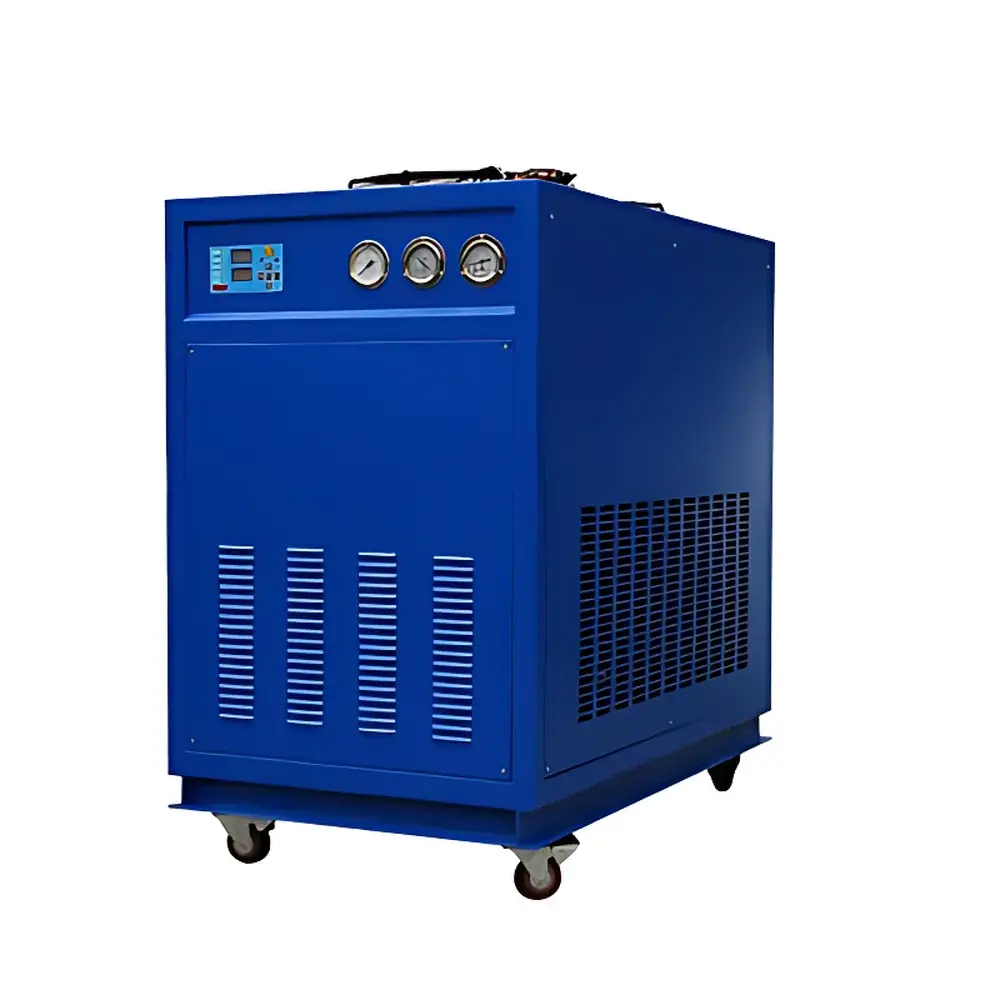
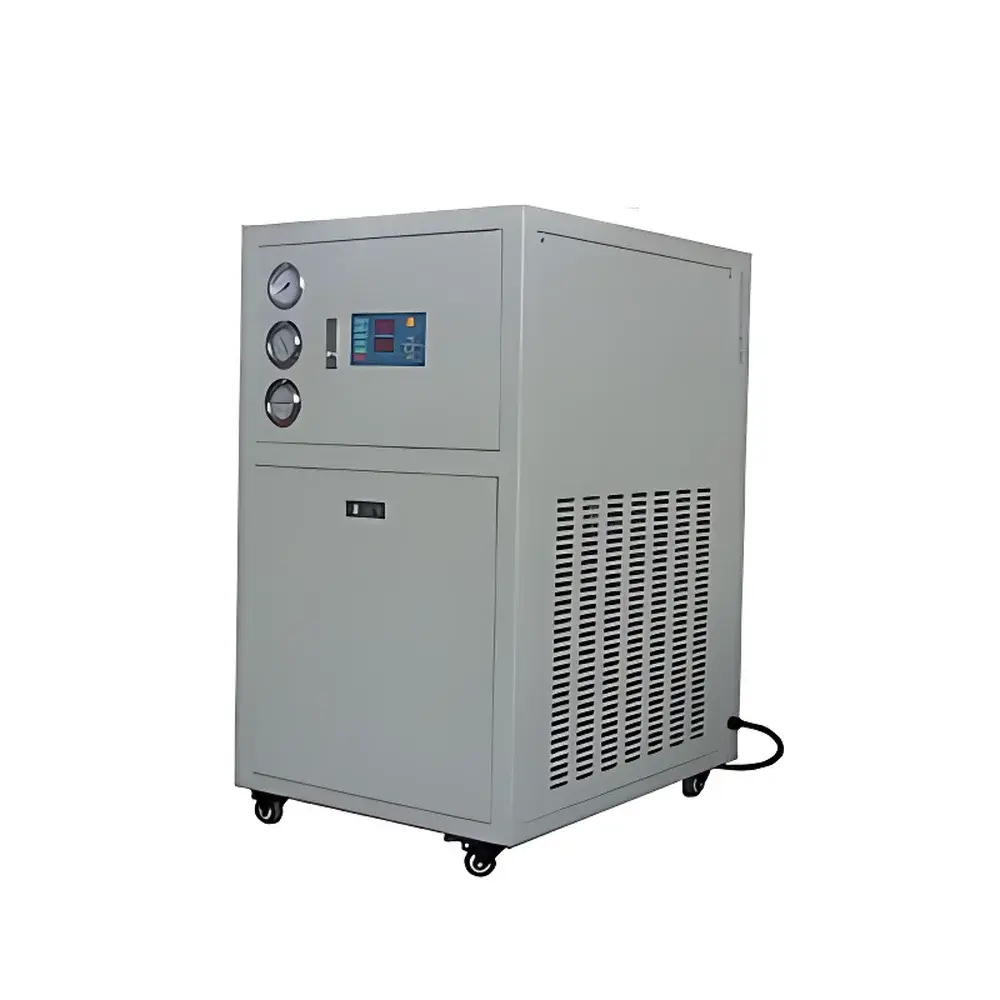
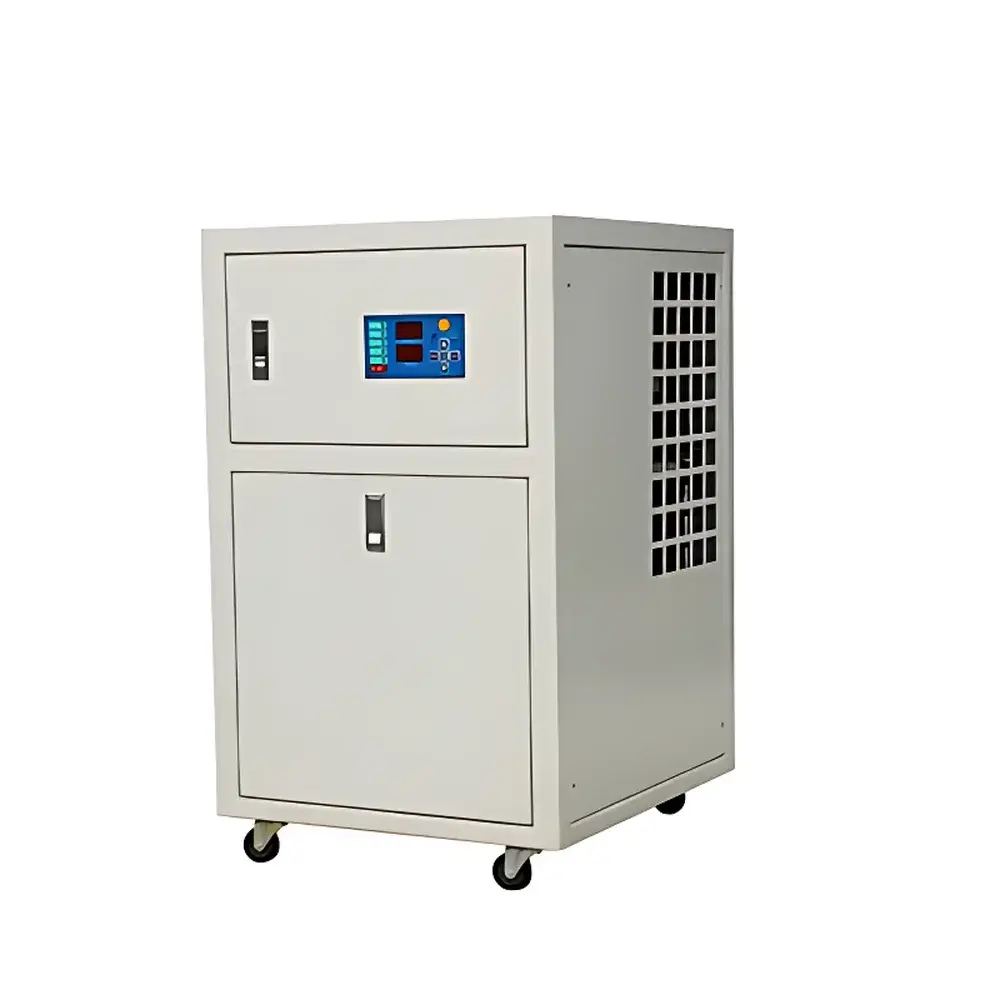
Tianfeng LS-30000W Integrated Circulating Chiller
| Brand | Tianfeng |
|---|---|
| Origin | Shanghai, China |
| Manufacturer Type | Direct Manufacturer |
| Equipment Type | Integrated Circulating Chiller |
| Cooling Method | Water-Cooled |
| Refrigeration Capacity | 30 kW (25,800 kcal/h) |
| Temperature Stability | ±0.1°C |
| Water Tank Volume | 260 L |
| Circulating Pump Flow Rate | 0–60 L/min |
| Pump Pressure | 0–2 kgf/cm² |
| Input Power | 11.5 kW |
| Dimensions (L×W×H) | 1610 × 900 × 1850 mm |
| Power Supply | 220 V, 50 Hz |
| Safety Protections | Compressor overheat protection, overcurrent protection, high/low pressure cut-off, and overtemperature alarm |
| Construction | Stainless steel tank and pump |
| Control System | Digital PID temperature controller (optional RKC Japan unit) |
| Compressor | High-efficiency scroll compressor (EU/US origin) |
| Key Components | Italian/German expansion valves, solenoid valves, Siemens/Schneider/Omron electrical components |
| Noise Level | Low-noise design (<72 dB(A)) |
| Operating Temperature Range | 5–30°C (chilled water outlet), ΔT 3–8°C typical |
| Compliance | ISO 9001:2000 certified manufacturing |
Overview
The Tianfeng LS-30000W Integrated Circulating Chiller is an engineered thermal management solution designed for precision cooling of high-heat-load laboratory and industrial equipment. It operates on a closed-loop vapor-compression refrigeration cycle, utilizing a high-efficiency scroll compressor, thermostatically regulated expansion valve, and optimized heat exchanger geometry to deliver stable chilled water at precisely controlled temperatures. Unlike ambient-air-cooled units, this water-cooled chiller maintains consistent thermal performance regardless of ambient air temperature fluctuations—critical for applications demanding long-term repeatability and minimal thermal drift. Its compact integrated architecture eliminates the need for external condenser piping or remote cooling towers, making it suitable for space-constrained laboratories, cleanrooms, and production floors where infrastructure flexibility is essential.
Key Features
- Stainless steel insulated reservoir (260 L capacity) with level sensor and anti-corrosion coating for extended service life and compatibility with deionized or inhibited coolant solutions.
- Digital PID temperature controller with real-time display, adjustable setpoint range (5–30°C), and ±0.1°C temperature stability under steady-state load conditions.
- Variable-flow centrifugal circulation pump (0–60 L/min, 0–2 kgf/cm²) equipped with pressure relief and dry-run protection to safeguard against cavitation and flow interruption.
- Multi-layer safety architecture including compressor discharge temperature monitoring, refrigerant high/low pressure switches, phase-loss detection, and overcurrent circuit breakers compliant with IEC 61000-4 EMC standards.
- Modular electrical cabinet housing UL-listed Siemens, Schneider, or Omron contactors, relays, and power distribution components—designed for GLP/GMP-aligned maintenance traceability.
- Low-noise operation (<72 dB(A) at 1 m) achieved through acoustic insulation, vibration-dampened mounting, and optimized fan/compressor sequencing.
- Optional RS-485 Modbus RTU interface for integration into centralized building management systems (BMS) or laboratory information management systems (LIMS).
Sample Compatibility & Compliance
The LS-30000W is validated for continuous-duty cooling of analytical instrumentation requiring stable thermal environments—including graphite furnace atomic absorption spectrometers (GFAAS), inductively coupled plasma optical emission spectrometers (ICP-OES), ICP-mass spectrometers (ICP-MS), X-ray fluorescence (XRF) and X-ray diffraction (XRD) systems, scanning and transmission electron microscopes (SEM/TEM), and laser-based processing tools (e.g., marking, cutting, welding). It meets ISO 9001:2000 quality system requirements for design, manufacturing, and documentation control. All electrical components conform to CE marking directives (2014/30/EU EMC, 2014/35/EU LVD). While not FDA 21 CFR Part 11–certified out-of-box, its digital controller supports audit-trail-ready logging when paired with validated third-party data acquisition software—facilitating compliance with GLP, GMP, and ISO/IEC 17025 laboratory accreditation requirements.
Software & Data Management
The chiller features a non-volatile memory-based controller capable of storing up to 10 user-defined temperature profiles with ramp/soak parameters. Local operation includes password-protected parameter editing, event log history (last 100 alarms with timestamps), and real-time sensor diagnostics (inlet/outlet water temp, compressor discharge temp, suction pressure). Optional communication modules enable remote monitoring via Ethernet or RS-485, supporting standard Modbus RTU register mapping for integration with SCADA platforms or custom Python/LabVIEW control scripts. Data export is supported in CSV format via USB port; no proprietary cloud platform or vendor lock-in is required. Firmware updates are performed offline using signed binary files—ensuring integrity and traceability per NIST SP 800-193 guidelines.
Applications
This chiller serves as a critical thermal stabilization subsystem across multiple domains: In analytical laboratories, it maintains optimal detector and source temperatures in XRF and XRD systems to minimize spectral drift and improve counting statistics. For electron microscopy, it regulates cold traps and circulates coolant through objective lens housings to suppress thermal lensing effects. In laser material processing, it sustains diode-pumped solid-state (DPSS) laser head temperatures within ±0.3°C—directly influencing wavelength stability and beam pointing accuracy. Industrial applications include mold temperature control in injection molding (reducing cycle time by up to 25% and improving surface finish Ra values), hydraulic oil cooling in CNC machining centers (limiting thermal growth to <5 µm/m over 8-hour shifts), and vacuum chamber cooling in PVD/CVD deposition systems. Its wide operating range (5–30°C outlet) also supports fermentation temperature control in biopharmaceutical pilot-scale reactors.
FAQ
What is the recommended maximum return water temperature for continuous operation?
For compressor longevity and refrigerant cycle efficiency, inlet water temperature should not exceed 40°C. Sustained return temperatures above this threshold accelerate oil degradation and increase discharge superheat—potentially triggering high-pressure cutouts.
Can this chiller operate with deionized water or glycol mixtures?
Yes—stainless steel wetted parts ensure compatibility with DI water and aqueous ethylene/propylene glycol solutions up to 35% concentration. Glycol use requires recalibration of flow sensors and adjustment of PID tuning parameters due to viscosity changes.
Is remote monitoring and alarm notification supported?
Standard models include dry-contact fault outputs for integration with facility alarm panels. Optional Ethernet/Modbus modules enable SNMP trap generation and email alerts via external gateway devices.
What maintenance intervals are recommended for laboratory-grade reliability?
Compressor oil analysis every 2,000 operating hours; refrigerant circuit leak check annually; heat exchanger cleaning every 6 months in hard-water regions; filter cartridge replacement every 3 months under continuous duty.
Does the unit comply with electromagnetic compatibility (EMC) standards for use near sensitive instrumentation?
Yes—tested to IEC 61000-4-2 (ESD), -4-3 (radiated RF), and -4-4 (electrical fast transients) with full shielding of power and signal lines. Typical conducted emissions remain >10 dB below Class B limits at 30–230 MHz.



