
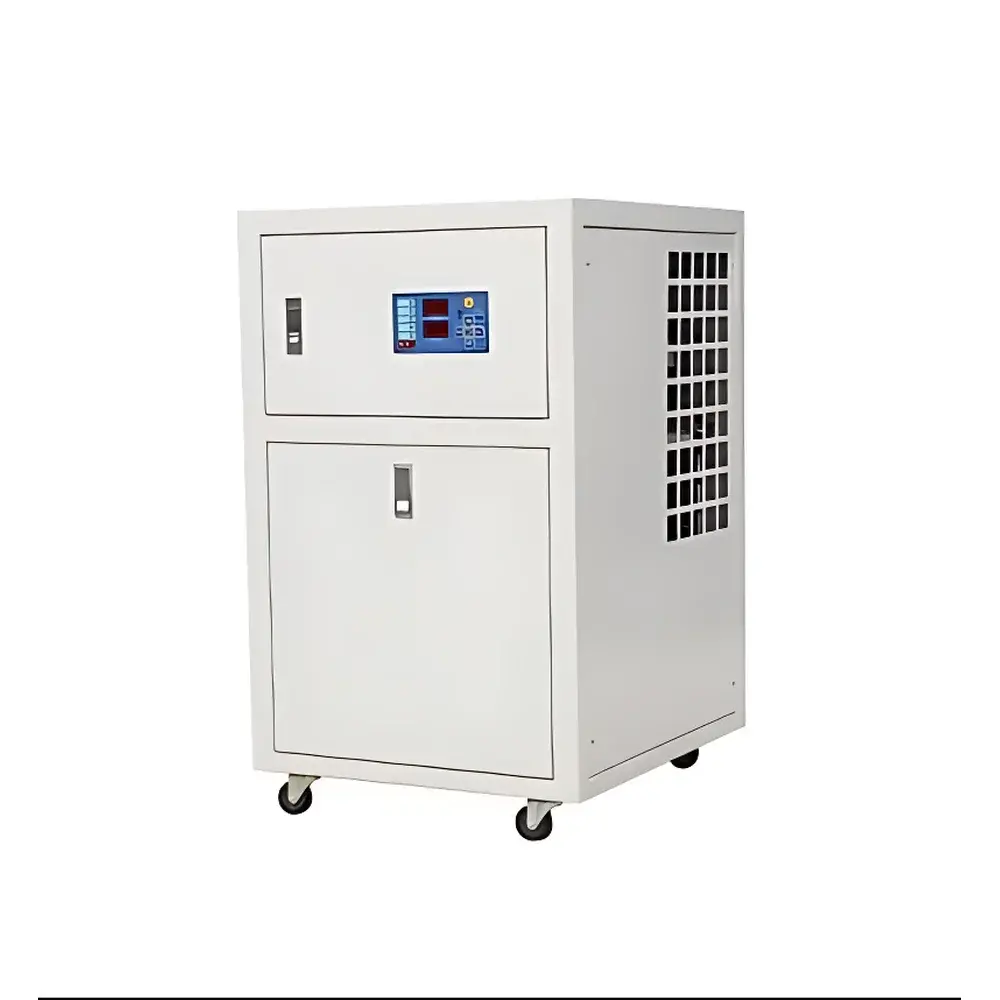
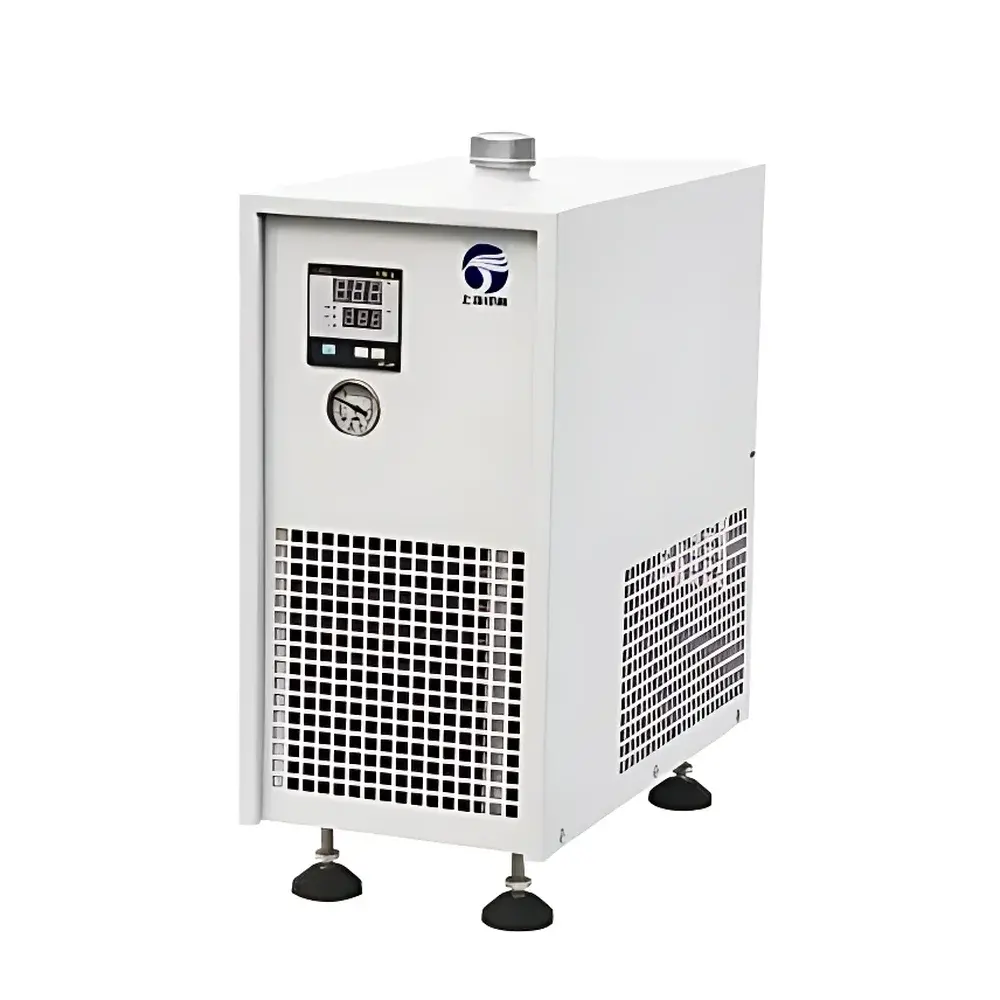
Tianfeng LS-4HP Precision Circulating Chiller
| Brand | Tianfeng |
|---|---|
| Origin | Shanghai, China |
| Manufacturer Type | OEM Manufacturer |
| Equipment Type | Integrated Circulating Chiller |
| Cooling Method | Water-Cooled |
| Temperature Control Range | 0–10 °C |
| Cooling Capacity | 12.5 kW |
| Temperature Stability | ±0.1 °C |
| Circulation Pump Pressure | 2.0 bar |
| Circulation Flow Rate | 2 L/min |
| Reservoir Volume | 80 L |
| Operating Mode | Continuous Duty |
| Power Supply | 220 V, 50 Hz |
| Compressor Type | Scroll Compressor |
| Safety Protections | High/Low Pressure Switch, Overcurrent Protection, Compressor Overheat Protection, Overtemperature Alarm |
| Construction | Stainless Steel Reservoir & Pump |
| Controller | Digital PID Temperature Controller (Optional RKC Japan) |
| Electrical Components | Siemens / Schneider / Omron |
| Refrigeration Components | Imported Expansion Valve & Solenoid Valve (Italy/Germany) |
Overview
The Tianfeng LS-4HP Precision Circulating Chiller is an engineered thermal management solution designed for high-stability, continuous-duty cooling of sensitive laboratory and industrial instrumentation. It operates on a closed-loop vapor-compression refrigeration cycle, utilizing a scroll compressor, thermostatic expansion valve, and optimized heat exchanger architecture to deliver precise temperature control within a narrow band of ±0.1 °C across its operational range of 0–10 °C. Unlike general-purpose chillers, the LS-4HP integrates real-time PID feedback control with digital setpoint resolution of 0.1 °C, enabling consistent thermal regulation critical for analytical instruments where thermal drift directly impacts measurement repeatability—such as graphite furnace atomic absorption spectrometers (GFAAS), inductively coupled plasma optical emission spectrometers (ICP-OES), X-ray diffractometers (XRD), scanning electron microscopes (SEM), and transmission electron microscopes (TEM). Its water-cooled condenser design ensures stable performance under variable ambient conditions, while the stainless steel reservoir and pump minimize corrosion and particulate generation—essential for maintaining fluid purity in recirculating coolant loops.
Key Features
- High-precision temperature control (±0.1 °C stability) over 0–10 °C range, validated per ASTM E2234 for thermal uniformity in circulating systems
- 12.5 kW nominal cooling capacity at standard conditions (7 °C outlet, 12 °C inlet, 30/40 °C ambient air)
- Integrated scroll compressor with low-noise operation (<65 dB(A) at 1 m) and extended service life under continuous load
- Stainless steel 80 L reservoir and circulation pump, compliant with ISO 8502-3 for surface cleanliness in controlled environments
- Digital PID controller with programmable ramp-soak profiles, data logging capability, and RS485 Modbus RTU interface for integration into lab automation networks
- Comprehensive safety architecture: high/low refrigerant pressure monitoring, motor overcurrent protection, compressor discharge temperature cutoff, and reservoir overtemperature alarm
- Adjustable flow rate (0–2 L/min) and pressure (0–2.0 bar) via calibrated bypass valve; compatible with instrument inlet restrictions up to 3 bar backpressure
- Compact integrated footprint (1200 × 715 × 1105 mm) with castor-mounted base for repositioning within ISO Class 7 cleanrooms or analytical labs
Sample Compatibility & Compliance
The LS-4HP is validated for use with thermally sensitive analytical platforms requiring stable coolant delivery, including but not limited to laser-based systems (e.g., excimer lasers, fiber lasers), vacuum deposition tools, and high-resolution spectroscopic instrumentation. Its stainless steel wetted components meet USP material compatibility requirements for non-reactive coolant pathways. The unit complies with IEC 61000-6-3 (EMC emissions) and IEC 61000-6-2 (immunity), and its electrical safety conforms to IEC 61010-1 for laboratory equipment. Optional validation documentation (IQ/OQ protocols) supports GLP and GMP environments, including audit-ready calibration records traceable to NIST standards. The chiller’s firmware architecture supports FDA 21 CFR Part 11-compliant electronic signatures when paired with validated LIMS or SCADA systems.
Software & Data Management
The embedded controller provides local setpoint adjustment, real-time temperature/flow display, and event-driven alarm logging (timestamped, non-volatile memory). Via optional RS485 Modbus RTU, the chiller interfaces with LabVIEW, MATLAB, or enterprise-level building management systems (BMS) for remote monitoring and centralized thermal log aggregation. Data export (CSV format) enables post-acquisition correlation between instrument thermal load and analytical output variance. Firmware updates are performed via secure USB interface with version rollback capability—critical for regulated environments requiring configuration control. Audit trails record all parameter changes, user logins, and alarm acknowledgments, satisfying ALCOA+ data integrity principles.
Applications
- Thermal stabilization of graphite furnace atomizers in AAS systems to suppress matrix interferences and improve detection limits
- Cooling ICP torches and interface cones to maintain plasma stability and reduce oxide formation rates (CeO+/Ce+ ratio monitoring)
- Heat extraction from XRD goniometer bearings and detector Peltier stages to prevent angular drift during long-duration scans
- Maintaining SEM/TEM column vacuum integrity by stabilizing cryo-pump temperatures and reducing outgassing variability
- Controlling coolant temperature in laser ablation ICP-MS sample introduction systems to ensure reproducible aerosol transport efficiency
- Supporting GLP-compliant stability chambers and environmental test enclosures requiring secondary chilled-water supply
FAQ
What is the maximum allowable return water temperature for continuous operation?
For sustained compressor longevity and refrigerant cycle efficiency, the recommended maximum return temperature is 40 °C. Exceeding this threshold increases discharge pressure and accelerates oil degradation.
Is the chiller compatible with deionized or inhibited glycol solutions?
Yes—the stainless steel fluid path and EPDM seals are compatible with aqueous solutions containing ≤30% propylene glycol or corrosion inhibitors meeting ASTM D1384 specifications.
Does the unit support external temperature feedback control?
Yes—via optional 0–10 V or 4–20 mA analog input, the chiller can accept external sensor signals (e.g., from instrument cold finger or detector housing) for cascade temperature regulation.
What maintenance intervals are recommended for GLP-regulated use?
Compressor oil and refrigerant filter driers should be replaced every 12 months or 8,000 operating hours; system leak checks and calibration verification required quarterly per internal SOPs.
Can the chiller be integrated into a central building cooling network?
Yes—water-cooled condenser configuration allows connection to facility chilled water loops (5–15 °C supply); flow and pressure must remain within specified 2.0 bar / 2 L/min operating envelope.



