
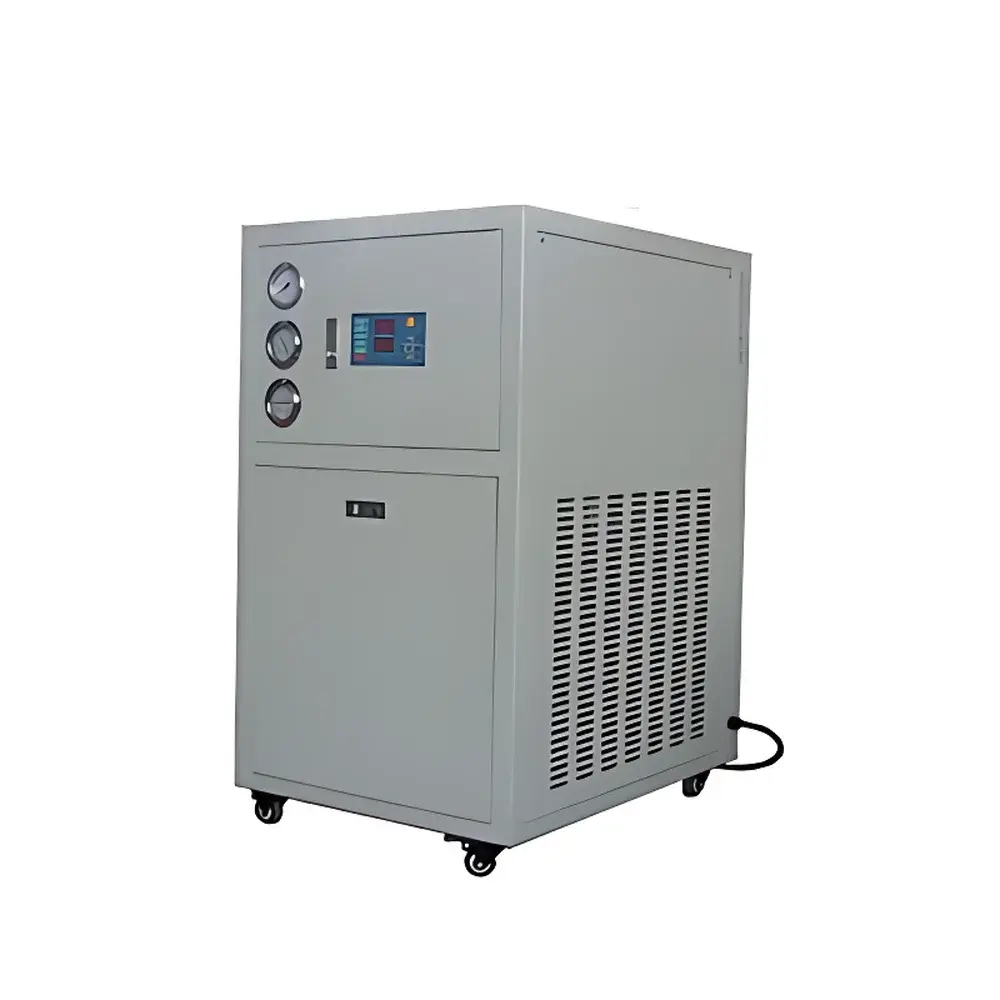
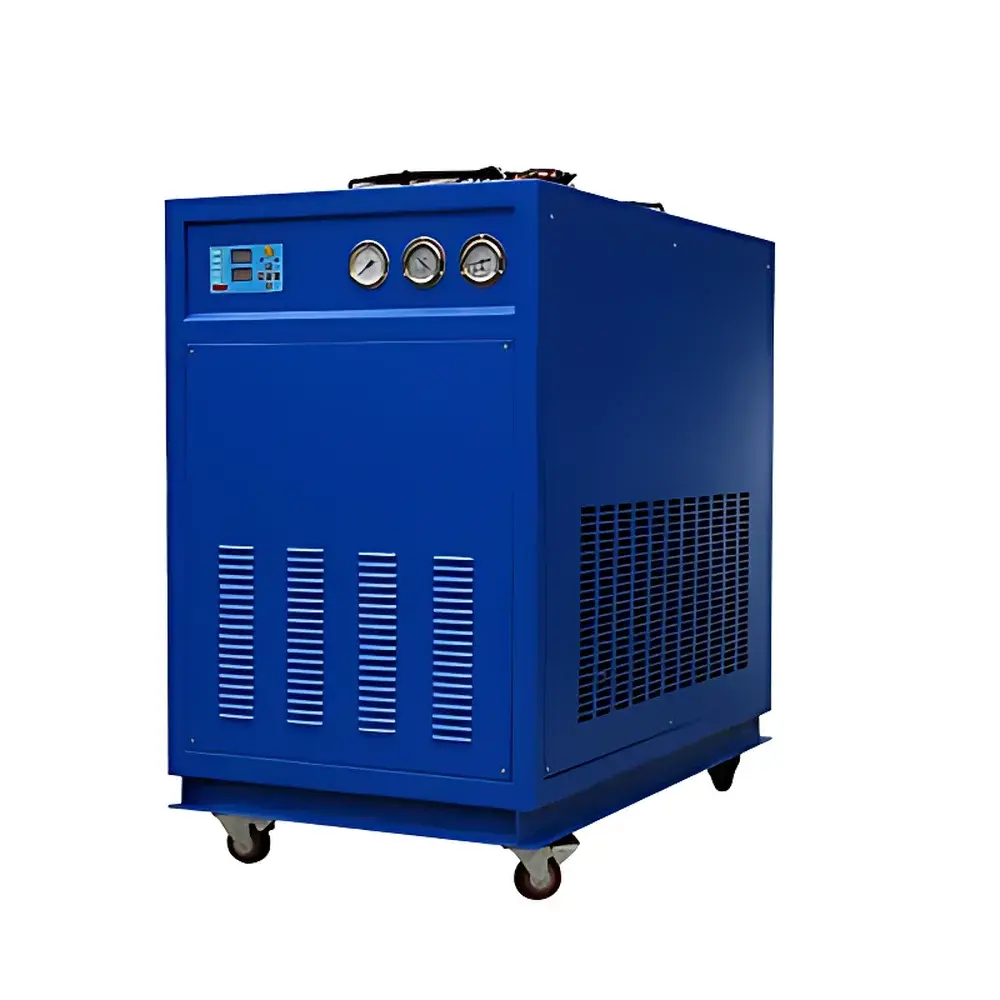
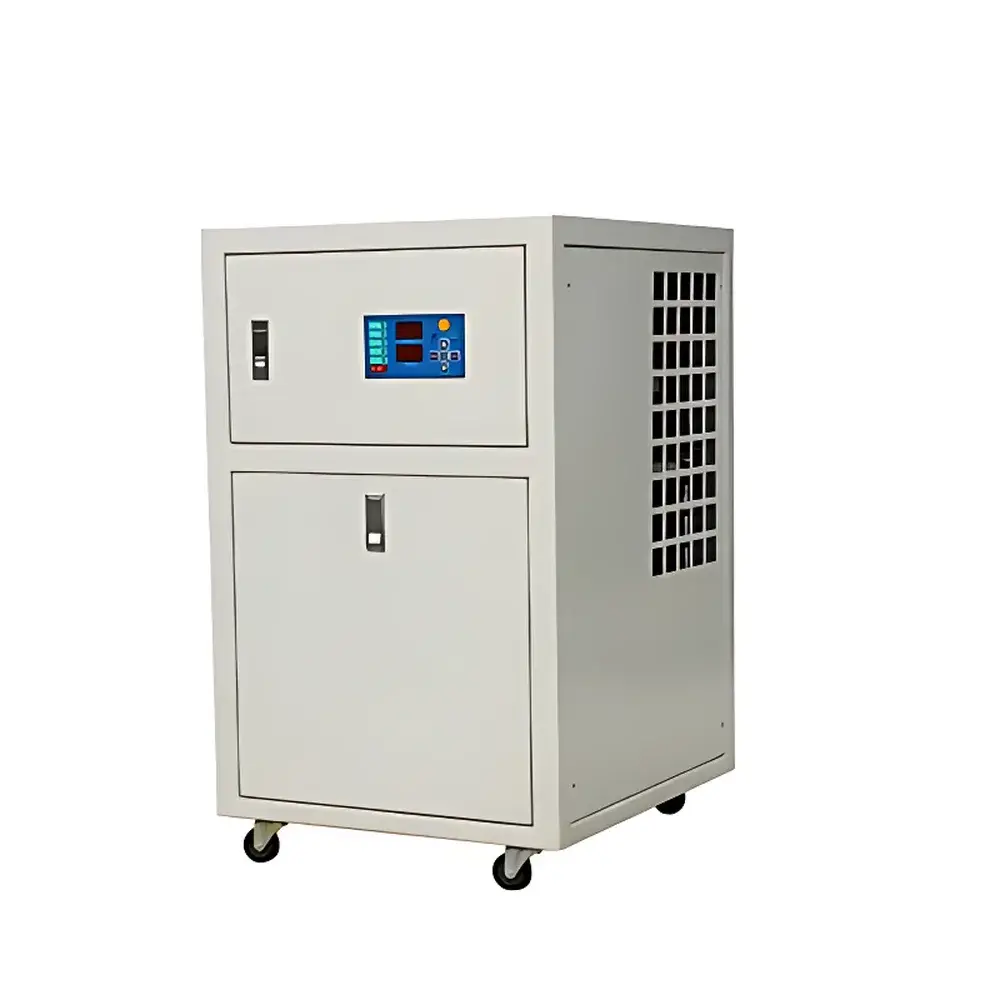
Tianfeng LS-4KW Integrated Circulating Chiller
| Brand | Tianfeng |
|---|---|
| Origin | Shanghai, China |
| Manufacturer Type | Direct Manufacturer |
| Equipment Type | Integrated Circulating Chiller |
| Cooling Method | Water-Cooled |
| Temperature Control Range | 0–40 °C |
| Refrigeration Capacity | 4 kW (3,440 kcal/h) |
| Temperature Stability | ±0.1 °C |
| Circulating Pump Pressure | 0–2.0 bar |
| Circulating Flow Rate | 0–38 L/min |
| Reservoir Volume | 45 L |
| Power Input | 1.8 kW |
| Supply Voltage | 220 V / 50 Hz |
| Dimensions (L×W×H) | 800 × 600 × 1065 mm |
| Safety Protections | Compressor Overheat Protection, Overcurrent Protection, High/Low Pressure Switches, Overtemperature Alarm |
| Construction | Stainless Steel Reservoir & Pump |
| Compressor | Scroll-Type, High-Efficiency |
| Expansion Valve & Solenoid Valve | Imported (Italy/Germany) |
| Temperature Controller | Domestic High-Accuracy PID Controller (Optional RKC Japan) |
| Electrical Components | Siemens / Schneider / Omron |
| Operating Mode | Continuous Duty |
| Noise Level | Low |
| Compliance | ISO 9001:2000 Certified |
Overview
The Tianfeng LS-4KW Integrated Circulating Chiller is an engineered solution for precise, stable thermal management in demanding laboratory and industrial environments. Based on vapor-compression refrigeration cycle principles, it utilizes a high-efficiency scroll compressor, imported thermostatic expansion valves, and a stainless-steel circulation loop to deliver consistent cooling performance across a wide operational range. Designed for continuous-duty applications, the unit maintains fluid temperature within ±0.1 °C stability over its 0–40 °C setpoint range—critical for instruments sensitive to thermal drift, including atomic absorption spectrometers (GFAAS), ICP-OES and ICP-MS systems, X-ray fluorescence (XRF) and X-ray diffraction (XRD) analyzers, scanning and transmission electron microscopes (SEM/TEM), and high-power laser sources. Its integrated architecture eliminates external piping complexity while supporting direct connection to equipment requiring regulated coolant supply at up to 38 L/min flow and 2.0 bar pressure.
Key Features
- High-precision PID temperature control with digital display and real-time monitoring of outlet water temperature
- Stainless steel reservoir (45 L capacity) and pump housing for corrosion resistance and long-term fluid integrity
- Dual-mode operation: fixed-temperature mode for steady-state applications; intelligent adaptive mode that dynamically adjusts cooling output based on real-time load fluctuations
- Comprehensive safety architecture including compressor overheat protection, high/low refrigerant pressure cutoffs, overcurrent interruption, and overtemperature alarm with fault signal output
- Low-noise scroll compressor paired with vibration-dampened mounting and optimized airflow design
- Modular electrical cabinet featuring certified components from Siemens, Schneider, and Omron for reliability under extended duty cycles
- Compact footprint (800 × 600 × 1065 mm) enabling flexible placement in confined lab spaces or near analytical instrumentation
- Configurable inlet/outlet connections compatible with standard 1/2″–3/4″ NPT or BSP fittings
Sample Compatibility & Compliance
This chiller is validated for use with a broad spectrum of laboratory instrumentation requiring active thermal stabilization. It meets the thermal load requirements of graphite furnace AAS systems (e.g., PerkinElmer PinAAcle, Thermo iCE), plasma-based spectrometers (Agilent 5110 ICP-OES, Thermo iCAP RQ ICP-MS), benchtop XRF units (Bruker S2 PUMA), and high-resolution electron microscopy platforms where sample chamber or detector cooling directly impacts signal-to-noise ratio and spatial resolution. The unit complies with ISO 9001:2000 quality management standards for design, manufacturing, and testing processes. While not inherently FDA 21 CFR Part 11 compliant as a standalone device, its analog/digital alarm outputs and optional RS485 communication interface support integration into GLP/GMP-aligned infrastructure when paired with validated data acquisition systems. All refrigerant handling adheres to international environmental protocols (R410A, zero ozone depletion potential).
Software & Data Management
The LS-4KW operates via embedded firmware without proprietary software dependency. Temperature setpoints, operational status, and alarm conditions are accessible through the front-panel LCD interface. For system-level integration, an optional RS485 serial interface (Modbus RTU protocol) enables remote monitoring and control via laboratory information management systems (LIMS) or building automation platforms. Logged events—including compressor run time, fault codes, and temperature deviation history—are retained in non-volatile memory for audit trail generation. When deployed in regulated environments, users may configure external PLCs or SCADA systems to record timestamped temperature readings at user-defined intervals, satisfying basic ALCOA+ data integrity requirements for routine instrument qualification (IQ/OQ/PQ).
Applications
- Laboratory Instrument Cooling: Stabilizes detectors and optics in XRD, SEM, TEM, and laser-based systems; prevents thermal lensing in high-power UV/IR lasers
- Elemental Analysis: Maintains graphite furnace thermal profiles in GFAAS; stabilizes plasma torch and interface temperatures in ICP instruments
- Materials Characterization: Controls sample stage temperature during in-situ XRF mapping or synchrotron beamline experiments
- Pharmaceutical QC: Supports controlled cooling of dissolution testers, HPLC column ovens, and lyophilizer condenser plates
- Electronics Testing: Regulates junction temperature during semiconductor probe station operation or power device burn-in
- Industrial Process Support: Provides closed-loop cooling for CNC spindles, vacuum deposition chambers, and precision metrology equipment
FAQ
What is the recommended maximum return water temperature for continuous operation?
For optimal compressor longevity and system efficiency, return water temperature should not exceed 40 °C. Sustained inlet temperatures above this threshold increase discharge pressure and reduce volumetric efficiency, accelerating wear on refrigeration circuit components.
Can this chiller be integrated into a facility’s central monitoring system?
Yes—via optional RS485 Modbus RTU interface, enabling bidirectional communication with BMS or LIMS for real-time parameter readout, alarm forwarding, and scheduled start/stop commands.
Is the unit suitable for use with deionized or corrosive coolants?
The stainless steel reservoir and wetted components are compatible with DI water and common glycol-water mixtures (up to 30% ethylene or propylene glycol). For aggressive chemistries (e.g., low-pH buffers), consult factory for optional passivation or coating upgrades.
Does the chiller meet electromagnetic compatibility (EMC) requirements for laboratory environments?
Yes—the unit conforms to EN 61326-1:2013 for electromagnetic immunity and emissions, ensuring stable operation near sensitive RF or low-noise measurement equipment.
What maintenance intervals are recommended for uninterrupted service?
Quarterly visual inspection of condenser coil cleanliness and coolant level; annual verification of refrigerant charge and calibration of temperature sensor against NIST-traceable reference; biennial replacement of desiccant filter drier if operating in high-humidity environments.
Related Products



