
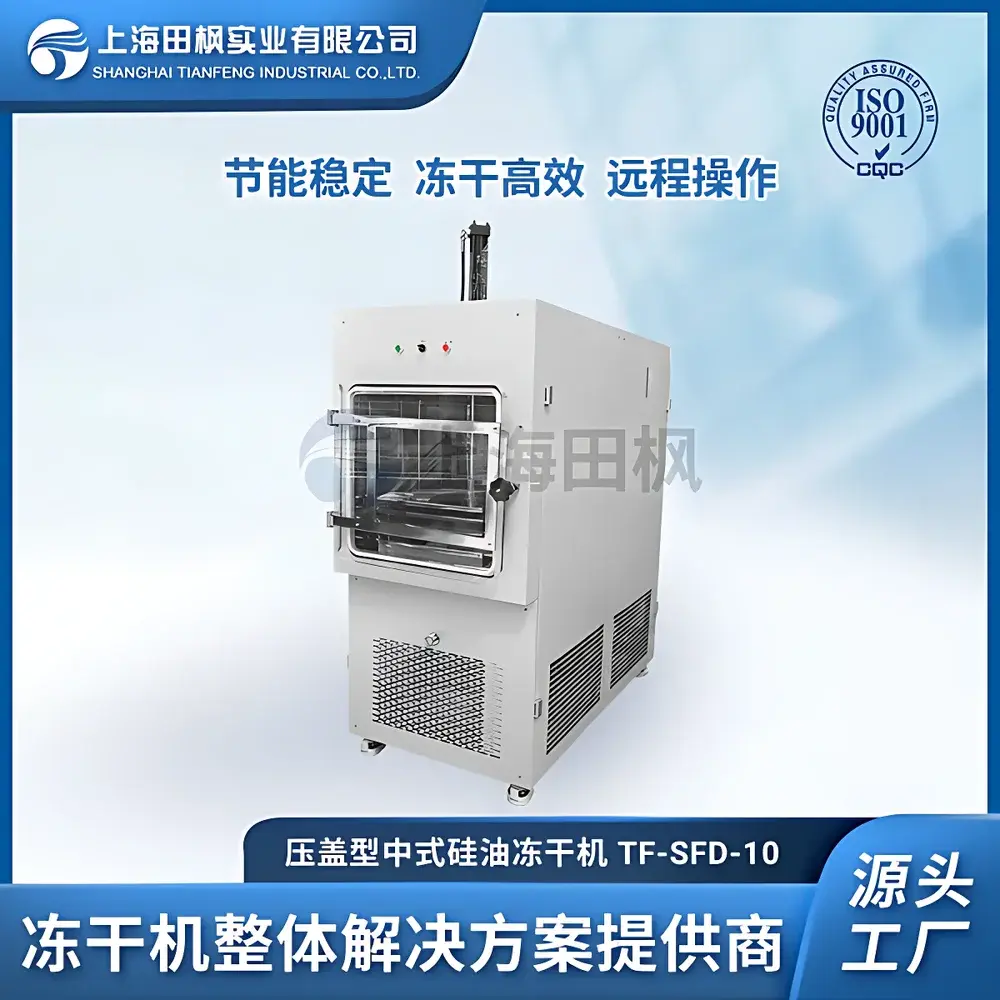
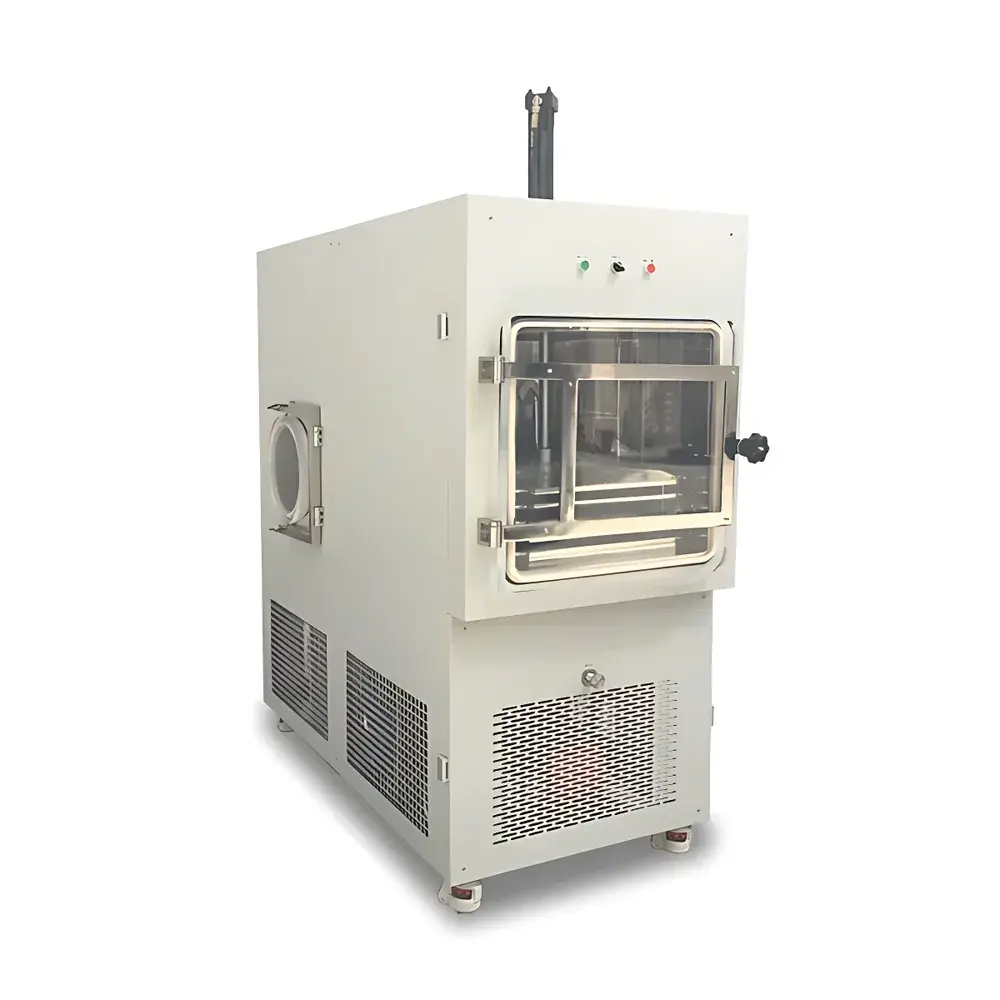
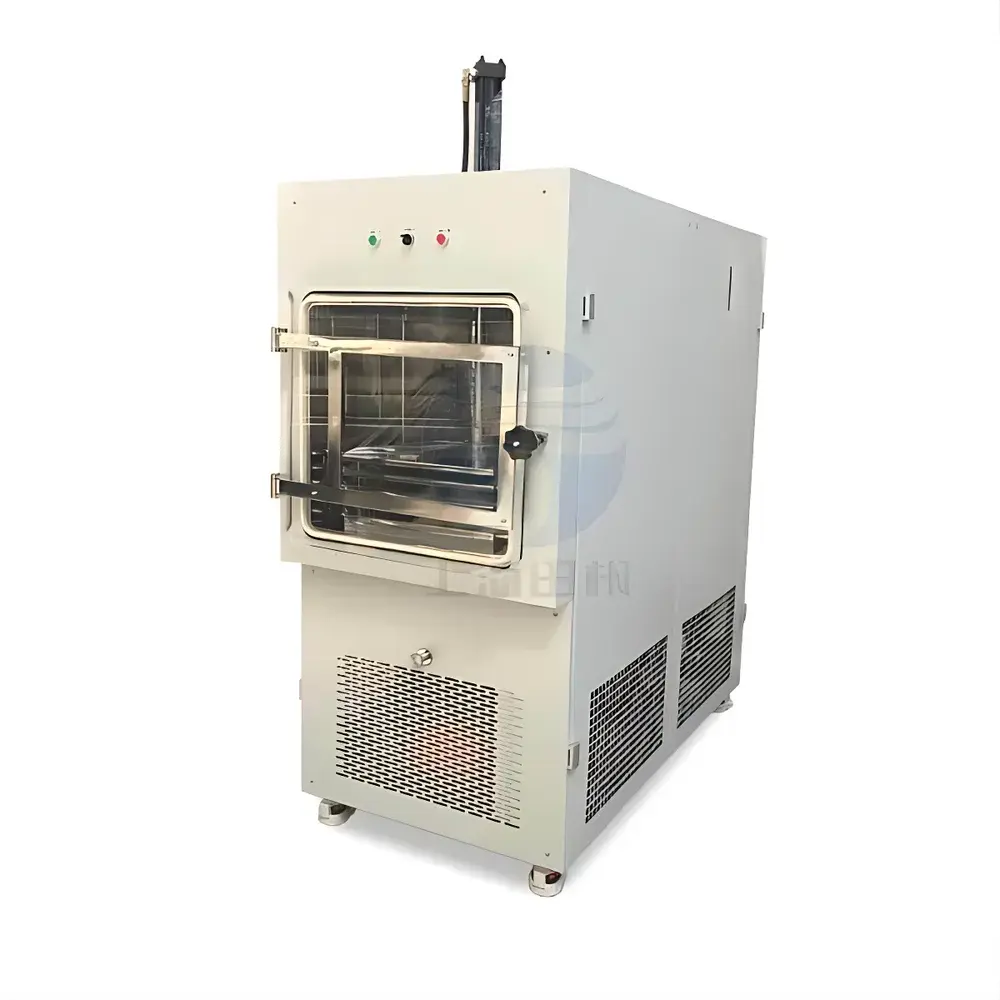
Tianfeng SFD-10 Stoppering Freeze Dryer for Cosmetic & Pharmaceutical Applications
| Brand | Tianfeng |
|---|---|
| Origin | Shanghai, China |
| Manufacturer Type | Direct Manufacturer |
| Instrument Type | In-situ Stoppering Freeze Dryer |
| Application Scope | Pilot-scale Production |
| Shelf Area | 1.05 m² |
| Ultimate Vacuum | ≤5 Pa |
| Condenser Temperature | ≤−70 °C |
| Ice Capacity (24 h) | 16 kg/24 h |
| Shelf Dimensions | 450 mm × 600 mm |
| Shelf Quantity | 5 (4 working + 1 bottom) |
| Shelf Spacing | 70 mm |
| Shelf Temp Range | −50 °C to +80 °C |
| Power Rating | 8 kW |
| Net Weight | 850 kg |
| Chamber Viewing Window | High-transparency acrylic door |
| Control System | PLC with 7″ color touchscreen |
| Programmability | 5 stored protocols, up to 24 segments per protocol |
| Data Logging | Real-time vacuum & shelf temperature curves, full operational audit trail |
| Optional | In-line eutectic point detection, inert gas purge valve (N₂/Ar) |
| Compliance | Designed per ISO 9001:2000 |
Overview
The Tianfeng SFD-10 Stoppering Freeze Dryer is an in-situ lyophilization system engineered for pilot-scale production of sterile, biologically active formulations—particularly cosmetic freeze-dried powders (e.g., growth factor serums, peptide complexes, enzymatic actives) and pharmaceutical injectables (e.g., monoclonal antibodies, live-attenuated vaccines, small-molecule APIs). It operates on the fundamental principle of sublimation: a thermodynamically controlled phase transition where ice is removed directly from the frozen solid state to vapor under high vacuum (≤5 Pa), bypassing the liquid phase. This preserves labile macromolecular structures, prevents oxidative degradation, and eliminates thermal denaturation—critical for maintaining conformational integrity of proteins, peptides, polysaccharides, and probiotic strains. Unlike benchtop units, the SFD-10 integrates primary drying, secondary drying, and stoppering within a single stainless-steel chamber, eliminating manual vial transfer and minimizing contamination risk—a requirement aligned with ISO 13408-1 (aseptic processing) and FDA guidance for lyophilized drug products.
Key Features
- In-situ freezing and drying: Eliminates pre-freezing logistics and thermal shock during vial transfer.
- Silicone oil-heated shelves with ±0.5 °C temperature uniformity (≤1 °C inter-shelf delta), ensuring reproducible drying kinetics across all 5 shelves.
- Programmable lyophilization: 5 user-defined protocols, each supporting up to 24 time-temperature-vacuum segments; real-time parameter adjustment during operation.
- Comprehensive data acquisition: Continuous logging of shelf temperature, chamber pressure, condenser temperature, and elapsed time; exportable CSV files for regulatory review.
- Robust condenser: Dual-stage cascade refrigeration achieves ≤−70 °C, enabling efficient capture of 16 kg ice per 24-hour cycle—optimized for high-solids formulations common in cosmeceuticals.
- Stoppering mechanism: Hydraulic or pneumatic (optional) lid press ensures consistent rubber stopper seating under vacuum, meeting USP container closure integrity requirements.
- Process transparency: Full-view acrylic chamber door allows visual monitoring of cake structure, collapse onset, and drying front progression without compromising sterility.
- Security & traceability: Password-protected operator interface; immutable audit trail records all user actions, parameter changes, and alarm events—supporting 21 CFR Part 11 compliance when paired with validated software.
Sample Compatibility & Compliance
The SFD-10 accommodates standard pharmaceutical and cosmetic vial formats (Φ16 mm: 3900 units/batch; Φ20 mm: 2016 units/batch) with a total loading capacity of 13 L of aqueous solution. Its shelf geometry (450 × 600 mm, 70 mm spacing) supports both shallow trays and stacked vial racks. The system is routinely deployed for: sterile cosmetic actives (EGF, bFGF, hyaluronic acid sodium salt), biopolymer-based delivery systems (chitosan nanoparticles, liposomal encapsulates), herbal extracts (Panax ginseng, Cordyceps sinensis), and diagnostic reagents (ELISA kits, PCR master mixes). It meets foundational design standards referenced in ISO 22042 (freeze-drying equipment), EN 61000-6-2 (EMC immunity), and IEC 61010-1 (safety). While not certified for GMP manufacturing out-of-the-box, its architecture—including stainless-steel 316L contact surfaces, HEPA-filtered inert gas purge capability, and full process documentation—enables qualification per ASTM F2338 (container closure integrity) and EU Annex 1 (sterile processing).
Software & Data Management
The embedded PLC control system features a 7-inch capacitive touchscreen with intuitive icon-driven navigation. All process parameters—including shelf setpoints, vacuum ramp rates, hold durations, and pressure feedback—are configurable via hierarchical menus. The system automatically generates time-stamped lyophilization curves (shelf temp vs. time, pressure vs. time) viewable in real time or post-cycle. Raw data logs are stored internally (SD card backup optional) and exportable via USB to external PCs for statistical analysis (e.g., PCA of drying endpoints, moisture mapping). Audit trails comply with ALCOA+ principles: attributable, legible, contemporaneous, original, accurate, complete, consistent, enduring, and available. When integrated with validated third-party LIMS or MES platforms, the SFD-10 satisfies FDA 21 CFR Part 11 electronic record requirements for signature authentication and data integrity.
Applications
This system serves dual-purpose laboratories requiring scalability between R&D formulation development and clinical batch production. In cosmetics, it stabilizes thermolabile biomolecules (collagen peptides, tranexamic acid derivatives) without organic solvents—enabling “clean label” claims compliant with COSMOS and ECOCERT standards. In pharma, it supports Phase I–II clinical trial material production for parenteral biologics, including lyophilized mRNA-LNPs and viral vector intermediates. Academic users apply it to preserve sensitive nanomaterials (graphene oxide dispersions, MOF-based delivery carriers) and field-collected biological specimens (microbial consortia, tissue explants). Its versatility extends to food science (probiotic cultures, enzyme concentrates) and materials research (aerogel precursors, battery electrode slurries), where structural porosity and surface area retention post-drying are critical performance metrics.
FAQ
What is the maximum batch size for cosmetic serums using standard 2 mL vials?
With Φ16 mm vials filled to 1.5 mL, the SFD-10 accommodates up to 3,900 units per cycle—equivalent to 5.85 L of formulated product.
Does the system support automated eutectic temperature determination?
Yes—an optional in-line resistance temperature detector (RTD) probe kit enables real-time detection of the product’s collapse temperature (Tc) and eutectic point (Teutectic), critical for defining safe primary drying shelf temperatures.
Can the SFD-10 be qualified for GMP manufacturing?
While supplied as a Class I medical device (CE-marked per MDR 2017/745), formal GMP qualification requires IQ/OQ/PQ protocols executed by the end user or authorized service partner, referencing ASTM E2500 and ISPE Baseline Guide Vol. 5.
What maintenance intervals are recommended for the refrigeration system?
Compressor oil and filter driers should be replaced every 2,000 operating hours; condenser coils require quarterly cleaning with non-corrosive solvent; vacuum pump oil must be changed after every 500 hours or if water saturation exceeds 1,000 ppm.
Is remote monitoring supported?
Standard Ethernet port enables Modbus TCP communication; optional OPC UA gateway allows integration into SCADA or cloud-based IIoT platforms for predictive maintenance alerts and cross-facility fleet management.



