
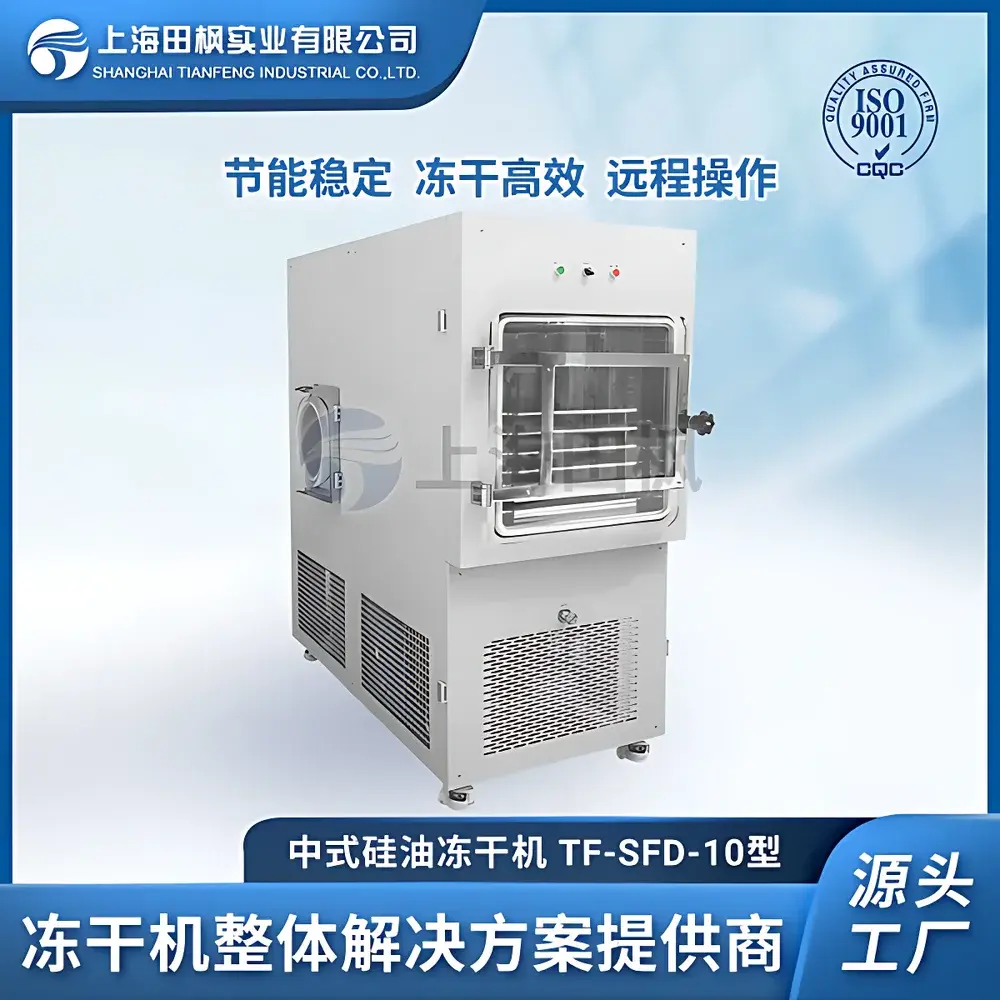
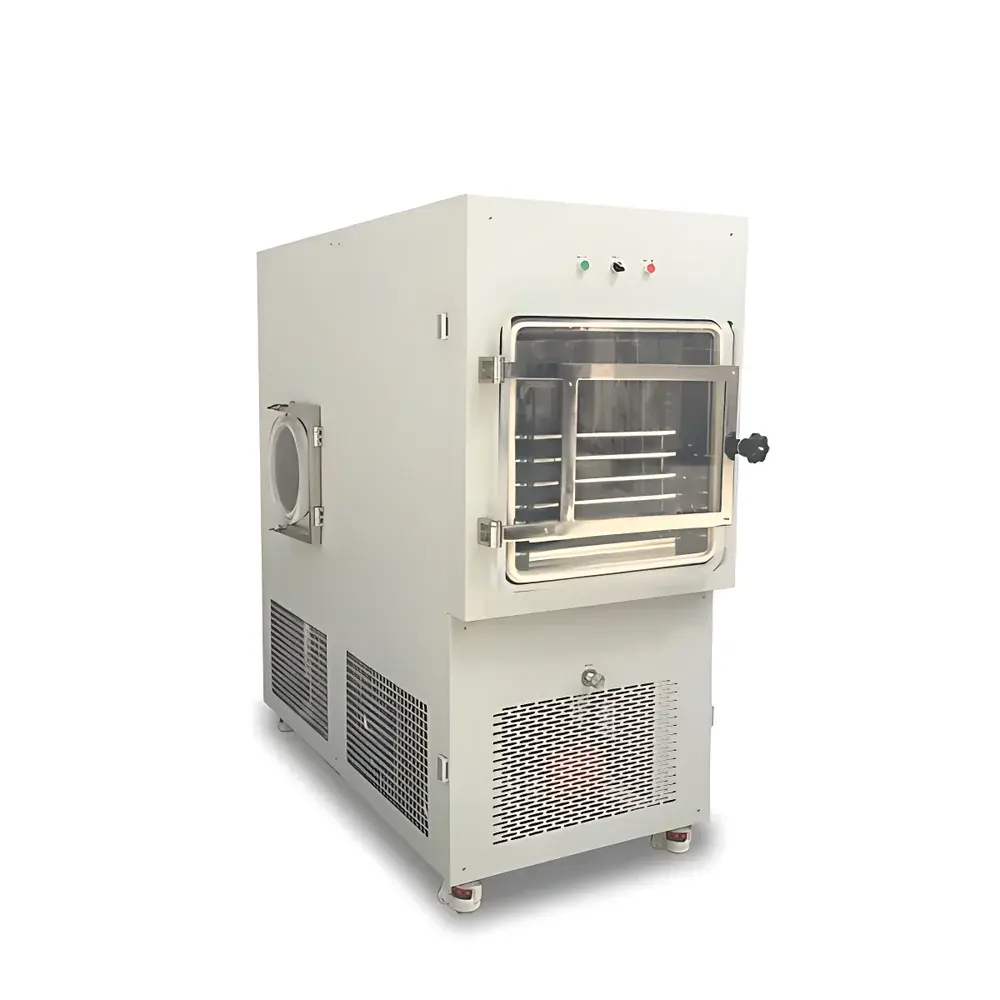
Tianfeng SFD-10m² Pilot-Scale Freeze Dryer – Standard Shelf-Type Lyophilizer
| Brand | Tianfeng |
|---|---|
| Origin | Shanghai, China |
| Manufacturer Type | Direct Manufacturer |
| Region Classification | Domestic (China) |
| Model | SFD-10m² Standard Type |
| Instrument Type | Standard Shelf-Type Freeze Dryer |
| Application Scope | Pilot-Scale |
| Freeze-Drying Area | 1.04 m² |
| Ultimate Vacuum | ≤5 Pa |
| Condensate Capacity (24 h) | 13 L |
| Condenser Temperature | ≤−70 °C |
| Main Unit Dimensions (W × D) | 480 × 360 mm |
| Shelf Dimensions (W × L) | 360 × 480 mm |
| Shelf Spacing | 70 mm |
| Number of Shelves | 6 + 1 (including bottom shelf) |
| Shelf Temperature Range | −50 to +80 °C |
| Shelf Temperature Uniformity | ≤±1 °C |
| Control System | PID + PLC (optional), 7-inch HMI touchscreen |
| Data Logging | Real-time vacuum & shelf temperature curves, full audit trail, up to 5 programmable cycles (24 segments each) |
| Optional Features | In-situ eutectic point detection, inert gas backfill valve (N₂/Ar), transparent acrylic chamber door |
| Power Requirement | 8 kW |
| Net Weight | 750 kg |
| Compliance | ISO 9001:2000 certified design and manufacturing process |
| Software Capability | RS485/RS232 & Ethernet interface for SCADA integration, user-access control (password protection), FDA 21 CFR Part 11–compatible data export (CSV/PDF) |
Overview
The Tianfeng SFD-10m² Pilot-Scale Freeze Dryer is an engineered solution for translational development between laboratory-scale lyophilization research and small-batch GMP-compliant production. Designed around the fundamental principles of sublimation-based primary drying under high vacuum and cryogenic condensation, this shelf-type lyophilizer supports controlled freezing, primary drying, and secondary drying phases with precise thermal management. Its 1.04 m² effective shelf area accommodates standardized pharmaceutical vials (e.g., up to 3,828 × Φ16 mm or 2,016 × Φ20 mm), bulk trays, or pet food slabs—making it suitable for pilot validation of freeze-drying cycles in biopharmaceutical formulation development, nutraceutical stabilization, functional pet treat manufacturing, and botanical extract preservation. The system employs silicone oil as a heat transfer medium for uniform shelf temperature distribution (≤±1 °C across all shelves), minimizing batch heterogeneity and supporting reproducible process parameter mapping per ICH Q5C and USP .
Key Features
- Integrated in-chamber pre-freezing: Eliminates external ultra-low temperature freezers and reduces contamination risk during sample transfer.
- PID-controlled silicone oil heating/cooling system ensures stable shelf temperature regulation from −50 °C to +80 °C with ≤±1 °C inter-shelf uniformity—critical for consistent ice nucleation and drying front propagation.
- 7-inch high-resolution HMI touchscreen with real-time graphical display of shelf temperature, chamber pressure, and condenser temperature; supports dual-unit (°C / °F) and multi-language UI (English default).
- Programmable cycle storage: Up to five complete drying protocols, each configurable with up to 24 time-temperature-pressure segments; parameters modifiable during active runs without interruption.
- Comprehensive data logging: Timestamped vacuum pressure (capacitance manometer), shelf temperature (PT100 sensors), and condenser temperature recorded at user-defined intervals; all logs exportable as CSV or PDF for regulatory review.
- Optional eutectic point detection module enables real-time monitoring of product collapse temperature during ramped freezing—supporting rational cycle design per ASTM F2644-22.
- Inert gas backfill valve (N₂ or Ar) allows controlled re-pressurization post-drying to prevent oxidation and support aseptic handling in non-classified environments.
- Front-access chamber with high-transparency acrylic door permits continuous visual monitoring of cake morphology, sublimation front progression, and potential melt-back events without vacuum break.
Sample Compatibility & Compliance
The SFD-10m² accommodates diverse sample formats including glass vials (1–30 mL), stainless steel trays (up to 480 × 360 mm), aluminum pans, and custom pet treat molds. Its −70 °C condenser and ≤5 Pa ultimate vacuum enable efficient water vapor removal from high-moisture matrices such as meat purees, fish hydrolysates, and fruit pulps—common in functional pet nutrition applications. All structural materials comply with FDA 21 CFR 177.2600 (food-contact plastics) and ISO 13485–aligned surface finish standards. Manufacturing adheres to ISO 9001:2000 quality management systems, with full traceability of critical components (compressors, vacuum pumps, controllers). Documentation packages include Factory Acceptance Test (FAT) reports, IQ/OQ templates, and material certifications—facilitating GLP, GMP, and ASME BPE-aligned facility qualification.
Software & Data Management
The embedded PLC-based control architecture supports deterministic real-time operation with millisecond-level I/O response. Communication interfaces include RS485 (Modbus RTU), RS232 (for legacy printer output), and optional Ethernet (TCP/IP) for integration into centralized lab information management systems (LIMS) or MES platforms. Audit trails capture all operator actions—including login/logout, parameter changes, manual overrides, and alarm acknowledgments—with immutable timestamps and user IDs. Exported datasets conform to ALCOA+ principles (Attributable, Legible, Contemporaneous, Original, Accurate, Complete, Consistent, Enduring, Available) and are compatible with statistical process control (SPC) tools such as JMP or Minitab. Electronic signatures and role-based access control (administrator/operator/auditor) meet baseline requirements for FDA 21 CFR Part 11 compliance when deployed with validated IT infrastructure.
Applications
- Biopharmaceutical: Cycle development and stability testing of monoclonal antibodies, vaccines, and recombinant proteins using vial-based formulations.
- Nutraceuticals: Stabilization of probiotics, enzymes, and omega-3-rich marine oils without thermal degradation.
- Pet Nutrition: Production of shelf-stable, high-protein freeze-dried treats (e.g., chicken liver, salmon fillet, bone broth cubes) retaining enzymatic activity and volatile aroma compounds.
- Academic Research: Investigation of ice nucleation kinetics, mass transfer limitations, and collapse behavior in amorphous and crystalline systems.
- Botanical Processing: Preservation of thermolabile phytochemicals (e.g., curcuminoids, anthocyanins, terpenes) from herbs and superfoods.
FAQ
What is the maximum batch capacity for vial-based lyophilization?
Standard configuration supports up to 3,828 × Φ16 mm vials or 2,016 × Φ20 mm vials per cycle, assuming 5 mm fill depth and standard tray layout.
Can the system be validated for GMP use?
Yes—Tianfeng provides IQ/OQ documentation templates, FAT reports, and material traceability records; final validation remains site-specific and must be executed by the end user’s qualified personnel.
Is remote monitoring supported out of the box?
Ethernet connectivity is optional; when installed, it enables secure read-only access to live process data and historical logs via web browser or dedicated SCADA client.
What maintenance intervals are recommended for the vacuum system?
Oil-lubricated rotary vane pump oil should be replaced every 500 operational hours; condenser coil cleaning is advised quarterly under continuous use; full preventive maintenance (PM) scheduled annually per OEM checklist.
Does the unit comply with electrical safety standards for export markets?
The base model meets CE marking requirements (EN 61000-6-2/6-4, EN 61010-1); UL/cUL certification is available upon request for North American deployment.



