
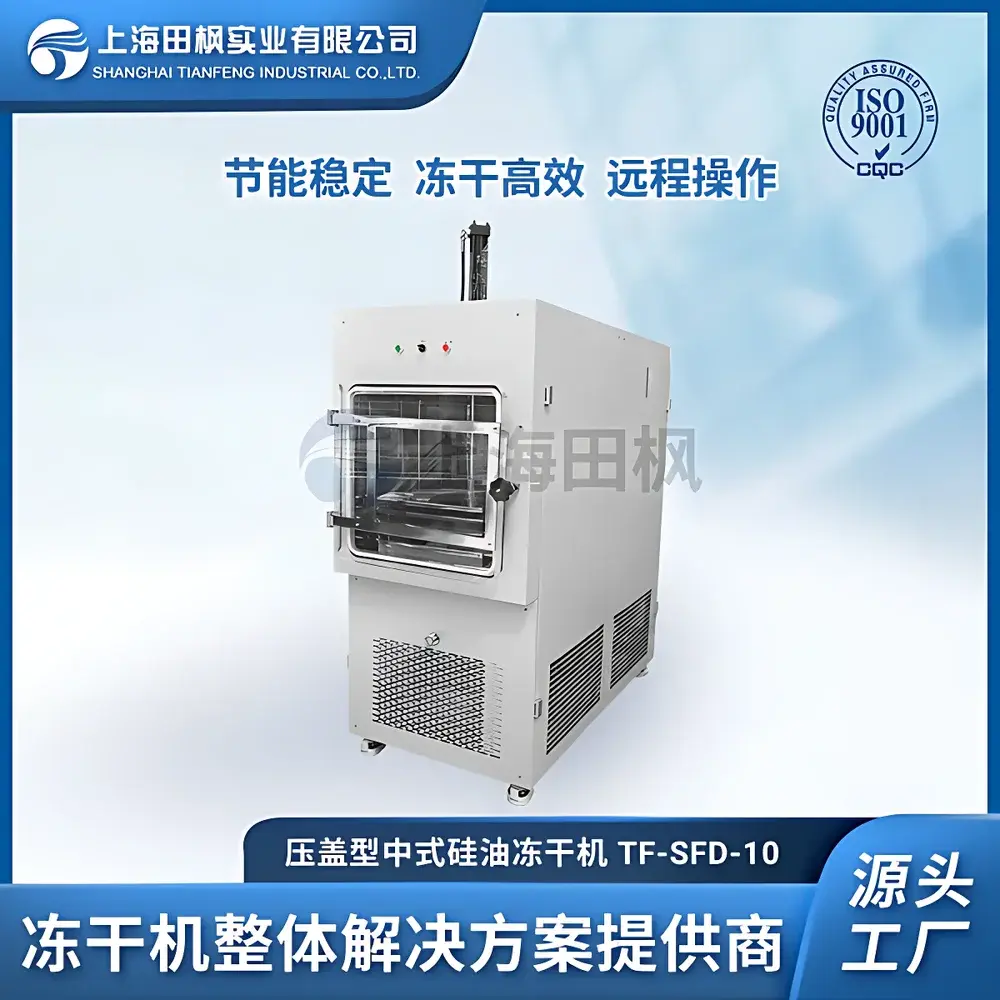
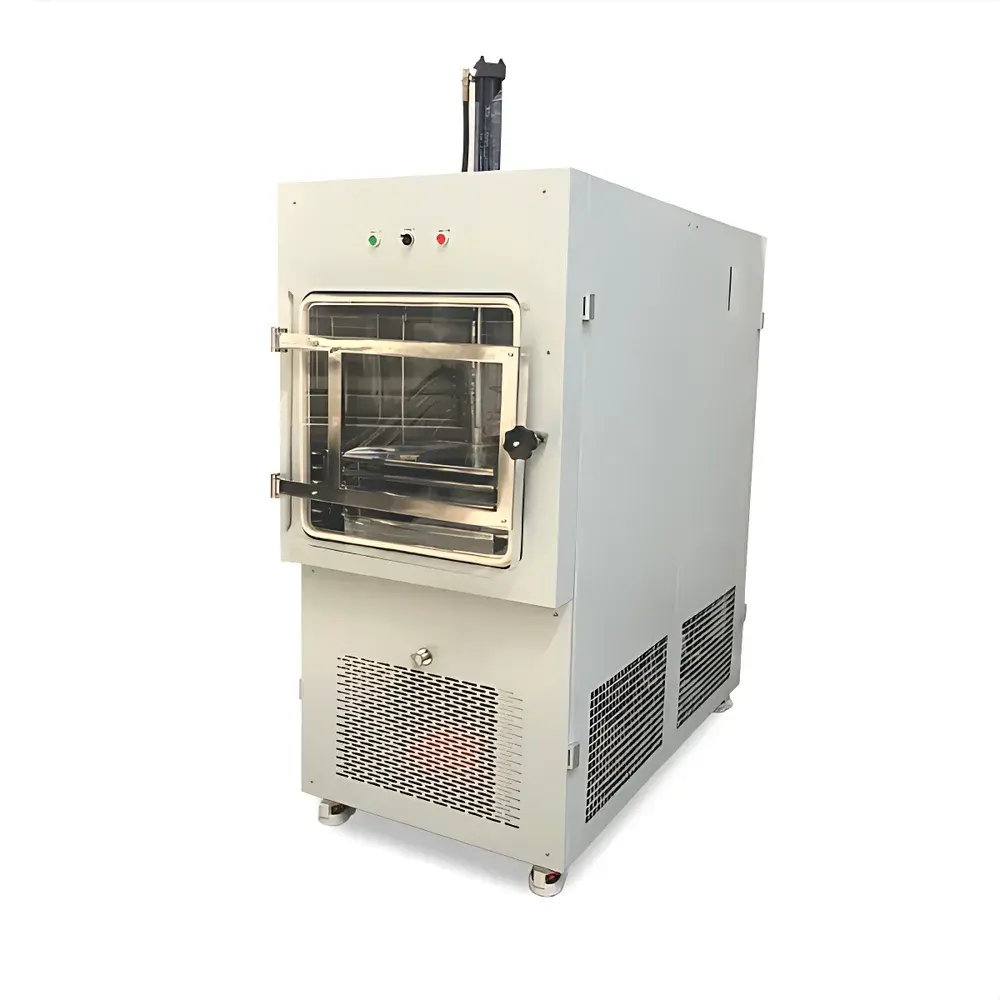
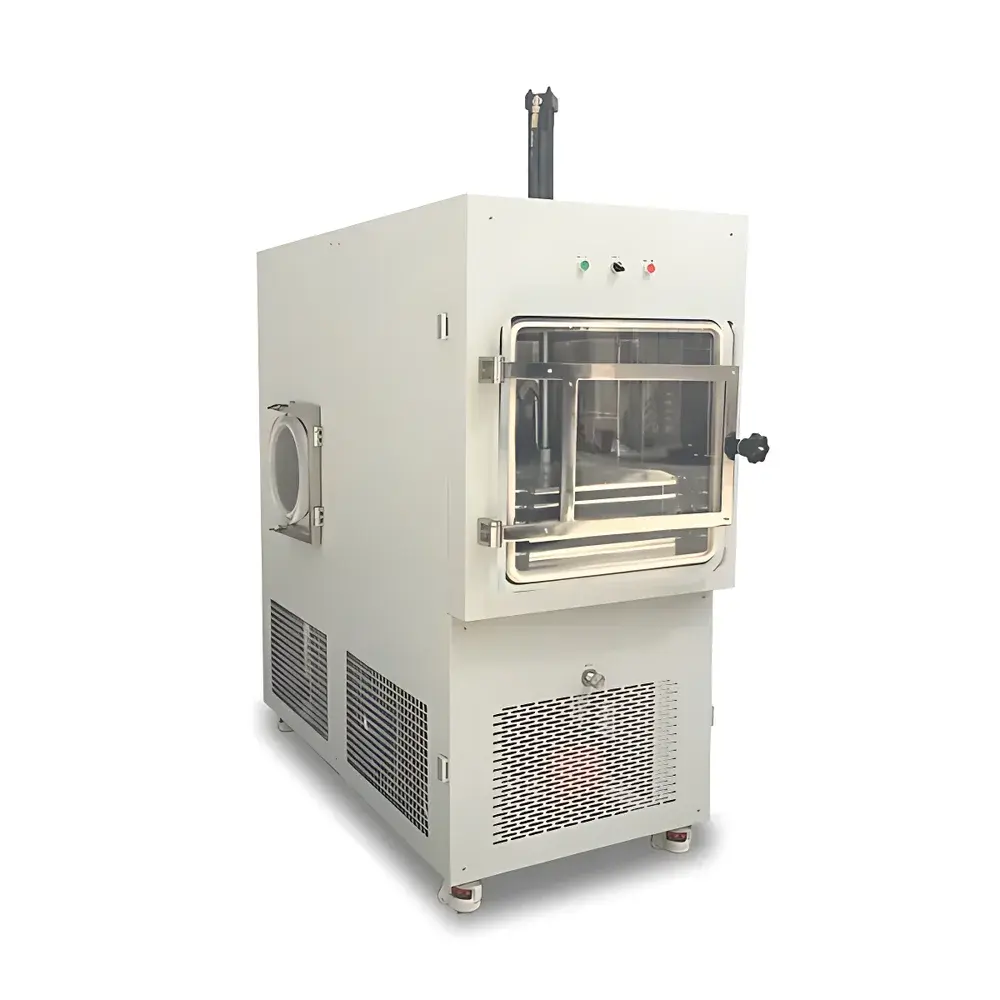
Tianfeng SFD-10m² Shelf-Type In-Situ Freeze Dryer
| Brand | Tianfeng |
|---|---|
| Origin | Shanghai, China |
| Manufacturer Type | Direct Manufacturer |
| Equipment Type | Shelf-Type In-Situ Freeze Dryer |
| Application Scope | Pilot-Scale Production & Process Development |
| Lyophilization Area | 1.05 m² |
| Ultimate Vacuum | ≤5 Pa |
| Condenser Capacity (24h) | 13 L |
| Condenser Temperature | ≤−70 °C |
| Chamber Dimensions (W×D) | 600 × 450 mm |
| Shelf Configuration | 4+1 shelves, 70 mm spacing |
| Shelf Size | 450 mm × 600 mm |
| Shelf Temp Range | −50 to +80 °C |
| Power Consumption | 8 kW |
| Net Weight | 850 kg |
| Control System | PLC-based Touchscreen Interface with Data Logging |
| Compliance | ISO 9001:2000 Certified |
| Optional Features | In-situ Eutectic Point Detection, Inert Gas Purge Valve, Audit Trail & User Access Control |
Overview
The Tianfeng SFD-10m² Shelf-Type In-Situ Freeze Dryer is an engineered pilot-scale lyophilization system designed for rigorous process development, formulation optimization, and small-batch production under controlled, reproducible conditions. It operates on the fundamental principles of sublimation-based dehydration: frozen samples are subjected to deep vacuum while heat is precisely delivered via silicone oil–circulated shelves, enabling primary drying without melting the ice matrix. Secondary drying follows to remove bound water, ensuring residual moisture levels suitable for long-term stability of thermolabile compounds—particularly critical in pharmaceutical, biotechnology, and advanced materials R&D. Unlike benchtop units, this system integrates in-situ pre-freezing, eliminating manual transfer and reducing contamination risk. Its 1.05 m² shelf area supports scalable loading configurations—including vials, trays, and custom containers—while maintaining uniform thermal distribution (±1 °C shelf-to-shelf and point-to-point) through a closed-loop silicone oil heating/cooling system.
Key Features
- In-situ freezing and drying within a single chamber, minimizing handling and preserving sample integrity.
- Silicone oil–heated shelves with ±0.5 °C temperature control accuracy across full operating range (−50 to +80 °C), ensuring consistent drying kinetics and product homogeneity.
- High-efficiency condenser operating at ≤−70 °C with 13 L/24 h water vapor capture capacity—optimized for rapid ice sublimation and shortened cycle times.
- PLC-controlled touchscreen interface supporting up to five user-defined protocols, each with up to 24 programmable segments; real-time parameter adjustment during operation permitted.
- Comprehensive data logging: vacuum pressure, shelf temperature, condenser temperature, and time-stamped operational events—all stored internally with export capability (CSV/USB).
- Optional eutectic point detection module enables empirical determination of collapse temperature for formulation-specific cycle design.
- Front access via high-transparency, non-yellowing acrylic door allows unobstructed visual monitoring of cake formation, shrinkage, or collapse throughout drying.
- Integrated inert gas purge valve (N₂ or argon compatible) facilitates oxygen-sensitive processing and final container backfilling under controlled atmosphere.
- Structural rigidity ensured by reinforced stainless-steel chamber and square tray-compatible shelf geometry—resistant to warping and simplifying cleaning validation.
Sample Compatibility & Compliance
The SFD-10 accommodates diverse sample formats: standard serum vials (Φ16 mm: up to 3,900 units/batch; Φ20 mm: up to 2,016 units), aluminum trays (max. 13 L total fill volume), and custom molds. Its design adheres to core requirements for Good Manufacturing Practice (GMP) and Good Laboratory Practice (GLP) environments—including traceable parameter logging, user-level access control (password-protected settings), and audit trail functionality. While not certified to FDA 21 CFR Part 11 out-of-the-box, the system’s architecture supports validation documentation packages and can be configured with electronic signature-ready firmware upon request. ISO 9001:2000 certification confirms adherence to documented quality management procedures across design, manufacturing, testing, and post-delivery support.
Software & Data Management
The embedded HMI runs on a deterministic real-time PLC platform, delivering deterministic response timing and immunity to OS-level instability. All process data—including vacuum transducer output, shelf thermocouple readings, and condenser thermistor logs—are sampled at 1-second intervals and timestamped with microsecond precision. Historical datasets are retained onboard for ≥12 months (configurable retention policy) and exportable via USB to external PCs for statistical analysis (e.g., JMP, MATLAB, or Python-based drying curve modeling). Optional software modules provide automated deviation alerts, trend analysis of batch-to-batch consistency, and CSV-formatted reports compliant with ALCOA+ principles (Attributable, Legible, Contemporaneous, Original, Accurate, Complete, Consistent, Enduring, Available).
Applications
This freeze dryer serves as a bridge between laboratory feasibility studies and commercial-scale manufacturing. It is routinely deployed for: lyophilized vaccine and monoclonal antibody formulation screening; ceramic and polymer nanocomposite powder synthesis via cryogelation; preservation of probiotic cultures and enzyme preparations; preparation of porous scaffolds for tissue engineering; and stabilization of diagnostic reagents requiring ambient-temperature storage. Its thermal uniformity and vacuum stability make it especially suited for DOE-driven optimization of critical process parameters (CPPs) such as shelf ramp rate, hold duration, and primary drying endpoint detection.
FAQ
Is the SFD-10 validated for GMP-compliant production?
It meets foundational GMP infrastructure requirements (e.g., material traceability, calibration records, IQ/OQ documentation support) but requires site-specific PQ and formal validation per ICH Q5C and EU Annex 15.
Can the system be integrated into a central SCADA network?
Yes—via optional Modbus TCP or OPC UA gateway modules for bidirectional communication with plant-level control systems.
What maintenance intervals are recommended for the vacuum pump and refrigeration circuit?
Oil-lubricated vacuum pumps require oil changes every 500 operational hours; refrigerant charge and condenser coil inspection are advised annually or after 2,000 freeze-dry cycles.
Does the unit support automated stoppering?
No—this model is a non-sterile, open-chamber system; stoppering must be performed offline in a laminar flow hood or isolator.
Are spare parts and technical documentation available internationally?
Yes—Tianfeng maintains a global spare parts warehouse and provides English-language operation manuals, electrical schematics, and PLC ladder logic backups upon purchase.



