
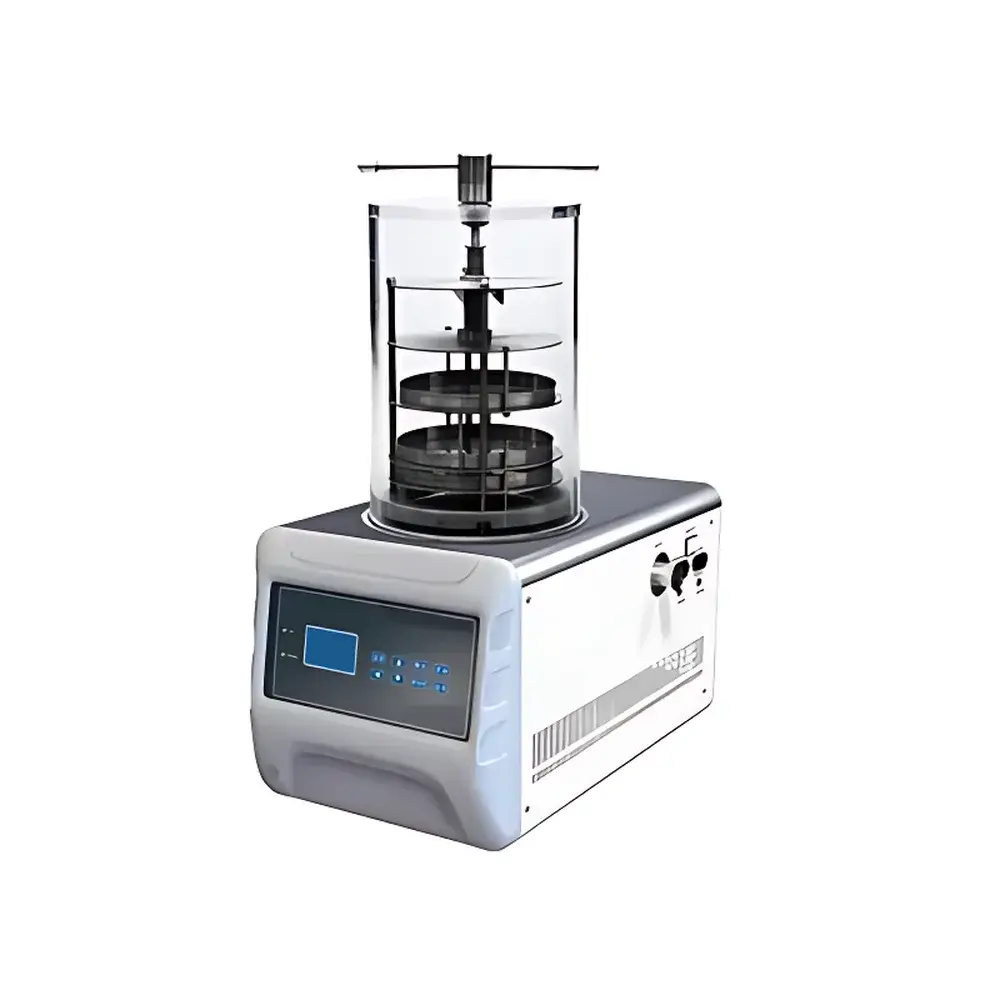
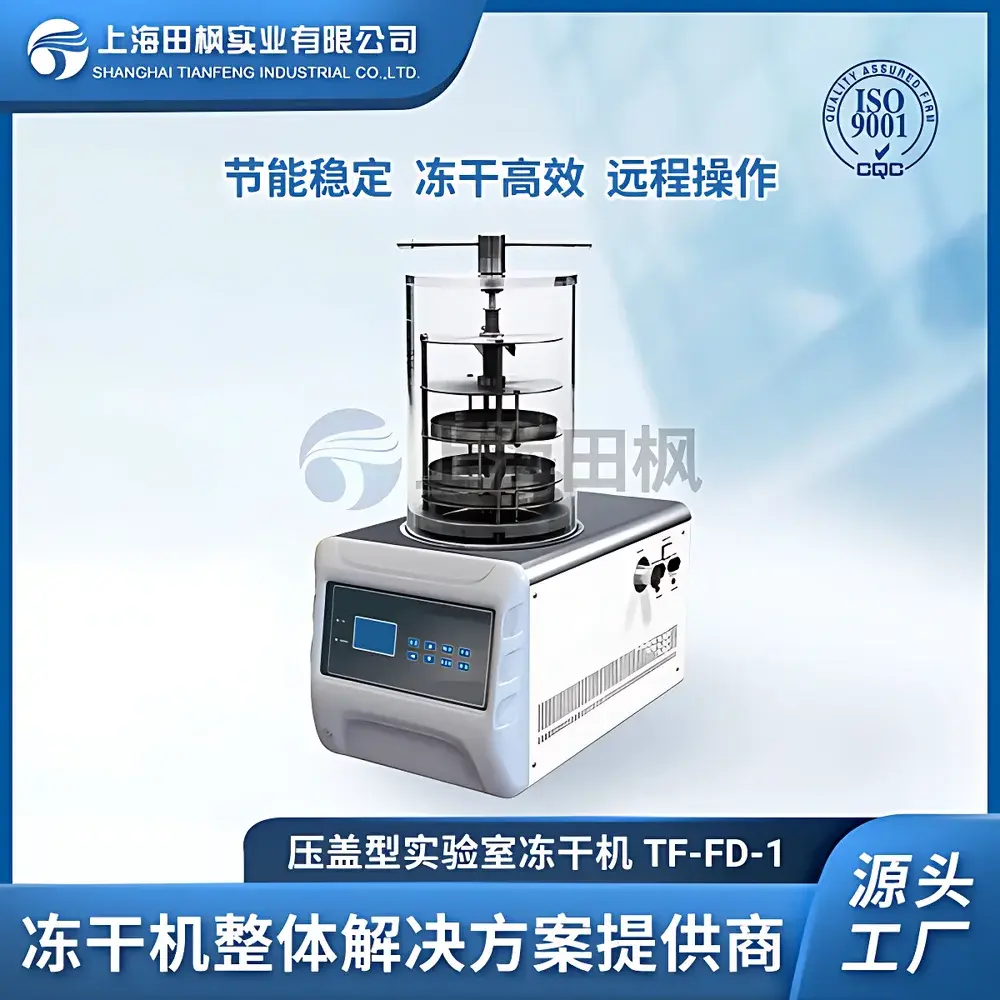
Tianfeng TF-FD-1 Benchtop Lyophilizer with Stoppering Function
| Brand | Tianfeng |
|---|---|
| Origin | Shanghai, China |
| Manufacturer Type | Direct Manufacturer |
| Model | TF-FD-1 Stoppering-Type Laboratory Freeze Dryer |
| Instrument Type | Stoppering-Enabled Benchtop Freeze Dryer |
| Application Scope | Laboratory R&D and Small-Scale Production |
| Shelf Area | 0.07 m² |
| Ultimate Vacuum | <15 Pa (at no-load) |
| Condenser Temperature | <−50 °C |
| Ice Capacity | 3 kg/24 h |
| Overall Dimensions | 370 mm × 650 mm × 360 mm |
| Power Consumption | 1100 W |
| Electrical Supply | 220 V, 50 Hz |
| Chamber Material | 304 Stainless Steel |
| Viewport | Transparent Acrylic Door |
| Control System | Touchscreen LCD with Real-Time Drying Curve Display |
| Refrigeration | Air-Cooled Dual-Stage Condenser |
| Pre-freezing | In-situ via Shelf or Condenser |
| Optional Accessories | Temperature Data Logger, Inlet Gas Valve (N₂ or Argon), Eutectic Point Tester, Automatic Stopper Actuator |
Overview
The Tianfeng TF-FD-1 is a benchtop stoppering-type laboratory freeze dryer engineered for reproducible lyophilization of heat-sensitive biological and pharmaceutical samples under controlled low-temperature vacuum conditions. It operates on the fundamental principle of sublimation: aqueous samples are first frozen solid (typically at ≤ −50 °C), then subjected to deep vacuum (<15 Pa), enabling ice to transition directly from solid to vapor phase without passing through liquid—preserving structural integrity, bioactivity, and chemical stability. Unlike conventional thermal drying methods that induce denaturation, oxidation, or collapse, lyophilization maintains the original porous matrix architecture, ensuring rapid reconstitution and minimal loss of volatile or labile components. This makes the TF-FD-1 especially suited for stabilizing biologics—including hormones, vaccines, enzymes, monoclonal antibodies, and plasma derivatives—where retention of conformational fidelity and potency is critical for downstream analysis or clinical use.
Key Features
- Stoppering-compatible chamber design enables sterile vial sealing under vacuum post-drying—eliminating secondary handling and reducing contamination risk in GMP-aligned workflows.
- In-situ pre-freezing capability via integrated condenser (≤ −50 °C) or shelf cooling; eliminates need for external ultra-low temperature freezers and streamlines process continuity.
- Touchscreen HMI with real-time graphical display of shelf temperature, chamber pressure, condenser temperature, and time-based drying curves—supports PID-controlled ramp/hold protocols and deviation monitoring.
- Robust air-cooled dual-stage refrigeration system ensures stable condensing performance and high ice capture efficiency (3 kg/24 h), even with moderately volatile solvents.
- Translucent acrylic door and internal LED illumination permit unobstructed visual observation throughout freezing, primary drying, and secondary drying stages—critical for method development and troubleshooting.
- 304 stainless steel construction (chamber, condenser, shelves) delivers corrosion resistance, ease of cleaning, and compliance with ISO 14644-1 Class 8 cleanroom-compatible surface requirements.
- Configurable inert gas inlet valve allows controlled backfilling with nitrogen or argon—preventing oxidation during storage or vial stoppering.
- Modular architecture supports optional accessories including GLP-compliant temperature data loggers (with audit-trail-capable timestamps), eutectic point analyzers, and programmable automatic stopper actuators.
Sample Compatibility & Compliance
The TF-FD-1 accommodates standard Ø180 mm sample trays across three stacked shelves, supporting batch processing of vials, ampoules, or bulk formulations up to 0.07 m² total drying area. Its −50 °C condenser temperature and <15 Pa ultimate vacuum meet minimum operational thresholds defined in USP , Ph. Eur. 2.9.40, and ISO 22055 for laboratory-scale lyophilization validation. While not certified to FDA 21 CFR Part 11 out-of-the-box, the system’s data logging interface supports integration with compliant third-party software for electronic signature, audit trail, and user access control—facilitating alignment with GLP and GMP documentation standards. The unit complies with IEC 61000-6-3 (EMC) and IEC 61010-1 (safety) for laboratory equipment, and its manufacturing quality system is certified to ISO 9001:2015.
Software & Data Management
The embedded control firmware records all critical process parameters—including shelf temperature (±0.5 °C accuracy), chamber pressure (capacitance manometer, ±0.1 Pa resolution), condenser temperature, and elapsed time—at user-defined intervals (1–60 s). Data exports natively to CSV format via USB port for offline analysis in MATLAB, Python, or statistical process control (SPC) platforms. Optional temperature data loggers provide independent, calibrated traceability meeting ALCOA+ principles (Attributable, Legible, Contemporaneous, Original, Accurate). All parameter setpoints, alarms, and event logs are timestamped and stored locally with password-protected user roles (Operator, Supervisor, Administrator) to support accountability and change control procedures.
Applications
- Pharmaceutical R&D: Stabilization of peptide hormones (e.g., insulin, growth hormone), cytokines, and vaccine candidates prior to stability testing per ICH Q5C guidelines.
- Biobanking: Long-term preservation of primary cell isolates, serum, plasma, and tissue lysates without cryoprotectant-induced artifacts.
- Diagnostics: Lyophilization of ELISA reagents, lateral flow assay conjugates, and molecular detection kits to extend shelf life and eliminate cold-chain dependency.
- Academic Research: Method optimization for novel formulations containing organic co-solvents (e.g., acetonitrile, ethanol), where enhanced condenser capture efficiency prevents pump oil contamination.
- Botanical & Natural Product Processing: Gentle dehydration of thermolabile phytochemicals (e.g., flavonoids, alkaloids) while retaining antioxidant activity and spectral profiles.
FAQ
What is the maximum sample volume per batch?
The TF-FD-1 supports up to 0.07 m² of shelf area, typically accommodating three Ø180 mm trays—equivalent to ~120–150 standard 10 mL serum vials depending on fill height and headspace.
Can the system handle samples with organic solvents?
Yes—the −50 °C condenser provides sufficient cold trap margin for common low-boiling solvents such as methanol, acetone, or ethyl acetate; however, for highly volatile solvents (e.g., dichloromethane), extended primary drying times or staged pressure ramping is recommended.
Is in-chamber pre-freezing possible?
Yes—samples can be frozen either directly on the shelves (via conductive cooling) or within the condenser chamber prior to vacuum initiation, enabling full process autonomy without external cryogenic equipment.
Does the unit comply with regulatory documentation requirements?
The base configuration meets mechanical and electrical safety standards (IEC 61010-1); for full 21 CFR Part 11 compliance, integration with validated third-party data management software and procedural SOPs is required.
What maintenance is required for long-term reliability?
Routine tasks include vacuum pump oil changes every 500 operating hours, condenser coil cleaning every 6 months, and annual calibration verification of temperature and pressure sensors using NIST-traceable references.



