
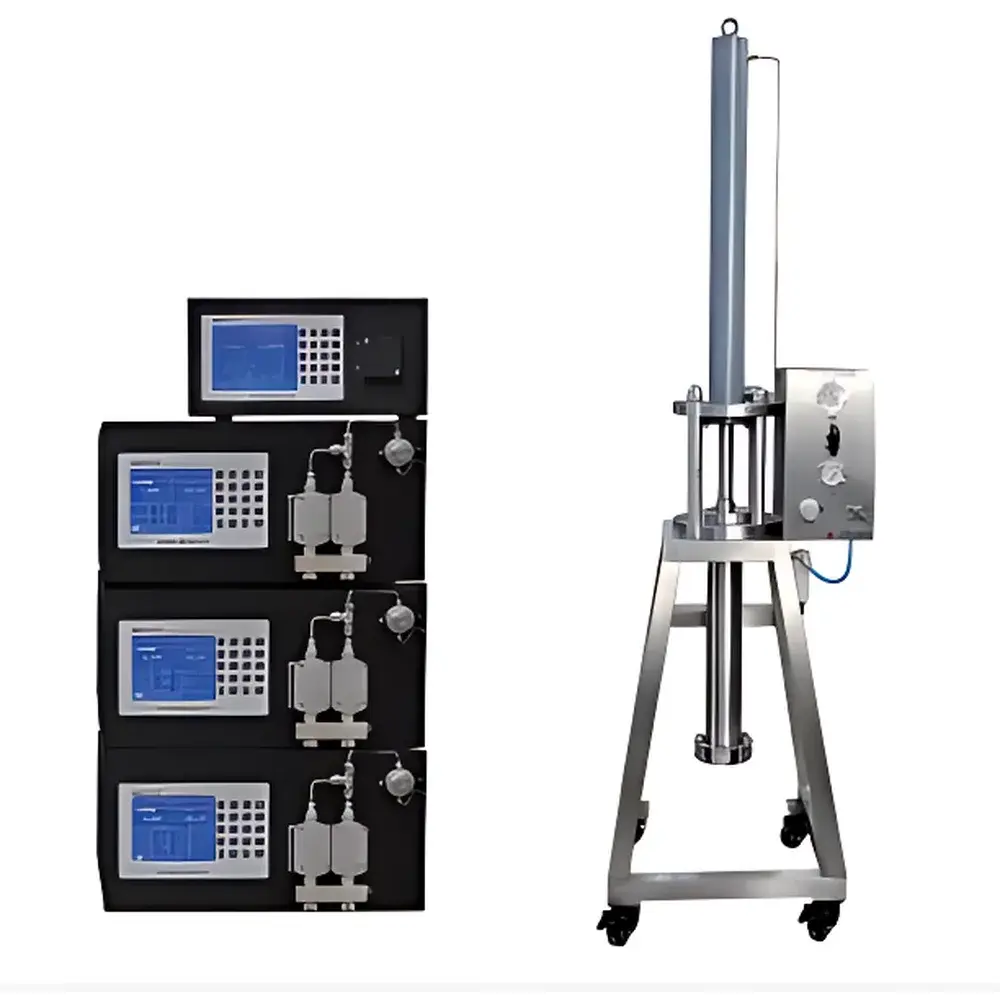
Hanbon NS4360 Preparative HPLC Plunger Pump System
| Brand | Hanbon |
|---|---|
| Origin | Jiangsu, China |
| Manufacturer Type | Direct Manufacturer |
| Product Category | Domestic |
| Model | NS4360 |
| Application Level | Industrial-Scale Preparative |
| Instrument Type | High-Pressure Preparative Liquid Chromatography System |
| Flow Rate Range | 0.01–599.99 mL/min |
| Flow Accuracy | ±1% |
| Flow Precision (RSD) | ≤1% |
| Maximum Pressure | 15 MPa |
| Wavelength Range | ±2 nm |
| Wavelength Repeatability | 0.2 nm |
| Baseline Noise | 2 × 10⁻⁵ AU (254 nm, TC = 1 s) |
| Data Acquisition Frequency | 5 Hz |
Overview
The Hanbon NS4360 Preparative HPLC Plunger Pump System is an industrial-grade high-pressure liquid chromatography platform engineered for scalable purification of active pharmaceutical ingredients (APIs), natural product isolates, fermentation-derived metabolites, and synthetic intermediates. Built upon a dual-plunger positive-displacement pumping architecture, the system delivers precise, pulse-free solvent delivery across a wide flow range (0.01–599.99 mL/min) under sustained pressures up to 15 MPa—enabling compatibility with both standard stainless-steel and high-performance columns, including dynamic axial compression (DAC) and multi-functional axial compression systems. Its core design adheres to fundamental chromatographic principles: consistent mobile-phase composition control via electronic damping-based gradient formation, minimal dwell volume for rapid method transfer, and thermally stable optical path geometry in the UV-Vis detector to ensure spectral fidelity. The system serves as a bridge between analytical method development and GMP-compliant manufacturing, supporting seamless scale-up from mg-to-gram to kilogram-level purification campaigns.
Key Features
- Triple-solvent high-pressure plunger pump with electronically damped flow control, minimizing pulsation and improving gradient accuracy and retention time reproducibility
- Floating piston seal design reduces mechanical wear on pump seals, extending service life and lowering long-term maintenance cost
- Dual-wavelength UV-Vis detector (200–400 nm, ±2 nm wavelength accuracy, 0.2 nm repeatability) with baseline noise <2 × 10⁻⁵ AU at 254 nm (1 s time constant)
- Wetted-path materials configurable in SS316L, titanium alloy, or PEEK to accommodate aggressive solvents (e.g., TFA, HFIP) and corrosive mobile phases
- Modular detection options: compatible with optional RID (refractive index) and ELSD (evaporative light scattering) detectors for non-UV-absorbing analytes
- Integrated data acquisition at 5 Hz sampling rate, supporting real-time peak tracking and high-fidelity chromatogram reconstruction
Sample Compatibility & Compliance
The NS4360 accommodates diverse sample matrices—including polar and non-polar small molecules, peptides, oligonucleotides, and labile natural compounds—without degradation or adsorption artifacts, thanks to inert fluidic pathways and low-dead-volume fittings. Column compatibility spans analytical-scale HPLC columns (4.6–21.2 mm ID), preparative spring-loaded columns (25–100 mm ID), and large-bore DAC columns (up to 200 mm ID). The system supports compliance-critical workflows: audit trails, user access levels, and electronic signatures can be implemented via third-party LIMS or validated chromatography data systems (CDS). While not pre-certified, its architecture aligns with key regulatory expectations—including FDA 21 CFR Part 11 (when paired with compliant software), ISO/IEC 17025 traceability requirements, and ICH Q5A/Q5B guidelines for biopharmaceutical purity assessment.
Software & Data Management
Control and data handling are executed through Hanbon’s proprietary ChromaLink™ software (v3.x), which provides intuitive method building, real-time chromatogram visualization, and automated fraction collection logic. The software supports multiple collection modes: time-based, threshold-triggered (peak height/area), and manual override—all synchronized with detector signal and pump status. Raw data files (.chd) are stored in vendor-neutral formats compatible with OpenLab CDS, Chromeleon, and Empower for cross-platform review. All acquisition parameters, instrument logs, and user actions are timestamped and exportable for GLP/GMP documentation. Optional API integration enables direct communication with enterprise MES or ERP systems for batch record linkage.
Applications
- Purification of synthetic APIs under cGMP pilot-scale conditions (e.g., kinase inhibitors, antiviral nucleoside analogs)
- Isolation of bioactive flavonoids, alkaloids, and terpenoids from plant extracts with minimal thermal or oxidative degradation
- Downstream processing of monoclonal antibody fragments following enzymatic cleavage
- Chiral separation of racemic mixtures using polysaccharide-based preparative columns
- Process validation support: robustness testing, loading capacity studies, and column lifetime monitoring under accelerated stress conditions
FAQ
What column formats are supported by the NS4360 system?
Standard analytical HPLC columns (4.6–21.2 mm ID), spring-loaded preparative columns (25–100 mm ID), and dynamic axial compression (DAC) columns up to 200 mm ID.
Can the system operate under Good Manufacturing Practice (GMP) conditions?
Yes—when integrated with validated chromatography data software (e.g., Waters Empower or Thermo Chromeleon) and configured with role-based access control, audit trail logging, and electronic signature capability.
Is the UV-Vis detector capable of simultaneous dual-wavelength quantitation?
Yes—the detector acquires absorbance signals at two user-defined wavelengths concurrently, enabling ratiometric analysis or orthogonal peak confirmation.
What solvent compatibility considerations apply to the wetted parts?
SS316L is suitable for most organic/aqueous mobile phases; titanium alloy is recommended for halogenated solvents and strong acids; PEEK is optimal for high-pH applications (>10) and fluoride-containing buffers.
Does the system support gradient delay compensation?
Yes—ChromaLink™ software includes adjustable dwell volume compensation to correct for system-induced gradient lag during method transfer from analytical to preparative scales.




