
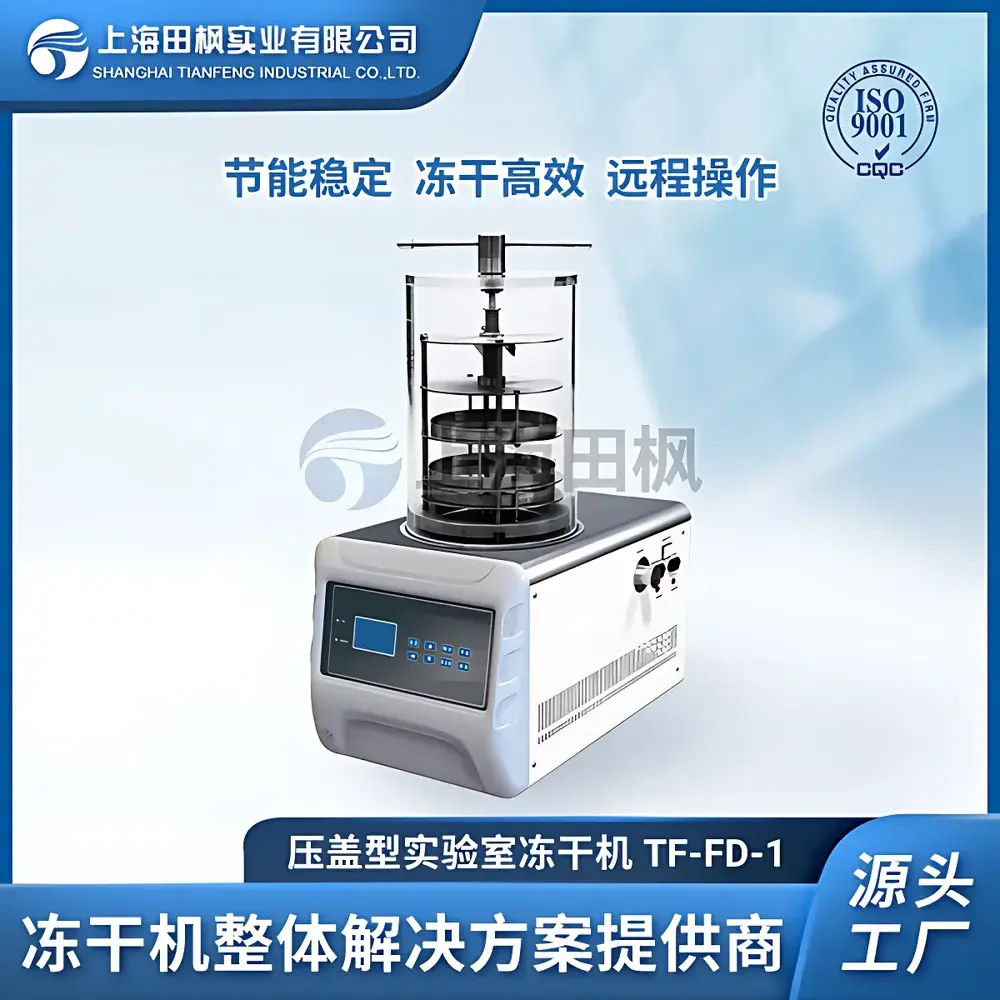
Tianfeng TF-FD-1 Press-Seal Laboratory Freeze Dryer
| Brand | Tianfeng |
|---|---|
| Origin | Shanghai, China |
| Manufacturer Type | Direct Manufacturer |
| Product Category | Domestic |
| Model | TF-FD-1 Press-Seal Type |
| Freeze-Drying Area | 0.07 m² |
| Ultimate Vacuum | <15 Pa (at no-load) |
| Condenser Temperature | <−50 °C |
| Ice Capacity | 3 kg/24 h |
| Power Consumption | 1100 W |
| Dimensions (W×D×H) | 370 × 650 × 360 mm |
| Electrical Supply | 220 V, 50 Hz |
| Chamber Material | 304 Stainless Steel |
| Viewing Window | Transparent Acrylic Door |
| Control System | Touchscreen LCD with PID Regulation and Real-Time Drying Curve Display |
| Pre-freezing | In-situ via condenser |
| Optional Accessories | Inert Gas Purge Valve, Temperature Data Logger, Eutectic Point Tester, Auto Stoppering Module |
Overview
The Tianfeng TF-FD-1 Press-Seal Laboratory Freeze Dryer is a compact, in-situ pre-freezing lyophilization system engineered for precise, reproducible freeze-drying of thermolabile biological and pharmaceutical samples in research and quality control laboratories. It operates on the fundamental principle of sublimation: aqueous samples are first frozen solid at low temperature, then subjected to high vacuum (<15 Pa), enabling ice to transition directly from solid to vapor without passing through the liquid phase. This preserves structural integrity, bioactivity, and chemical stability—critical for peptides, enzymes, monoclonal antibodies, vaccines, and other sensitive biologics. Unlike conventional drying methods that induce denaturation, oxidation, or collapse due to heat exposure, the TF-FD-1 maintains sample morphology within its native ice matrix, yielding a highly porous, reconstitutable cake with minimal residual moisture (<1–2% w/w typical under optimized cycles). Its press-seal configuration enables sterile vial stoppering under controlled vacuum conditions post-drying—essential for GMP-aligned small-batch production and formulation development.
Key Features
- In-situ pre-freezing capability: Samples freeze directly on the stainless steel shelf using the integrated condenser (≤ −50 °C), eliminating manual transfer and minimizing thermal shock or contamination risk.
- Precision PID-controlled drying cycle: Touchscreen interface displays real-time shelf temperature, chamber pressure, and condenser temperature; supports programmable ramp-hold profiles for primary and secondary drying stages.
- Robust condenser design: Dual-stage refrigeration system achieves stable condensing performance at ≤ −50 °C, with 3 kg/24 h ice capture capacity—sufficient for routine lab-scale batches (e.g., 3 × Φ180 mm trays).
- Hygienic and serviceable construction: Entire drying chamber and condenser housing fabricated from electropolished 304 stainless steel; transparent acrylic door allows unobstructed visual monitoring of sublimation progress and cake formation.
- Press-seal functionality: Integrated hydraulic or pneumatic stoppering mechanism enables simultaneous sealing of multiple vials under vacuum—reducing oxygen ingress and supporting sterility assurance protocols.
- Gas purge compatibility: Standard inert gas (N₂ or Ar) inlet valve permits backfilling to atmospheric pressure with dry, particle-free gas—critical for oxidation-prone compounds and residual solvent management.
- Regulatory-ready architecture: Supports optional 21 CFR Part 11-compliant data logging (with user access control, electronic signatures, and audit trail), aligning with GLP/GMP documentation requirements for method validation and batch release.
Sample Compatibility & Compliance
The TF-FD-1 accommodates a broad spectrum of aqueous-based formulations including peptide solutions, protein buffers, microbial cultures, diagnostic reagents, and herbal extracts. Its ≤ −50 °C condenser temperature ensures effective trapping of water and moderately volatile solvents (e.g., acetone, ethanol), though highly volatile organics (e.g., chloroform, hexane) require additional cold trap staging. The system complies with core international standards governing lyophilization equipment performance and data integrity: ISO 22042 (freeze dryer qualification), ASTM F2375 (pharmaceutical lyophilizer testing), and USP <1207> (package integrity and container closure). All electrical components meet IEC 61010-1 safety requirements for laboratory equipment. For regulated environments, optional e-signature-enabled temperature and pressure logging satisfies FDA 21 CFR Part 11 and EU Annex 11 expectations for electronic records and signatures.
Software & Data Management
The embedded control software provides intuitive cycle setup, live parameter visualization, and exportable CSV logs for shelf temperature, chamber pressure, condenser temperature, and elapsed time. Users may define up to 20 customizable drying protocols—including multi-step freezing ramps, primary drying hold points, and secondary drying gradients—with password-protected editing rights. When equipped with the optional data logger, the system generates tamper-evident, time-stamped records compliant with ALCOA+ principles (Attributable, Legible, Contemporaneous, Original, Accurate, Complete, Consistent, Enduring, Available). Exported datasets integrate seamlessly with LIMS platforms and statistical process control (SPC) tools for trend analysis across consecutive batches. Firmware updates are performed via USB—no network connectivity required—to maintain cybersecurity isolation in validated environments.
Applications
- Biopharmaceutical R&D: Lyophilization of clinical trial materials, reference standards, and stability-indicating assay controls.
- Vaccine formulation: Stabilization of live-attenuated and subunit antigens without adjuvant degradation.
- Peptide & oligonucleotide processing: Preservation of conformational integrity during long-term storage and shipping.
- Diagnostic kit manufacturing: Production of freeze-dried enzyme conjugates, antibody-coated beads, and lateral flow reagents.
- Academic & translational research: Sample archiving for metabolomics, proteomics, and microbiome studies requiring nucleic acid or protein recovery fidelity.
- Botanical & nutraceutical development: Stabilization of heat-sensitive phytochemicals (e.g., polyphenols, terpenes) while retaining antioxidant activity.
FAQ
What is the maximum sample volume per batch on the TF-FD-1?
With three Φ180 mm trays (0.07 m² total area), the unit supports up to ~1.2 L of aqueous solution at 5–10 mm fill depth—optimized for uniform drying and complete primary drying within 24–36 hours depending on formulation.
Can the TF-FD-1 handle organic solvent-containing samples?
Yes—its ≤ −50 °C condenser effectively traps water and common co-solvents such as ethanol, methanol, and acetonitrile at concentrations ≤20% v/v. For higher volatility or chlorinated solvents, consult application engineering for supplemental cold trap integration.
Is in-situ pre-freezing sufficient for eutectic point determination?
While the TF-FD-1 supports basic freezing characterization, accurate eutectic temperature mapping requires the optional eutectic point tester—a separate impedance-based probe that identifies crystallization onset during controlled cooling.
Does the press-seal function support ISO 5 cleanroom operation?
The press-seal module is designed for Class A/B environments when installed within an isolator or laminar flow hood; full ISO 5 compliance depends on facility HVAC integration and operator gowning protocols—not device-specific certification.
What maintenance intervals are recommended for sustained performance?
Condenser coil cleaning every 6 months; vacuum pump oil replacement every 500 operating hours; O-ring inspection and lubrication annually; full system calibration (temperature, pressure) prior to each critical validation campaign or quarterly—whichever occurs first.



