
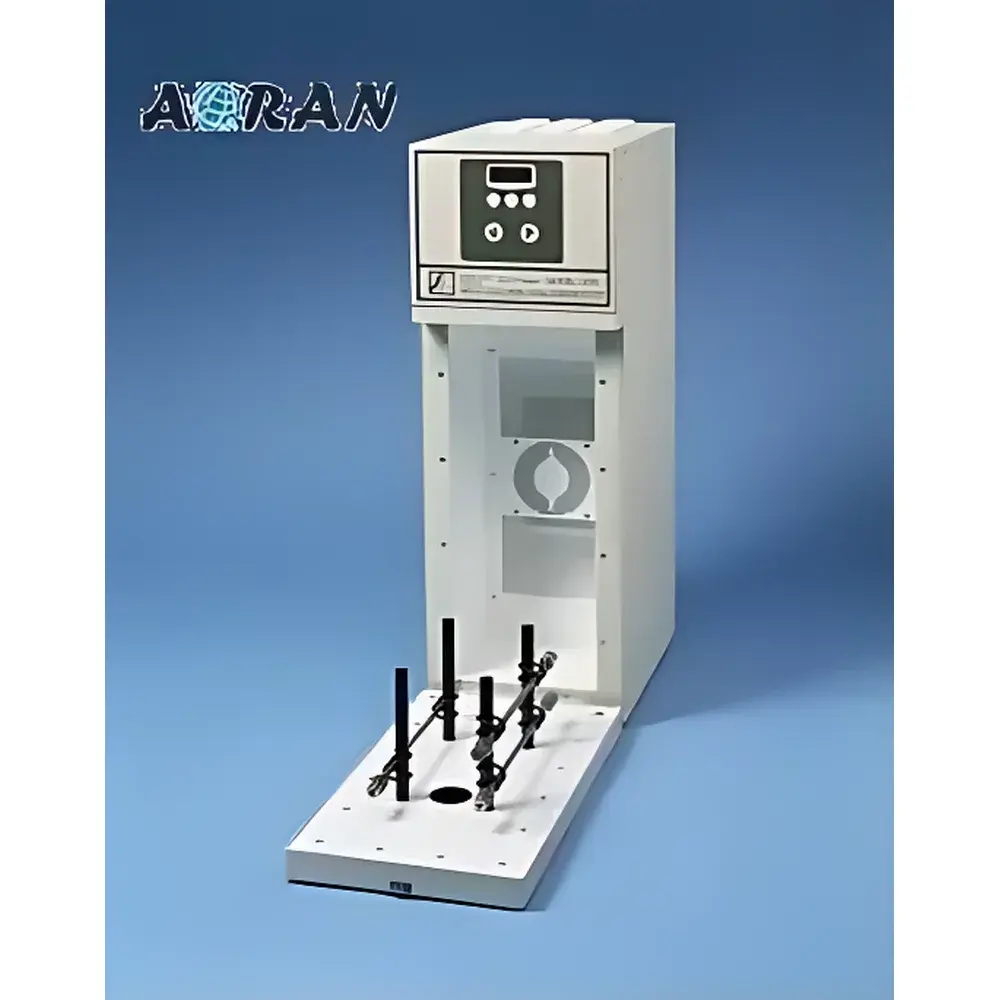
Torrey Pines CO30 & CO50 HPLC Column Oven
| Brand | Torrey Pines |
|---|---|
| Origin | USA |
| Model | CO30, CO50 |
| Temperature Range | 4.0–70.0 °C (CO30), 4.0–100.0 °C (CO50) |
| Temperature Resolution | 0.1 °C |
| Temperature Accuracy | ±0.2 °C |
| Temperature Stability | ±0.1 °C |
| Programmable Steps | 5 |
| Cycle Repetition | 1–99 |
| Timer Range | 0–99 h (up to 30 days) |
| Compatible Column Dimensions | CO30 — up to 300 mm × 25.4 mm |
| Column Capacity | 4 (CO30), 1 (CO50) |
| Interface | RS232 with electronic calibration |
| Certifications | UL, CSA, CE |
| Price | USD $4,000 |
Overview
The Torrey Pines CO30 and CO50 HPLC Column Ovens are precision-engineered thermal management systems designed specifically for high-performance liquid chromatography (HPLC) and ultra-high-performance liquid chromatography (UHPLC) applications. Built upon thermoelectric (Peltier) heating and cooling technology, these ovens deliver rapid thermal response, bidirectional temperature control, and exceptional stability—critical for reproducible retention time, peak shape, and resolution in gradient and isocratic separations. Unlike ambient-air convection ovens or large chromatography cabinets, the CO-series employs active solid-state thermal regulation, eliminating reliance on external chillers or compressors. This architecture ensures consistent column temperature independent of laboratory ambient fluctuations, supporting method robustness across GLP, GMP, and regulated QC environments.
Key Features
- Peltier-based thermoelectric module enables simultaneous heating and cooling within a single compact chassis—no separate chiller required.
- PID-controlled temperature regulation with 0.1 °C resolution and ±0.2 °C accuracy across the full operating range (4.0–70.0 °C for CO30; 4.0–100.0 °C for CO50).
- Thermal stability maintained at ±0.1 °C over time, verified under load with standard 300 mm analytical columns.
- Dual-model configuration: CO30 accommodates up to four 300 mm × 25.4 mm columns (e.g., preparative or parallel screening setups); CO50 supports one standard 300 mm × 6.3 mm or 9.6 mm column with optimized airflow and thermal coupling.
- Onboard programmable controller with five-step ramp/soak profiles and cycle repetition (1–99 cycles), supporting timed methods up to 30 days.
- RS232 serial interface for remote monitoring, parameter upload/download, and integration into LIMS or chromatography data systems (CDS).
- Factory-calibrated electronics with user-accessible electronic recalibration routine—no hardware adjustment tools required.
- UL 61010-1, CSA C22.2 No. 61010-1, and CE-compliant design validated for laboratory use under IEC 61326-1 EMC and safety requirements.
Sample Compatibility & Compliance
The CO30 and CO50 are engineered for direct mounting of stainless-steel or PEEK-bodied HPLC columns with standard fittings (e.g., 10-32 UNF, M7×0.5). Column compatibility includes all common internal diameters (2.1 mm, 3.0 mm, 4.6 mm, 6.3 mm, 9.6 mm, and 25.4 mm) and lengths up to 300 mm. The chamber geometry and forced-air thermal distribution ensure uniform axial and radial temperature profiles—validated per ASTM E2877-22 (Standard Guide for Thermal Validation of Chromatographic Column Heaters). Both models support 21 CFR Part 11-compliant audit trails when interfaced with compliant CDS platforms. Design documentation and factory test reports are provided to facilitate IQ/OQ validation in pharmaceutical and clinical labs adhering to USP , ISO/IEC 17025, and EU Annex 11 requirements.
Software & Data Management
While standalone operation requires no software, the RS232 interface enables ASCII command protocol communication for integration with third-party control environments—including Agilent OpenLab, Waters Empower, Thermo Chromeleon, and custom Python- or LabVIEW-based automation scripts. Firmware supports real-time temperature logging at user-defined intervals (1–60 s), with timestamped output exportable as CSV. Electronic calibration records—including date, operator ID, reference standard traceability, and deviation values—are stored in non-volatile memory and retrievable via serial query. All firmware updates are delivered as signed binary packages with SHA-256 checksums to ensure integrity and version control.
Applications
- Method development and transfer requiring strict column temperature control (e.g., chiral separations, polymer analysis, peptide mapping).
- Long-duration stability-indicating assays where baseline drift must be minimized over multi-hour runs.
- Temperature-gradient HPLC for optimizing selectivity without solvent composition changes.
- QC release testing in pharmaceutical manufacturing under cGMP conditions, where thermal consistency directly impacts system suitability criteria (USP ).
- Academic and contract research laboratories performing comparative column studies or column lifetime evaluation under accelerated thermal stress.
FAQ
What is the maximum column length supported by the CO30 and CO50?
Both models accept columns up to 300 mm in length. The CO30 accommodates wider-diameter columns (up to 25.4 mm OD), while the CO50 is optimized for standard analytical columns (6.3 mm or 9.6 mm OD).
Does the oven support external temperature probe input for independent verification?
No—temperature sensing is performed internally via calibrated platinum RTD sensors embedded in the thermal block. External probe inputs are not provided, but NIST-traceable calibration certificates are included with each unit.
Can the CO-series be integrated into a fully automated HPLC system with unattended overnight operation?
Yes. With RS232 connectivity and programmable timing (up to 30 days), the oven supports scheduled start/stop, profile switching, and error reporting compatible with scheduler modules in major CDS platforms.
Is firmware update capability available in the field?
Yes—firmware updates are performed via RS232 using Torrey Pines-provided utilities. Each update includes version confirmation, rollback support, and cryptographic signature verification.
What maintenance is required during routine operation?
None beyond periodic visual inspection of air intake grilles and wiping of the exterior housing with isopropyl alcohol. The Peltier module has no moving parts and is rated for >50,000 hours MTBF under continuous operation.
Related Products



