
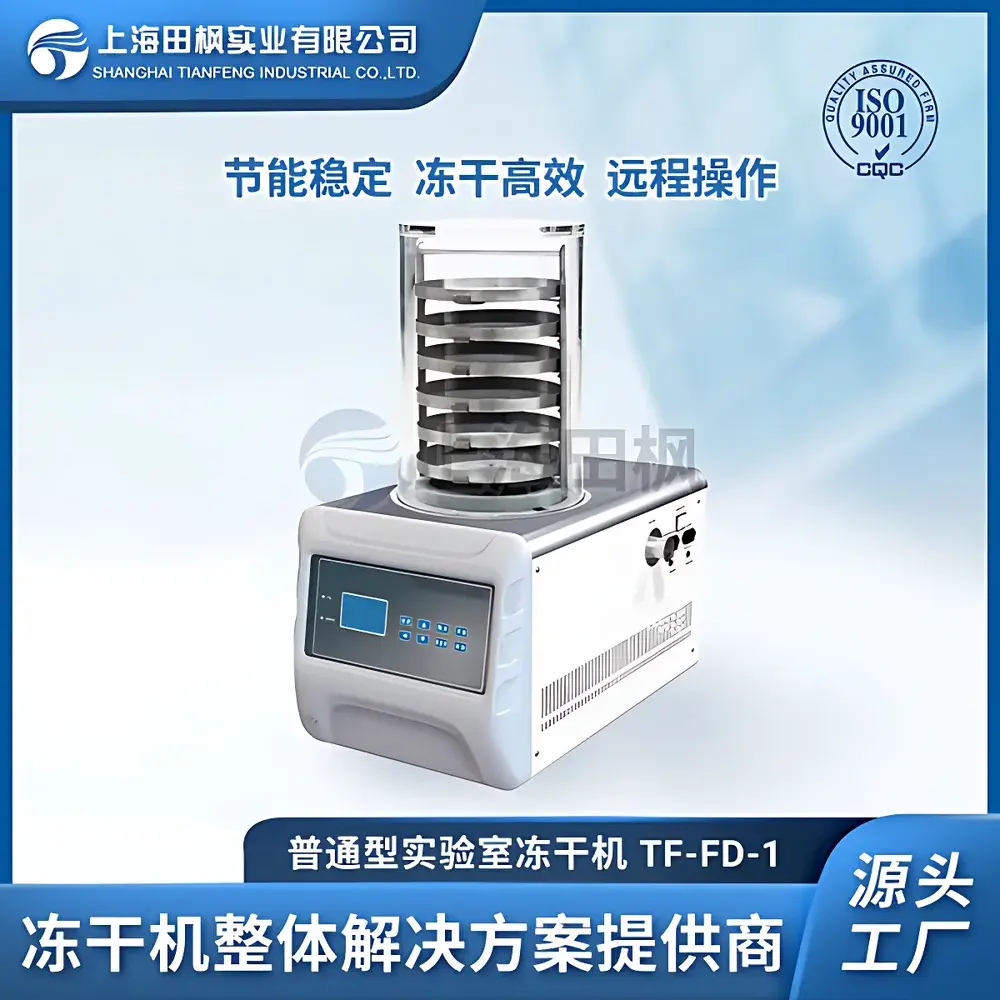
Tianfeng TF-FD-1 Standard Benchtop Freeze Dryer
| Brand | Tianfeng |
|---|---|
| Origin | Shanghai, China |
| Manufacturer Type | Direct Manufacturer |
| Product Category | Domestic |
| Model | TF-FD-1 Standard |
| Instrument Type | Standard Shelf-Type Freeze Dryer |
| Application Scope | Laboratory Use |
| Lyophilization Area | 0.12 m² |
| Ultimate Vacuum | <15 Pa (at no-load) |
| Condensate Capacity | 3 kg/24 h |
| Cold Trap Temperature | <−50 °C |
| Power Supply | 220 V, 50 Hz |
| Power Consumption | 1100 W |
| Dimensions (W×D×H) | 370 × 650 × 360 mm |
| Sample Tray | Φ200 mm × 4 layers |
| Cooling System | Air-Cooled Dual-Stage Refrigeration |
| Construction | Stainless Steel Cold Trap & Transparent Acrylic Drying Chamber |
Overview
The Tianfeng TF-FD-1 Standard Benchtop Freeze Dryer is a compact, air-cooled laboratory-scale lyophilization system engineered for reproducible primary and secondary drying of heat-sensitive biological and pharmaceutical samples. Based on the principle of sublimation under deep vacuum, this unit freezes aqueous samples to below −50 °C, then removes ice directly as vapor without passing through the liquid phase—preserving structural integrity, enzymatic activity, immunogenicity, and reconstitution fidelity. Unlike conventional thermal drying methods that induce denaturation, oxidation, or collapse, freeze drying maintains the original morphology of biomolecules within a porous, matrix-stabilized scaffold. The TF-FD-1 is specifically designed for routine lab use—including microbial culture media preservation, antibody formulation development, vaccine stabilization trials, and small-batch bioprocess validation—where consistent cycle repeatability, traceable process parameters, and GxP-aligned operational transparency are required.
Key Features
- Stainless steel cold trap with ≤−50 °C operating temperature, optimized for water vapor capture during primary drying
- Transparent acrylic drying chamber enabling real-time visual monitoring of ice sublimation, cake formation, and endpoint detection
- Standard shelf-type configuration with four removable Φ200 mm stainless steel trays (total lyophilization area: 0.12 m²)
- Air-cooled dual-stage refrigeration system—no external chiller or water supply required—ensuring stable operation in standard lab environments
- Integrated vacuum pump interface compatible with oil-lubricated or dry scroll pumps (vacuum level maintained at <15 Pa under no-load conditions)
- Robust mechanical architecture with CE-compliant electrical safety design and IP20-rated enclosure
- Front-accessible condenser and tray assembly for rapid cleaning, maintenance, and cross-contamination mitigation
Sample Compatibility & Compliance
The TF-FD-1 supports lyophilization of diverse sample types including bacterial and fungal culture media (e.g., nutrient agar, LB broth), enzyme solutions, monoclonal antibody preparations, plasmid DNA suspensions, and low-concentration protein standards. It accommodates both bulk-loaded vials and open-dish formats. While not certified to ISO 22000 or FDA 21 CFR Part 11 out-of-the-box, the system’s mechanical design conforms to key elements of ISO 13485:2016 (medical device QMS) and ASTM F2476–22 (standard guide for lyophilization cycle development). Its vacuum stability, cold trap efficiency, and temperature uniformity across the shelf surface meet baseline requirements for GLP-compliant method development and analytical reference material preparation. Users may implement supplementary documentation controls—including manual logbooks, calibrated external thermocouples, and independent vacuum verification—to support audit readiness in regulated environments.
Software & Data Management
The TF-FD-1 operates via an integrated digital control panel with LED display, offering manual setpoint adjustment for shelf temperature (indirectly controlled via chamber pressure modulation), vacuum hold time, and total cycle duration. Although it does not include embedded data logging or PC connectivity, its analog interface allows integration with third-party chart recorders or programmable logic controllers (PLCs) for basic trend capture. For full-cycle traceability, users commonly pair the unit with external Class A platinum resistance thermometers (PRTs) placed in representative vials and connect them to validated USB data loggers compliant with 21 CFR Part 11 Annex 11 principles. This hybrid setup supports generation of ALCOA+ (Attributable, Legible, Contemporaneous, Original, Accurate, Complete, Consistent, Enduring, Available) records suitable for internal QC review and pre-submission technical dossiers.
Applications
- Long-term stabilization of microbiological growth media for quality control labs and clinical diagnostics
- Preparation of lyophilized reference standards for HPLC, ELISA, and mass spectrometry calibration
- Rapid prototyping of freeze-dried formulations in early-stage biopharmaceutical development
- Preservation of thermolabile enzymes (e.g., Taq polymerase, restriction endonucleases) without activity loss
- Processing of botanical extracts and traditional medicine preparations requiring moisture removal without thermal degradation
- Small-volume lyophilization of cell lysates, exosome suspensions, and CRISPR-Cas ribonucleoprotein complexes
FAQ
What is the maximum sample volume per batch?
With four Φ200 mm trays, the TF-FD-1 accommodates up to ~600 mL of evenly distributed aqueous solution (assuming 3–5 mm fill depth), yielding approximately 30–50 g of dried solid depending on solute concentration.
Can organic solvents be processed in this unit?
No—the cold trap temperature of <−50 °C is insufficient for efficient capture of common organic solvents (e.g., acetonitrile, methanol, ethanol); use of such solvents may cause pump oil contamination and premature vacuum failure. For solvent-containing formulations, consider the TF-FD-1SL (−80 °C cold trap) or consult application engineering for condenser retrofit options.
Is the system suitable for GMP manufacturing?
It is intended for R&D, method development, and non-commercial scale-up—not for commercial GMP production. However, it serves as a validated platform for generating comparative lyophilization cycle data prior to transfer to qualified production-scale equipment.
How often does the vacuum pump oil require replacement?
Under typical lab usage (2–3 cycles/week), oil should be changed every 3–6 months or after processing >50 L of total water load, depending on pump manufacturer specifications and ambient humidity levels.
Does the unit include a sterile filtration option for inlet/outlet gas lines?
No—gas ballast and inert gas backfilling (e.g., N₂) require user-supplied 0.22 µm hydrophobic membrane filters installed upstream of the chamber vent port.



