
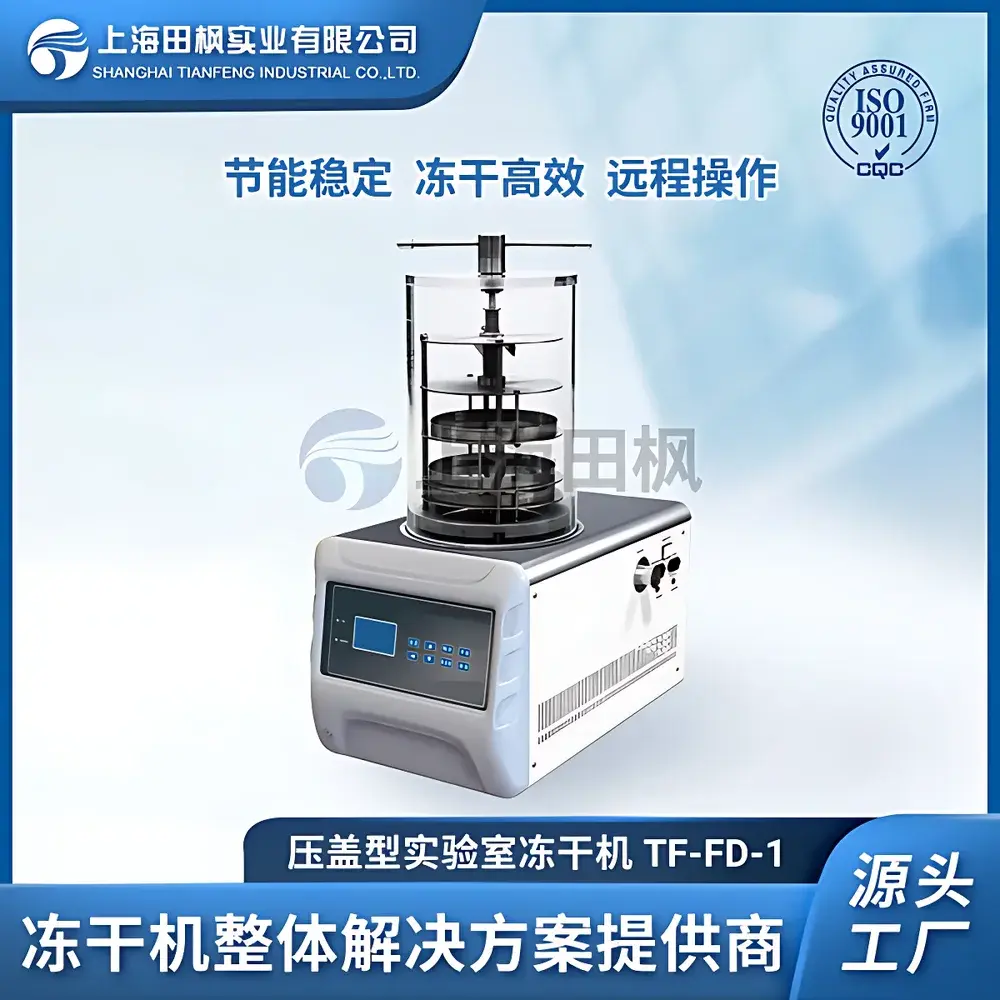
Tianfeng TF-FD-1 Stoppering Laboratory Freeze Dryer
| Brand | Tianfeng |
|---|---|
| Origin | Shanghai, China |
| Manufacturer Type | Direct Manufacturer |
| Equipment Type | Stoppering (Hydraulic or Manual Lid-Sealing) Freeze Dryer |
| Application | Laboratory-Scale Lyophilization |
| Shelf Area | 0.07 m² |
| Ultimate Vacuum (Empty Chamber) | <15 Pa |
| Condenser Temperature | <−50 °C |
| Ice Capacity | 3 kg/24 h |
| Power Consumption | 1100 W |
| Dimensions (W×D×H) | 370 × 650 × 360 mm |
| Electrical Supply | 220 V, 50 Hz |
| Sample Tray | Φ180 mm × 3 layers |
| Construction | Stainless Steel Body, Transparent Acrylic Drying Chamber |
| Refrigeration System | Air-Cooled Dual-Stage Compressor |
| Compliance | Designed for GLP-aligned workflows |
Overview
The Tianfeng TF-FD-1 Stoppering Laboratory Freeze Dryer is a compact, air-cooled lyophilization system engineered for reproducible, small-batch freeze drying of thermolabile biological and pharmaceutical materials under controlled vacuum and sub-zero conditions. It operates on the fundamental principle of lyophilization—sequential freezing, primary drying (sublimation under vacuum), and secondary drying (desorption)—to remove water from samples while preserving structural integrity, bioactivity, and reconstitution fidelity. Unlike conventional thermal drying methods, this system maintains sample temperatures below −40 °C during freezing and holds chamber pressure below 15 Pa during sublimation, minimizing protein denaturation, oxidation, and volatile loss. Its stoppering function enables in-chamber vial sealing post-drying—critical for maintaining sterility and moisture barrier integrity in pre-filled vial formats common in early-stage drug development, vaccine R&D, and diagnostic reagent manufacturing.
Key Features
- Stainless steel condenser and chamber housing ensure corrosion resistance and compliance with laboratory hygiene standards.
- Transparent acrylic drying chamber allows real-time visual monitoring of ice formation, sublimation front progression, and cake morphology without process interruption.
- Integrated stoppering mechanism (manual or optional hydraulic actuation) permits sterile lid sealing immediately after primary drying—eliminating exposure to ambient humidity and particulate contamination.
- Air-cooled dual-stage refrigeration system achieves stable condenser temperatures below −50 °C, enabling efficient capture of water vapor and supporting consistent drying cycles across varied sample loads.
- Three-tier stainless steel shelf configuration (Φ180 mm per tray) provides 0.07 m² total drying area optimized for standard 10–20 mL serum vials or custom sample containers.
- Robust vacuum architecture includes a high-efficiency oil-sealed rotary vane pump (not included) and calibrated vacuum sensor, delivering reliable <15 Pa ultimate vacuum under no-load conditions.
- Front-panel digital controller with LED display supports manual parameter setting (vacuum setpoint, drying time, shelf temperature offset) and cycle status feedback.
Sample Compatibility & Compliance
The TF-FD-1 accommodates aqueous and low-concentration organic-aqueous formulations typical of monoclonal antibodies, recombinant proteins, plasmid DNA, viral vectors, and sterile APIs. While not rated for high-boiling-point solvents (e.g., DMSO >189 °C), it reliably processes common lyophilization excipients including sucrose, trehalose, mannitol, and sodium phosphate buffers. The system’s mechanical design and material selection align with ISO 13485–informed cleanability requirements and support installation in ISO Class 7 (10,000) or better environments. Though not pre-certified to FDA 21 CFR Part 11, its operational log capability (via external data logger) and deterministic process parameters facilitate audit-ready documentation for GLP and GMP Phase I–II studies. Validation packages—including Installation Qualification (IQ), Operational Qualification (OQ), and user-defined Performance Qualification (PQ) templates—are available upon request.
Software & Data Management
The TF-FD-1 operates via an embedded microcontroller interface with non-volatile memory for up to 10 user-defined drying profiles. While it does not include PC-based software or Ethernet connectivity, its analog output ports (0–10 V DC) enable integration with third-party data acquisition systems (e.g., LabVIEW, DeltaV, or custom SCADA) for time-stamped recording of chamber pressure, condenser temperature, and elapsed cycle time. For laboratories requiring electronic records compliant with ALCOA+ principles, optional RS-485 or USB-to-serial adapters allow connection to validated charting software with audit trail, electronic signature, and backup functionality—supporting adherence to Annex 11 and USP analytical instrument qualification guidelines.
Applications
This freeze dryer serves critical roles across preclinical and translational research domains: stabilization of reference standards and calibration materials; preparation of lyophilized cell culture media supplements; long-term archiving of clinical trial biospecimens (serum, plasma, PBMCs); formulation screening for parenteral biologics; and small-scale production of lyophilized diagnostics (ELISA kits, lateral flow reagents). Its stoppering capability makes it especially suited for labs developing lyo-ready vial configurations prior to technology transfer to pilot-scale or commercial freeze dryers. Academic users leverage its transparency and repeatability for teaching lyophilization kinetics, collapse temperature determination (Tg’), and mass transfer modeling.
FAQ
Does the TF-FD-1 include a vacuum pump?
No—the unit requires an external oil-sealed or dry scroll vacuum pump (recommended pumping speed ≥ 4 m³/h) to achieve and maintain <15 Pa operating pressure.
Can the condenser be used for pre-freezing samples?
Yes—the condenser doubles as a pre-freezing shelf; samples in open vials may be frozen directly on the cold surface prior to chamber evacuation.
Is the stoppering function automated or manual?
Standard configuration features manual stoppering via integrated lever mechanism; hydraulic or pneumatic stoppering upgrade kits are available for repeatable force application.
What maintenance is required for long-term reliability?
Biannual inspection of refrigerant charge, annual replacement of vacuum pump oil (if used), and quarterly cleaning of condenser fins and chamber gaskets are recommended per manufacturer guidelines.
How is temperature uniformity across shelves verified?
Temperature mapping studies using calibrated PT100 probes are advised during initial qualification; typical deviation across the three trays is ±1.5 °C at −40 °C setpoint.



