
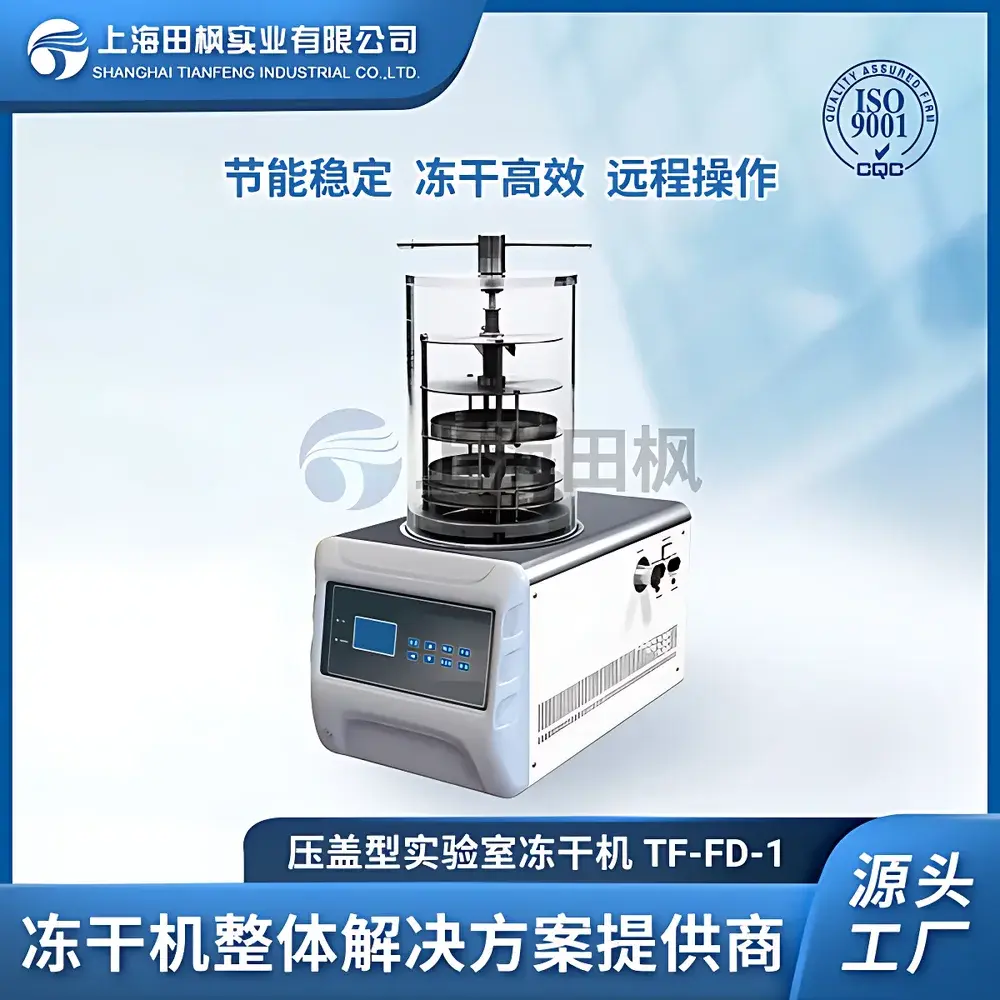
Tianfeng TF-FD-1 Stoppering Laboratory Freeze Dryer
| Brand | Tianfeng |
|---|---|
| Origin | Shanghai, China |
| Manufacturer Type | OEM Manufacturer |
| Product Category | Domestic |
| Model | TF-FD-1 Stoppering Type |
| Instrument Type | Stoppering Freeze Dryer |
| Application Scope | Laboratory Use |
| Shelf Area | 0.07 m² |
| Ultimate Vacuum | <15 Pa (at no-load) |
| Condenser Temperature | <−50 °C |
| Ice Capacity | 3 kg/24 h |
| Dimensions (W×H×D) | 370 mm × 650 mm × 360 mm |
| Power Supply | 220 V, 50 Hz |
| Rated Power | 1100 W |
| Chamber Material | 304 Stainless Steel |
| Viewing Window | Transparent Acrylic Door |
| Refrigeration System | Air-Cooled Single-Stage Compressor |
| Pre-freezing Method | In-situ (via condenser) |
| Control Interface | Touchscreen LCD with PID Control |
| Optional Accessories | Temperature Data Logger, Gas Inlet Valve (for inert gas backfill), Eutectic Point Tester, Automatic Stoppering Unit |
Overview
The Tianfeng TF-FD-1 Stoppering Laboratory Freeze Dryer is a compact, air-cooled, in-situ pre-freezing freeze dryer engineered for precision lyophilization of heat-sensitive biological and polymeric materials—including pharmaceuticals, biologics, nanomaterials (e.g., graphene oxide dispersions), and polymer-based formulations. It operates on the fundamental principle of sublimation: samples are first frozen solid at low temperature, then subjected to high vacuum (<15 Pa), enabling ice to transition directly from solid to vapor phase without passing through liquid—thereby preserving structural integrity, bioactivity, and chemical stability. Unlike conventional drying methods involving thermal exposure, freeze drying minimizes denaturation, oxidation, and aggregation, making it indispensable for stabilizing labile compounds such as enzymes, monoclonal antibodies, vaccine candidates, and functional nanomaterials like oxidized graphene sheets prior to storage or formulation development.
Key Features
- In-situ pre-freezing capability via integrated condenser (≤−50 °C), eliminating need for external ultra-low temperature freezers and reducing contamination risk during sample transfer.
- Stoppering-compatible chamber design with stainless steel shelf (Φ180 mm × 3 layers) and motorized lid actuation—enabling sterile, post-drying vial sealing under controlled vacuum or inert gas (N₂/Ar) atmosphere via optional gas inlet valve.
- Touchscreen LCD interface with real-time graphical display of shelf temperature, condenser temperature, chamber pressure, and drying time—supporting user-defined PID control loops for reproducible process optimization.
- Air-cooled single-stage refrigeration system with high-efficiency copper-aluminum finned condenser; robust 304 stainless steel construction ensures corrosion resistance, cleanability, and compliance with laboratory hygiene standards.
- Optically clear acrylic viewing door provides unobstructed visual monitoring throughout all drying stages—from nucleation and primary drying to secondary drying—facilitating empirical validation of cake morphology and collapse onset.
- Compliant with ISO 9001:2000 quality management framework; designed to support Good Laboratory Practice (GLP) workflows including audit-ready documentation when paired with optional temperature data logger (±0.5 °C accuracy, configurable logging intervals).
Sample Compatibility & Compliance
The TF-FD-1 accommodates aqueous and low-concentration organic solvent systems (e.g., ethanol/water mixtures used in graphene oxide dispersion processing), though extended exposure to high-volatility solvents (>10% v/v) is not recommended without cold trap enhancement. Its 0.07 m² shelf area supports standard 10–20 mL serum vials (up to 120 units per batch) or custom trays for polymer films and hydrogels. The system meets baseline mechanical and electrical safety requirements per IEC 61010-1 and is suitable for use in Class II biosafety cabinets or ISO Class 5/7 cleanrooms when operated with appropriate environmental controls. While not FDA 21 CFR Part 11–validated out-of-the-box, its data logging architecture permits integration into validated environments via third-party software qualification protocols.
Software & Data Management
Embedded firmware enables local storage of up to 10 complete drying cycles with timestamped parameter logs (shelf temp, pressure, condenser temp). Export is supported via USB flash drive in CSV format for offline analysis in MATLAB, Python, or Excel. Optional temperature data logger provides GLP-compliant traceability: calibrated thermocouples (Type T) record shelf surface and product core temperatures at user-selectable intervals (1–60 min), generating PDF reports with digital signatures and metadata (operator ID, batch number, ambient conditions). All stored data retain immutable timestamps and cannot be edited post-acquisition—ensuring integrity for regulatory submissions and internal quality audits.
Applications
- Biopharmaceutical R&D: Lyophilization of protein therapeutics, mRNA-LNPs, and viral vectors; optimization of critical process parameters (annealing, ramp rates, endpoint determination) using real-time pressure rise test (PRT) correlation.
- Nanomaterial Stabilization: Preservation of colloidal stability in graphene oxide, MXene, and polymer-nanoparticle hybrids—preventing restacking and maintaining dispersibility upon reconstitution.
- Polymer Science: Processing of hydrogel scaffolds, electrospun nanofibers, and stimuli-responsive micelles where pore architecture and molecular weight distribution must remain intact post-drying.
- Diagnostic Reagents: Stabilization of enzyme conjugates, immunoassay calibrators, and PCR master mixes requiring long-term room-temperature storage without refrigeration.
- Academic Research: Teaching freeze drying fundamentals; comparative studies of excipient performance (trehalose vs. sucrose vs. dextran); investigation of collapse temperature (Tc) via manometric temperature measurement (MTM) add-ons.
FAQ
Can the TF-FD-1 handle samples containing organic solvents such as acetone or methanol?
The standard condenser (≤−50 °C) effectively traps water and low-volatility solvents (e.g., tert-butanol), but high-volatility solvents require supplemental cold trapping or reduced loading volumes to prevent pump oil contamination and premature vacuum degradation.
Is in-situ pre-freezing sufficient for eutectic point determination?
No—while the condenser achieves ≤−50 °C, precise eutectic temperature mapping requires an external cryostage or dedicated eutectic point tester (optional accessory), as the shelf does not provide active cooling during freezing.
What maintenance is required for long-term reliability?
Biannual inspection of refrigerant charge, vacuum pump oil replacement (every 500 operating hours), and O-ring lubrication with silicone grease; condenser coil cleaning every 6 months in dust-prone environments.
Does the system support automated cycle programming with multiple shelf temperature ramps?
Yes—the touchscreen interface allows up to 5 programmable segments per cycle, each with independent setpoints for shelf temperature, hold time, and vacuum level, enabling complex primary/secondary drying profiles.
Can the TF-FD-1 be integrated into a GMP-compliant manufacturing environment?
As supplied, it meets equipment qualification prerequisites (IQ/OQ); full GMP readiness requires documented installation in a qualified facility, vendor-supported PQ execution, and integration with enterprise-level LIMS or MES systems for electronic batch records.
Related Products



