
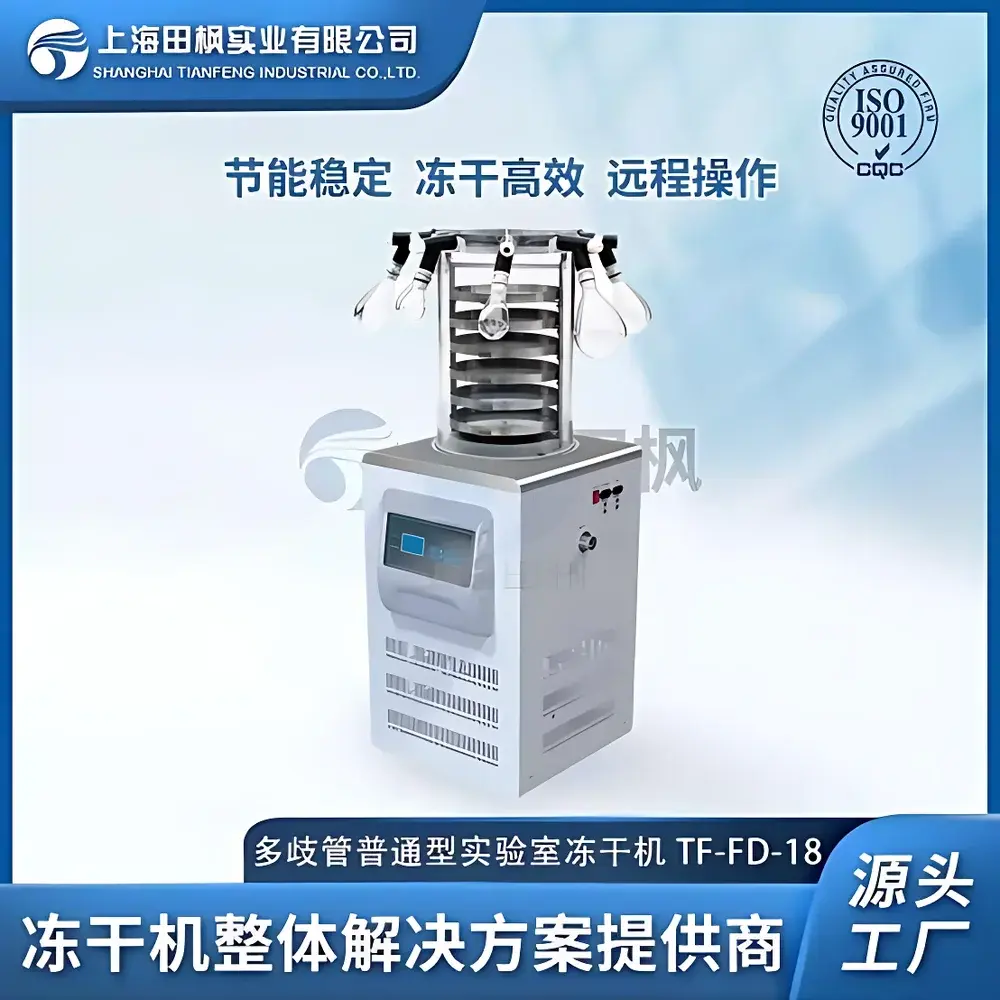
Tianfeng TF-FD-18 Manifold-Type Laboratory Freeze Dryer
| Brand | Tianfeng |
|---|---|
| Origin | Shanghai, China |
| Manufacturer Type | Direct Manufacturer |
| Equipment Type | Manifold-Type Freeze Dryer |
| Application Scope | Laboratory R&D and Small-Batch Production |
| Shelf Area | 0.18 m² |
| Ultimate Vacuum (No Load) | <15 Pa |
| Condenser Temperature | <−60 °C |
| Ice Capacity | 6 kg/24 h |
| Dimensions (W×D×H) | 550 mm × 550 mm × 960 mm |
| Power Supply | 220 V, 50 Hz |
| Rated Power | 1500 W |
| Chamber Material | 304 Stainless Steel + Transparent Acrylic Door |
| Condenser Type | Air-Cooled Dual-Stage Refrigeration System |
| Optional Accessories | Temperature Data Logger, In-Chamber Pre-Freezing, Inert Gas Purge Valve, Eutectic Point Tester |
Overview
The Tianfeng TF-FD-18 Manifold-Type Laboratory Freeze Dryer is a precision-engineered lyophilization system designed for reproducible, scalable freeze drying of heat-sensitive biological and pharmaceutical materials. It operates on the fundamental principle of sublimation—removing water from frozen samples under deep vacuum while maintaining temperatures below the eutectic point, thereby preserving structural integrity, enzymatic activity, and immunogenicity. Unlike conventional thermal drying methods that induce denaturation, shrinkage, or oxidation, this system enables primary drying at ≤0 °C and secondary drying at controlled temperatures up to 60 °C, yielding porous, reconstitutable matrices with minimal residual moisture (<2% w/w typical). Its manifold configuration supports simultaneous processing of multiple vials, flasks, or ampoules—ideal for parallel screening of formulations in biopharmaceutical development, probiotic stabilization, diagnostic reagent preparation, and academic research.
Key Features
- Manifold design with eight independent ports accommodating standard conical flasks (50–1000 mL) for flexible, non-contact sample handling;
- High-efficiency dual-stage air-cooled refrigeration system achieving condenser temperatures <−60 °C, optimized for rapid ice capture and stable vacuum maintenance;
- Stainless steel (AISI 304) condenser chamber and internal components ensure corrosion resistance, cleanability, and compliance with GMP-compatible cleaning protocols;
- Transparent acrylic drying chamber with integrated observation window enables real-time visual monitoring of sublimation progression and cake morphology;
- Intuitive 7-inch color touch screen interface displaying real-time vacuum pressure, condenser temperature, shelf temperature (if equipped), and customizable drying curves;
- PID-controlled vacuum regulation and optional inert gas purge valve (N₂ or Ar) support oxygen-sensitive applications and prevent oxidation during loading/unloading;
- Robust mechanical architecture with vibration-damped compressor mounting minimizes operational noise (<65 dB(A)) and extends service life;
- Compliance-ready design: supports 21 CFR Part 11–compliant data logging when paired with optional certified temperature recorders and audit-trail-enabled software.
Sample Compatibility & Compliance
The TF-FD-18 is validated for use with a broad spectrum of thermolabile substances—including live probiotic cultures (e.g., Lactobacillus, Bifidobacterium strains), monoclonal antibodies, recombinant proteins, viral vectors, plasmid DNA, enzyme preparations, and botanical extracts. Its −60 °C condenser provides sufficient cold margin for aqueous systems and low-concentration organic solvent mixtures (e.g., <5% ethanol or acetone), though high-volatility solvents require prior concentration or alternative trapping strategies. The system meets ISO 22000 and ISO 13485 foundational requirements for food and medical device manufacturing environments. While not pre-certified for FDA submission, its architecture aligns with ICH Q5C stability guidelines and USP compounding standards when operated within defined process parameters and documented SOPs.
Software & Data Management
The embedded control system logs timestamped vacuum pressure, condenser temperature, and ambient cabinet temperature at user-defined intervals (1–60 sec). Exportable CSV files facilitate integration with LIMS or ELN platforms. Optional add-ons include GLP-compliant temperature data loggers with NIST-traceable calibration certificates and configurable alarm thresholds (e.g., vacuum excursion >20 Pa, condenser temp rise >−50 °C). All recorded data retain immutable timestamps and operator ID fields—critical for regulatory audits under 21 CFR Part 11 when deployed with electronic signature modules. Firmware updates are delivered via secure USB import, ensuring traceable version control without network exposure.
Applications
- Stabilization of lyophilized probiotic powders for clinical trials and nutraceutical manufacturing;
- Routine freeze drying of cell lysates, purified antigens, and reference standards in QC laboratories;
- Preparation of sterile, pyrogen-free diagnostic reagents (e.g., ELISA kits, PCR master mixes);
- Long-term cryopreservation of microbial strains, tissue homogenates, and extracellular vesicles;
- Method development for formulation optimization (bulking agents, cryoprotectants, annealing cycles);
- Scale-down modeling for process transfer to pilot-scale or production lyophilizers (e.g., mapping critical quality attributes such as collapse temperature and drying rate).
FAQ
What is the maximum batch size supported by the TF-FD-18 manifold configuration?
The system accommodates up to eight 1000 mL flasks simultaneously, with total shelf area of 0.18 m² and 6 kg/24 h ice capacity—suitable for batches ranging from 500 mL to 4 L total volume.
Can the unit perform in-chamber pre-freezing?
Yes—the condenser serves as a pre-freezing surface; samples in flasks may be frozen directly inside the chamber prior to vacuum application, eliminating need for external ultra-low temperature freezers.
Is the system compatible with organic solvents?
It handles low-concentration aqueous-organic mixtures (e.g., ≤5% ethanol, methanol, or acetone); for higher volatility solvents, consult engineering support for trap modification or staged drying protocols.
Does it support automated cycle programming?
The base model includes manual stage control; optional upgrade enables multi-step ramp-hold profiles with automatic transition triggers based on vacuum stability or temperature differentials.
What maintenance is required for long-term reliability?
Recommended quarterly inspection of O-rings, annual refrigerant charge verification, and biannual calibration of vacuum transducer and temperature sensors using accredited traceable standards.



