
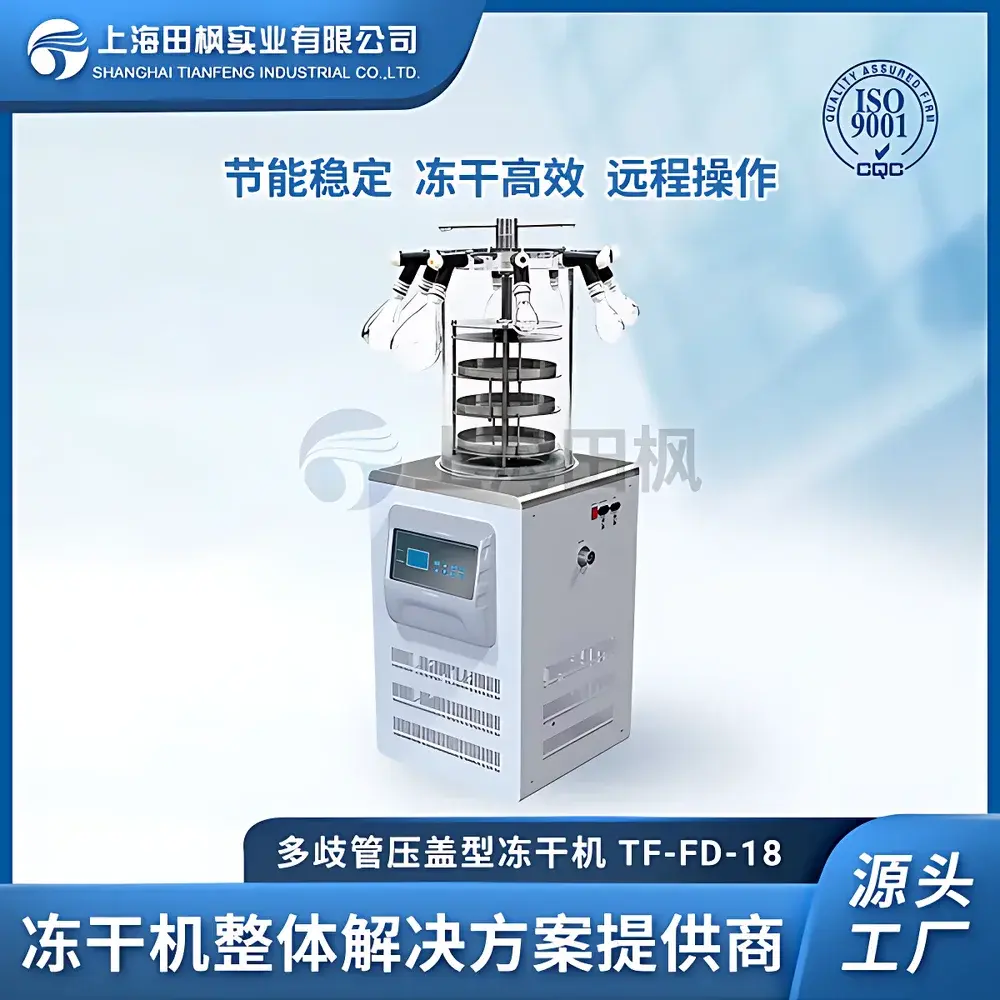
Tianfeng TF-FD-18S Manifold Freeze Dryer with Stoppering Function
| Brand | Tianfeng |
|---|---|
| Origin | Shanghai, China |
| Manufacturer Type | Direct Manufacturer |
| Instrument Type | Manifold Freeze Dryer |
| Application Scope | Laboratory Use |
| Shelf Area | 0.11 m² |
| Ultimate Vacuum (No Load) | <15 Pa |
| Condenser Temperature | <−60 °C |
| Water Capture Capacity | 6 kg/24 h |
| Dimensions (W×D×H) | 550 mm × 550 mm × 960 mm |
| Power Supply | 220 V, 50 Hz |
| Rated Power | 1700 W |
| Chamber Material | 304 Stainless Steel |
| Refrigeration System | Cascade Refrigeration |
| Control Interface | Touchscreen LCD with Real-Time Graphical Display |
| Heating Medium | Silicone Oil (Temperature Uniformity ≤ ±1 °C) |
| Optional Accessories | In-chamber Pressure Control Valve (Inert Gas Purge), Co-crystallization Point Tester, Automatic Stoppering Unit, Temperature Data Logger (GLP-Compliant) |
Overview
The Tianfeng TF-FD-18S Manifold Freeze Dryer with Stoppering Function is a laboratory-scale lyophilization system engineered for precise, reproducible freeze drying of heat-sensitive biological and pharmaceutical samples. It operates on the fundamental principle of sublimation—removing water from frozen material under deep vacuum while maintaining the sample in its solid phase. This process preserves structural integrity, bioactivity, and chemical stability far more effectively than conventional thermal drying methods. Designed for benchtop operation in R&D laboratories, quality control facilities, and academic research settings, the TF-FD-18S integrates a high-efficiency cascade refrigeration system, manifold-style sample ports for independent vial processing, and an integrated stoppering mechanism to enable sterile, post-drying sealing without breaking vacuum. Its −60 °C condenser temperature ensures robust ice capture during primary drying, while the <15 Pa ultimate vacuum supports efficient mass transfer of water vapor from sample to condenser surface.
Key Features
- Manifold configuration with eight independently controllable ports (compatible with 50–1000 mL vials), enabling parallel processing of heterogeneous samples without cross-contamination.
- Integrated hydraulic or pneumatic stoppering function for in-chamber, vacuum-compatible sealing—critical for aseptic handling of sterile pharmaceuticals and biologics.
- Cascade refrigeration system using dual-stage compressors and environmentally compliant refrigerants, delivering stable condenser temperatures below −60 °C with low acoustic noise (<62 dB(A)) and high thermal efficiency.
- Touchscreen HMI with real-time graphical display of shelf temperature, chamber pressure, condenser temperature, and user-defined drying profiles; PID-controlled shelf heating with ±1 °C uniformity via silicone oil circulation.
- Full 304 stainless steel construction of condenser chamber, manifold, and internal components—corrosion-resistant, non-porous, and compliant with ISO 14644-1 Class 5 cleanroom maintenance protocols.
- Optically transparent acrylic observation door with anti-fog coating and integrated LED lighting—enabling visual monitoring of sublimation front progression and cake morphology development.
- Standard inert gas inlet valve (N₂ or Ar) for controlled backfilling, oxygen-sensitive sample protection, and residual moisture reduction during secondary drying.
Sample Compatibility & Compliance
The TF-FD-18S accommodates a broad spectrum of thermolabile materials, including but not limited to: monoclonal antibodies, plasmid DNA, viral vectors, enzyme preparations, probiotic cultures, herbal extracts (e.g., Ophiocordyceps sinensis), vaccine candidates, and diagnostic reagents. Its 0.11 m² shelf area supports standard Φ220 mm trays across three levels, while the manifold ports accept common serum vials (2R–20R) and custom glassware. The system complies with essential regulatory frameworks for laboratory instrumentation: ISO 9001:2015 certified manufacturing, CE marking per Machinery Directive 2006/42/EC and Electromagnetic Compatibility Directive 2014/30/EU, and design alignment with ASTM F2375–22 (Standard Guide for Lyophilization Process Development). When equipped with optional GLP-compliant data logging, it supports audit-ready traceability per FDA 21 CFR Part 11 requirements—including electronic signatures, user access controls, and immutable event logs.
Software & Data Management
The embedded control firmware supports fully programmable multi-step drying cycles, including pre-freezing ramp rates, hold durations at eutectic temperature, primary drying ramp profiles, and secondary drying isotherms. All parameters—including shelf setpoints, chamber pressure setpoints, and condenser load—are logged at user-selectable intervals (1–60 seconds) and exportable in CSV format. Optional data logger modules provide time-stamped temperature traces from up to four external Pt100 probes (e.g., product core, shelf surface, condenser, and chamber ambient), meeting GLP documentation standards. Remote monitoring is enabled via Ethernet interface with Modbus TCP protocol support for integration into centralized LIMS or SCADA environments. Firmware updates are performed via USB drive with version-controlled checksum verification to ensure system integrity.
Applications
- Pharmaceutical R&D: Stabilization of parenteral formulations, development of lyophilized reference standards, and excipient screening under ICH Q5C guidelines.
- Biotechnology: Long-term preservation of cell lines, CRISPR/Cas9 ribonucleoprotein complexes, and extracellular vesicles without aggregation or denaturation.
- Traditional Medicine Research: Structural and metabolomic preservation of botanical actives (e.g., cordycepin from O. sinensis) for pharmacokinetic and stability studies.
- Diagnostic Manufacturing: Production of dry-reagent strips, ELISA kits, and rapid antigen test components requiring consistent rehydration kinetics.
- Agricultural Biotech: Lyophilization of mycorrhizal spores, rhizobial inoculants, and phage preparations for field deployment under ambient storage conditions.
FAQ
What is the maximum batch size supported by the TF-FD-18S manifold configuration?
The system accommodates up to eight standard vials simultaneously (50–1000 mL); total loaded sample mass should remain within the 6 kg/24 h condensation capacity limit to maintain optimal drying kinetics.
Can the TF-FD-18S be validated for GMP-compliant production?
While designed for laboratory use, the TF-FD-18S supports IQ/OQ protocols when configured with calibrated PT100 sensors, pressure transducers traceable to NIST standards, and optional 21 CFR Part 11-compliant data logging. Formal PQ requires site-specific risk assessment and process mapping.
Is silicone oil leakage a concern during long-duration cycles?
No—the sealed, double-jacketed circulation system uses food-grade methylphenyl silicone oil with thermal stability exceeding 200 °C and zero volatility under operating conditions (−40 °C to +60 °C shelf range).
How does the cascade refrigeration improve performance versus single-stage systems?
Cascade architecture separates high- and low-temperature circuits, enabling deeper condenser temperatures (≤−60 °C) with higher COP (coefficient of performance), faster cooldown times (<60 min from ambient), and improved ice entrapment efficiency during high-moisture loads.
What maintenance intervals are recommended for sustained reliability?
Condenser coil cleaning every 6 months; vacuum pump oil replacement every 500 operational hours; O-ring inspection and lubrication annually; full system calibration every 12 months using certified reference standards.
Related Products



