
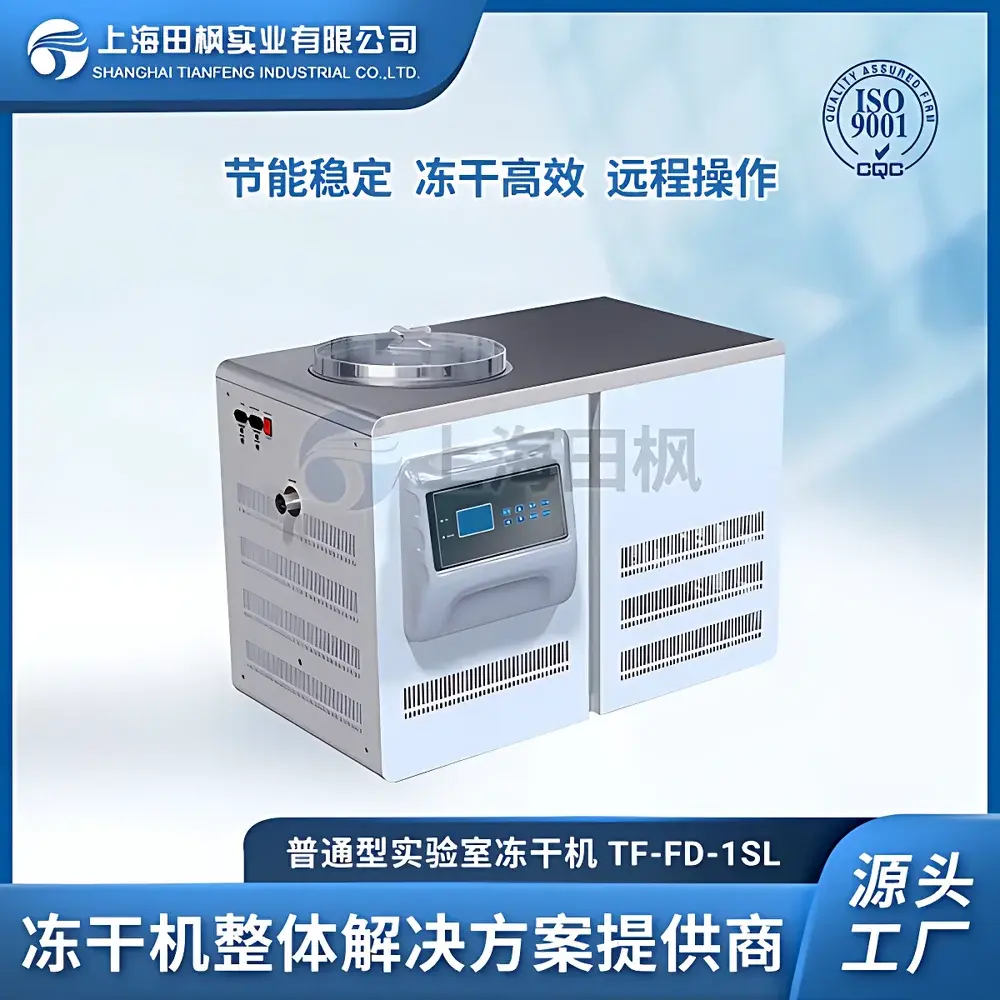
Tianfeng TF-FD-1SL In-Situ Pre-Freezing Explosion-Proof Laboratory Freeze Dryer
| Brand | Tianfeng |
|---|---|
| Origin | Shanghai, China |
| Manufacturer Type | Direct Manufacturer |
| Product Category | Domestic |
| Model | TF-FD-1SL (Standard Type, In-Situ Pre-Freezing) |
| Instrument Type | Standard Shelf-Type Freeze Dryer |
| Application Scope | Laboratory Use |
| Lyophilization Area | 0.12 m² |
| Ultimate Vacuum | <15 Pa (at no-load) |
| Condenser Temperature | <−80 °C |
| Ice Trapping Capacity | 8 kg/24 h |
| Power Consumption | 2200 W |
| Dimensions (W×D×H) | 1200 × 550 × 800 mm |
| Shelf Configuration | 4-layer Φ200 mm Stainless Steel Trays |
| Control System | Touchscreen LCD with Real-Time Shelf Temperature & Vacuum Curve Display |
| Refrigeration System | Dual-Stage Cascade Compressor |
| Chamber Material | 304 Stainless Steel Interior + High-Transparency Acrylic Door |
| Optional Features | Inert Gas Purge Valve, Temperature Data Logger, Eutectic Point Tester, Automatic Stoppering Module |
Overview
The Tianfeng TF-FD-1SL is a purpose-engineered, in-situ pre-freezing laboratory freeze dryer designed for safe and reproducible lyophilization of thermolabile biologicals—including vaccines, monoclonal antibodies, enzyme formulations, and sterile pharmaceutical intermediates—under intrinsically safe operating conditions. It implements the fundamental principle of sublimation-based drying: samples are first frozen solid at cryogenic temperatures (<−80 °C), then subjected to high vacuum (<15 Pa) to enable direct phase transition of ice to vapor without passing through the liquid state. This preserves structural integrity, bioactivity, and reconstitution fidelity—critical for GMP-aligned process development and stability studies. Unlike conventional hot-air or spray-drying methods that induce denaturation, oxidation, or collapse, lyophilization maintains molecular conformation and residual moisture content below 1–3% w/w, extending shelf life from months to years under ambient storage. The TF-FD-1SL’s explosion-proof architecture complies with IEC 60079-0 and EN 60079-15 standards for equipment used in potentially hazardous atmospheres containing flammable solvents (e.g., ethanol, acetone, tert-butanol) commonly employed in biopharmaceutical formulation.
Key Features
- In-situ pre-freezing capability with programmable shelf temperature control (−50 °C to +60 °C), eliminating manual transfer between freezer and dryer and minimizing thermal shock and contamination risk.
- Dual-stage cascade refrigeration system achieving stable condenser temperatures <−80 °C—essential for efficient capture of volatile organic solvents and high-moisture-load samples.
- 4-tier stainless steel (AISI 304) shelves (Φ200 mm each), engineered for uniform heat transfer and mechanical rigidity; compatible with standard serum vials, scintillation vials, and custom trays.
- High-transparency acrylic observation door enables real-time visual monitoring of ice morphology, sublimation front progression, and cake structure evolution without vacuum break.
- Touchscreen HMI with integrated PID control algorithm displays real-time vacuum pressure, shelf temperature, condenser temperature, and time-stamped lyophilization curves—supporting method development per ICH Q5C and USP <1208>.
- Integrated inert gas purge valve (N₂ or argon) for oxygen-sensitive products and post-drying headspace conditioning prior to stoppering.
- Full 304 stainless steel interior chamber and condenser housing—resistant to corrosion from acidic/basic buffers, saline solutions, and organic solvent vapors.
Sample Compatibility & Compliance
The TF-FD-1SL accommodates diverse sample formats: bulk solutions in glass vials (2–20 mL), lyophilization trays (up to 0.12 m² active area), and multi-port manifold configurations for parallel small-batch processing. It supports aqueous and partially organic solvent systems (e.g., ≤30% v/v ethanol/water), validated for use with vaccine candidates (mRNA-LNPs, viral vectors), diagnostic reagents, probiotic cultures, and botanical extracts. Its design meets core requirements for GLP-compliant laboratories (OECD 1998) and aligns with FDA 21 CFR Part 11 data integrity expectations when paired with optional audit-trail-enabled data loggers. All wetted surfaces comply with USP Class VI biocompatibility testing; vacuum system components conform to ISO 8573-1:2010 Class 2 purity specifications for compressed air/gas supply.
Software & Data Management
The embedded control firmware records timestamped process parameters at user-defined intervals (1–60 s resolution), exporting CSV files via USB port for traceability and statistical analysis (e.g., ANOVA of drying rates, Mann-Whitney U tests across batches). Optional compliant data logger modules provide electronic signatures, role-based access control, and 21 CFR Part 11–compliant audit trails—including operator ID, parameter change history, and alarm event logs. Exported datasets integrate natively with JMP, MATLAB, and Python-based lyo-modelling tools (e.g., LyoMod, PARETO) for primary drying endpoint prediction and critical quality attribute (CQA) correlation.
Applications
- Vaccine stabilization: Long-term storage of live-attenuated, inactivated, and subunit vaccines without cold-chain dependency.
- Biopharmaceutical R&D: Formulation screening of mAbs, fusion proteins, and gene therapy vectors under variable annealing and ramp protocols.
- Diagnostics: Preservation of ELISA antigens, PCR master mixes, and lateral flow assay conjugates with retained binding affinity.
- Cell banking: Cryopreservation of primary cells, stem cell lines, and microbial cultures with >90% post-rehydration viability.
- Food science: Pilot-scale dehydration of functional ingredients (e.g., anthocyanin-rich berry powders, lactic acid bacteria) while retaining antioxidant capacity and enzymatic activity.
- Material science: Preparation of porous scaffolds for tissue engineering and aerogel precursors via controlled ice templating.
FAQ
What safety certifications does the TF-FD-1SL hold for explosive environments?
It conforms to IEC 60079-0 (general requirements) and IEC 60079-15 (type of protection “nA”) for non-sparking equipment suitable for Zone 2/22 classified areas.
Can the system be validated for GMP manufacturing?
Yes—when equipped with IQ/OQ documentation packages, calibrated PT100 sensors (±0.2 °C), and 21 CFR Part 11–enabled data logging, it supports Phase 1–3 clinical trial material production per EU Annex 15.
Is shelf heating required for all lyophilization cycles?
No—primary drying may proceed without shelf heating for highly porous matrices; however, controlled conductive heating (0.1–1.0 °C/min ramp) is essential for dense formulations to maintain collapse temperature (Tc) margin and reduce cycle time by up to 40%.
What maintenance intervals are recommended for the dual-stage compressor?
Oil changes every 3,000 operational hours; annual inspection of refrigerant charge, desiccant cartridge, and vacuum pump oil; quarterly verification of door seal integrity and O-ring compression set.
Does the system support automated cycle transfer between instruments?
Yes—via standardized .lyo file import/export (ASTM E2500-13 compliant format), enabling method scalability from TF-FD-1SL (lab scale) to production-scale freeze dryers (e.g., 0.5–5 m² shelf area).



