
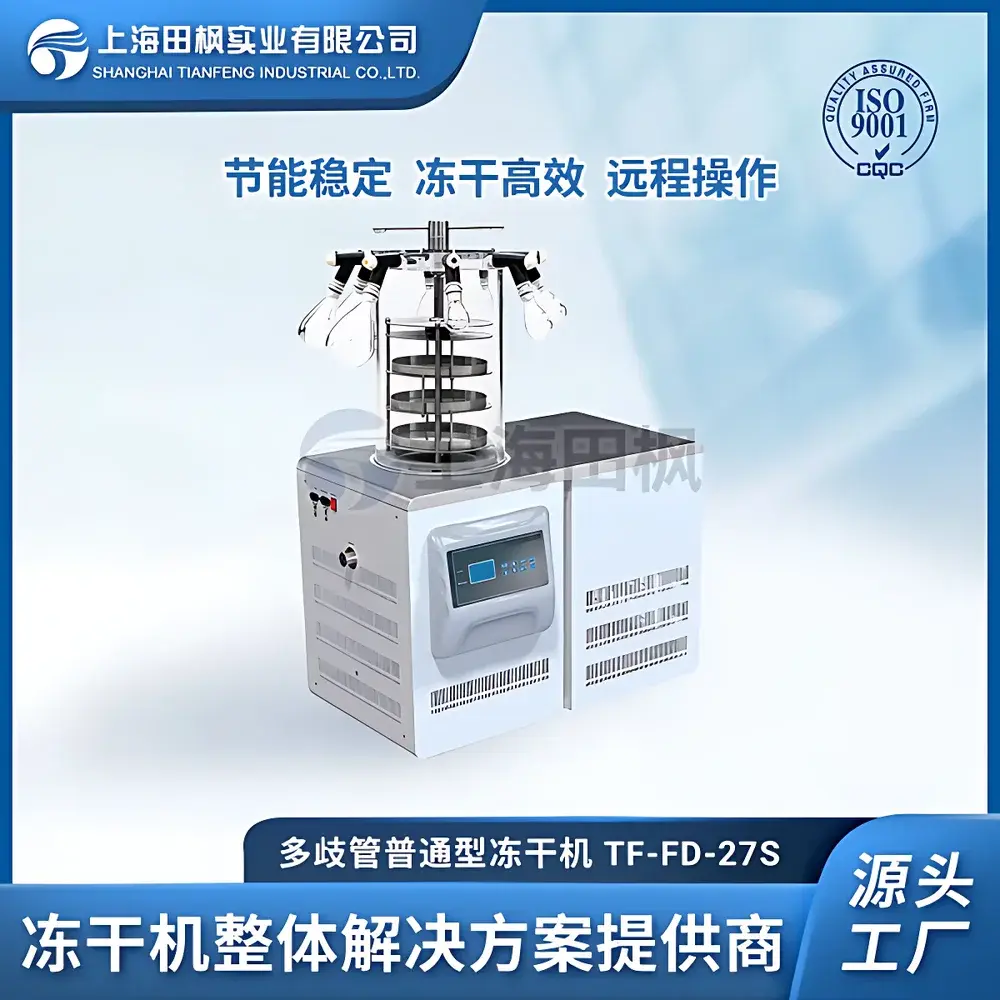
Tianfeng TF-FD-27 Manifold-Type Stoppering Freeze Dryer
| Brand | Tianfeng |
|---|---|
| Origin | Shanghai, China |
| Manufacturer Type | Direct Manufacturer |
| Instrument Type | Manifold-Type Freeze Dryer |
| Application Scope | Laboratory Use |
| Shelf Area | 0.11 m² |
| Ultimate Vacuum | <15 Pa (at no-load) |
| Condenser Temperature | <−80 °C |
| Ice Capacity | 6 kg/24 h |
| Power Consumption | 2200 W |
| Dimensions (H×W×D, excl. drying chamber) | 1200 × 550 × 870 mm |
| Sample Tray | Φ220 mm × 3 layers |
| Electrical Supply | 220 V, 50 Hz |
| Construction | 304 Stainless Steel Condenser & Chamber Interior |
| Refrigeration System | Dual-Stage Cascade Compressor |
| Optional Features | In-chamber pressure regulation valve (inert gas purge), temperature data logger, eutectic point measurement kit, automatic stoppering actuator |
Overview
The Tianfeng TF-FD-27 Manifold-Type Stoppering Freeze Dryer is a laboratory-scale lyophilization system engineered for reproducible, controlled freeze-drying of heat-sensitive biologicals, pharmaceuticals, and chemical materials. It operates on the fundamental principle of sublimation—removing water from frozen samples under high vacuum while maintaining temperatures below the eutectic point—thereby preserving structural integrity, bioactivity, and chemical stability. Unlike conventional thermal drying methods, lyophilization avoids thermal degradation, oxidation, and collapse of delicate matrices by performing primary drying in the solid phase and secondary drying at low residual moisture levels. The TF-FD-27 integrates a dual-stage cascade refrigeration system capable of achieving condenser temperatures below −80 °C, enabling efficient capture of volatile solvents—including acetone, ethanol, and ethyl acetate—commonly used in formulation development. Its manifold configuration supports simultaneous processing of multiple vials or flasks via individual isolation valves, while the integrated stoppering mechanism allows for sterile, in-chamber sealing under vacuum or inert atmosphere—critical for GMP-aligned small-batch production and analytical sample preparation.
Key Features
- Dual-stage cascade refrigeration system with condenser temperature ≤ −80 °C, ensuring high ice-trapping efficiency and compatibility with organic solvent-containing formulations
- Manifold-type design with eight independent stainless-steel ports, each fitted with precision-ground stopcocks for selective vacuum control and sample isolation
- Integrated hydraulic or pneumatic stoppering actuator (optional), enabling automated, contamination-free vial sealing post-lyophilization
- 304 stainless steel condenser and internal chamber surfaces—corrosion-resistant, non-porous, and compliant with ISO 14644-1 Class 5 cleanroom surface requirements
- High-transparency acrylic drying chamber with front access door, facilitating real-time visual monitoring of ice morphology, cake structure, and drying front progression
- Programmable touchscreen interface with PID-controlled shelf temperature modulation (when equipped with heated shelves), supporting multi-step drying profiles per ICH Q5C and USP <1211> guidance
- Onboard vacuum pump interface with digital pressure transducer (range: 0.1–1000 Pa), calibrated to NIST-traceable standards
- Optional eutectic point detection module for empirical determination of critical formulation temperatures prior to cycle development
- Pressure equalization valve compatible with nitrogen or argon purging, supporting oxygen-sensitive applications and residual moisture control per ASTM E1940
Sample Compatibility & Compliance
The TF-FD-27 accommodates a broad range of sample formats including serum vials (5–1000 mL), scintillation vials, glass flasks, and custom containers mounted on the manifold arms. Its 0.11 m² effective drying area and 6 kg/24 h ice capacity support batch processing of up to 24 × 20 mL vials or 8 × 100 mL bottles under standard conditions. The system meets key regulatory expectations for laboratory-scale lyophilization: vacuum performance complies with ISO 20514:2021 (freeze dryer qualification), condenser temperature stability aligns with ASTM F2375-04 (standard guide for lyophilizer qualification), and construction materials conform to USP <381> and FDA 21 CFR Part 11 requirements when paired with audit-trail-enabled software. All wetted parts are electropolished 304 stainless steel, validated for extractables and leachables per USP <661.1>. The unit is CE-marked and manufactured under an ISO 9001:2015-certified quality management system.
Software & Data Management
The embedded controller records time-stamped process data—including chamber pressure, condenser temperature, shelf temperature (if heated), and vacuum ramp rate—at user-defined intervals (1–60 s). Raw datasets export in CSV format for integration with LIMS or statistical process control platforms. Optional compliance-ready software adds electronic signatures, role-based access control, and 21 CFR Part 11–compliant audit trails—including operator ID, parameter changes, alarm events, and manual interventions. Temperature data loggers (optional) provide independent validation against shelf sensor readings, satisfying GLP and GMP traceability requirements. All firmware updates are digitally signed and version-locked to prevent unauthorized modification.
Applications
- Stabilization of monoclonal antibodies, recombinant proteins, and viral vectors for preclinical studies
- Lyophilization of small-molecule APIs dissolved in co-solvent systems (e.g., DMSO/water, acetonitrile/buffer)
- Preservation of microbial cultures, bacteriophages, and cell lysates without cryoprotectant additives
- Preparation of reference standards for HPLC, LC-MS, and elemental analysis with minimized matrix effects
- Rapid cycle development for parenteral dosage forms, including vial-based powder for reconstitution
- Material science applications: freeze-drying of MOFs, aerogels, and nanocellulose suspensions to retain nanostructure porosity
FAQ
What is the difference between manifold-type and shelf-type freeze dryers?
Manifold systems isolate each sample vessel under vacuum independently, minimizing cross-contamination and enabling heterogeneous batch processing—ideal for R&D screening. Shelf-type units offer uniform heat transfer and scalability but require homogeneous loading.
Can the TF-FD-27 handle samples containing >10% organic solvent?
Yes—the <−80 °C condenser and high-capacity dual-compressor system effectively trap methanol, ethanol, acetone, and THF vapors; however, solvent concentration limits should be validated per ICH Q3C guidelines.
Is in-chamber stoppering performed under vacuum or inert gas?
Both options are supported: the integrated pressure-regulation valve enables backfilling with nitrogen or argon to 0.5–1.0 bar prior to mechanical stoppering, preventing oxidation of sensitive biologics.
What validation documentation is supplied with the instrument?
Factory-issued IQ/OQ protocols, calibration certificates for pressure and temperature sensors (NIST-traceable), material compliance declarations (RoHS, REACH), and electrical safety test reports per IEC 61010-1 are included.
Does the system support automated cycle development?
While fully automated recipe generation requires external PAT tools, the controller supports up to 16 programmable steps with conditional logic (e.g., “hold until pressure stabilizes below 5 Pa”), enabling semi-automated optimization aligned with QbD principles.



