
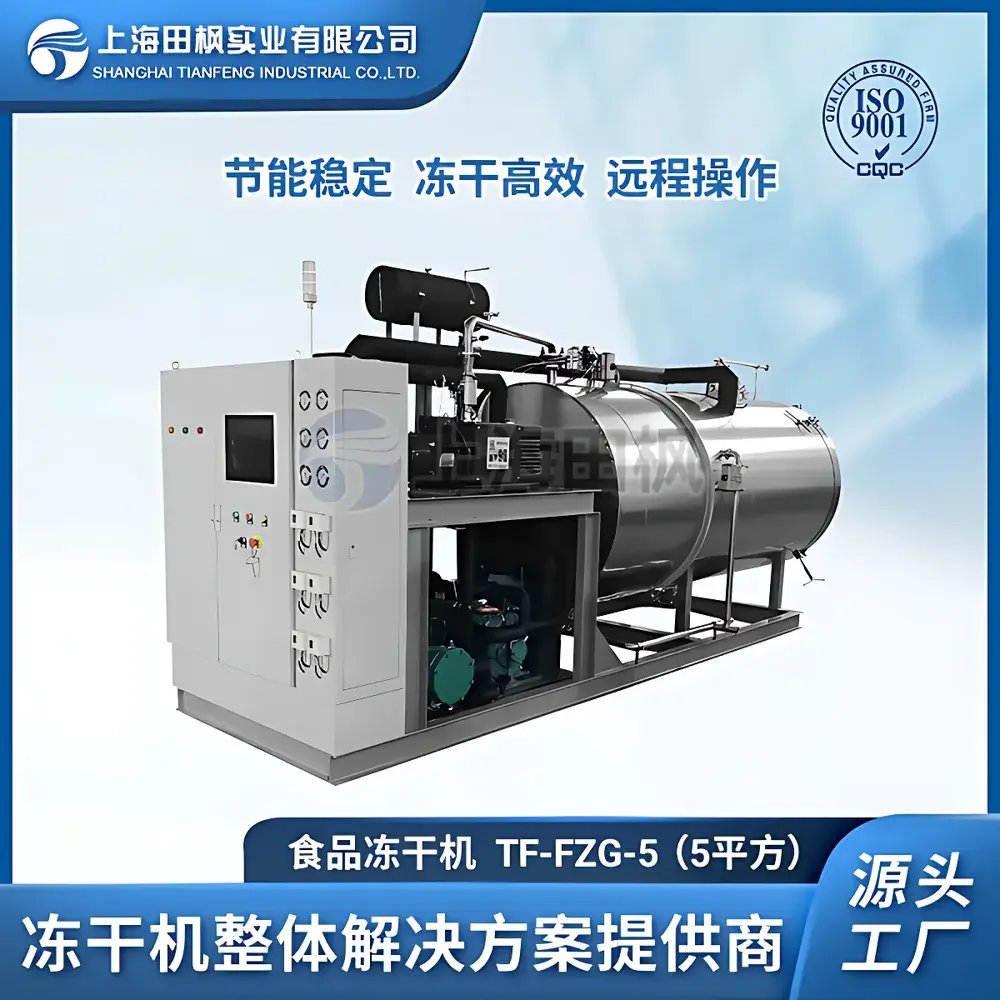
Tianfeng TF-FZG-5 Industrial-Scale Food Freeze Dryer
| Brand | Tianfeng |
|---|---|
| Origin | Shanghai, China |
| Manufacturer Type | Direct Manufacturer |
| Product Category | Domestic |
| Model | TF-FZG-5 |
| Freeze-Drying Area | 5.13 m² |
| Ultimate Vacuum | 2.7 Pa |
| Condenser Temperature | ≤ −65 °C |
| Ice Capacity (24 h) | 100 kg/24 h |
| Shelf Dimensions | 900 mm × 950 mm |
| Shelf Quantity | 7 layers (6+1) |
| Shelf Temperature Range | −45 °C to +70 °C |
| Shelf Temperature Uniformity | ≤ ±1 °C |
| Installed Power | 31.0 kW |
| Cooling Water Requirement | 11 m³/h |
| Net Weight | 5,000 kg |
| Control System | PLC with Touchscreen HMI |
| Data Logging & Remote Monitoring | Yes |
| CIP/SIP Compatible | Yes |
| Hydraulic Stoppering Option | Available |
Overview
The Tianfeng TF-FZG-5 Industrial-Scale Food Freeze Dryer is a purpose-engineered lyophilization system designed for pilot-scale and small-batch production of high-value freeze-dried food products—including fruit purees, yogurt-based snacks, vegetable crisps, seafood, functional ingredients, and botanical extracts. Operating on the fundamental principles of sublimation under deep vacuum and controlled thermal input, this unit performs primary drying (ice removal via升华) and secondary drying (bound water desorption) while maintaining product integrity across thermolabile compounds such as probiotics, anthocyanins, enzymes, and volatile aroma constituents. Unlike conventional thermal drying methods—where temperatures exceed 60 °C and cause structural collapse, oxidation, or denaturation—the TF-FZG-5 executes the entire process below 0 °C during freezing and maintains shelf surface temperatures no higher than +60 °C during desorption. This preserves native microstructure, reconstitution kinetics, color fidelity, and nutritional bioavailability—critical performance attributes validated in compliance with ISO 22000, Codex Alimentarius guidelines, and EU Regulation (EC) No 2073/2005 for microbiological criteria in ready-to-eat foods.
Key Features
- Integrated in-situ pre-freezing and primary/secondary drying within a single chamber—eliminating manual transfer and contamination risk.
- Seven stainless steel shelves (6 working + 1 bottom heating layer), each equipped with dual-phase thermal fluid circulation for precise, uniform temperature control (±1 °C across all shelves).
- High-efficiency condenser operating at ≤ −65 °C, rated for 100 kg ice capture per 24-hour cycle—optimized for high-moisture-content food matrices including fruit pulps and dairy gels.
- PLC-based automation with 10.4-inch resistive touchscreen HMI supporting multi-step recipe programming, real-time parameter logging, alarm history, and deviation tracking.
- Full Ethernet connectivity enabling remote supervision, data export (CSV/Excel), curve visualization, and integration into MES or SCADA environments.
- Modular construction with reinforced frame and integrated lifting lugs—designed for straightforward installation in GMP-compliant food processing rooms or shared-use pilot plants.
- Optional CIP (Clean-in-Place) manifolds and SIP (Sterilize-in-Place) steam jacketing compatible with FDA 21 CFR Part 11–compliant electronic signatures and audit trails when paired with validated software packages.
Sample Compatibility & Compliance
The TF-FZG-5 accommodates both bulk-loaded trays (up to 50 L total solution volume) and individualized packaging formats such as PET trays, aluminum foil pouches, and blister cavities—enabling flexibility from R&D prototyping to commercial-grade output. All wetted surfaces are electropolished AISI 316L stainless steel meeting ASME BPE-2022 surface finish standards (Ra ≤ 0.4 µm). The system complies with CE Machinery Directive 2006/42/EC, PED 2014/68/EU (for vacuum vessel classification), and EMC Directive 2014/30/EU. It supports GLP/GMP documentation workflows through configurable electronic batch records and time-stamped event logs traceable to NIST-traceable calibration references.
Software & Data Management
The embedded control firmware includes built-in freeze-drying curve storage (≥1,000 cycles), customizable alarm thresholds (vacuum, shelf temp, condenser load), and password-protected user roles (Operator, Technician, Administrator). Data export supports UTC timestamping and is compatible with third-party LIMS platforms via OPC UA or Modbus TCP protocols. Optional validation packages include IQ/OQ documentation templates aligned with ASTM F2975-22 (Standard Guide for Validation of Freeze Drying Processes) and Annex 15 of the EU Guidelines to Good Manufacturing Practice.
Applications
This system serves laboratories and contract manufacturers engaged in developing shelf-stable functional foods, infant nutrition powders, probiotic delivery systems, instant soup bases, pet treat formulations, and nutraceutical intermediates. Typical use cases include: optimizing primary drying endpoints for mango puree using pressure rise tests; validating residual moisture content (<3.5% w/w) in strawberry-yogurt composites via Karl Fischer titration post-lyophilization; assessing collapse temperature (Tc') of whey protein isolate gels using tunable diode laser absorption spectroscopy (TDLAS); and qualifying shelf-life stability under accelerated aging per ICH Q1A(R2).
FAQ
What is the maximum batch size for fruit yogurt mixtures?
Typical loading capacity is 40–45 kg of frozen product across seven shelves, assuming average density of 1.1 g/mL and 10–12 mm fill depth.
Can the system be validated for regulatory submissions?
Yes—when configured with optional validation support tools and operated under documented SOPs, it meets requirements for FDA, EFSA, and Health Canada dossier submissions.
Is nitrogen backfill capability available?
Standard configuration includes inert gas purging; optional programmable N₂ backfill module enables headspace control to <50 ppm O₂.
What maintenance intervals are recommended for the vacuum pump?
Oil-lubricated rotary vane pumps require oil changes every 500 operational hours; dry scroll alternatives are available upon request.
Does the unit support PAT (Process Analytical Technology) integration?
Yes—via analog 4–20 mA outputs and digital I/O ports for external NIR probes, capacitance moisture sensors, or tunable diode laser systems.
Related Products



