
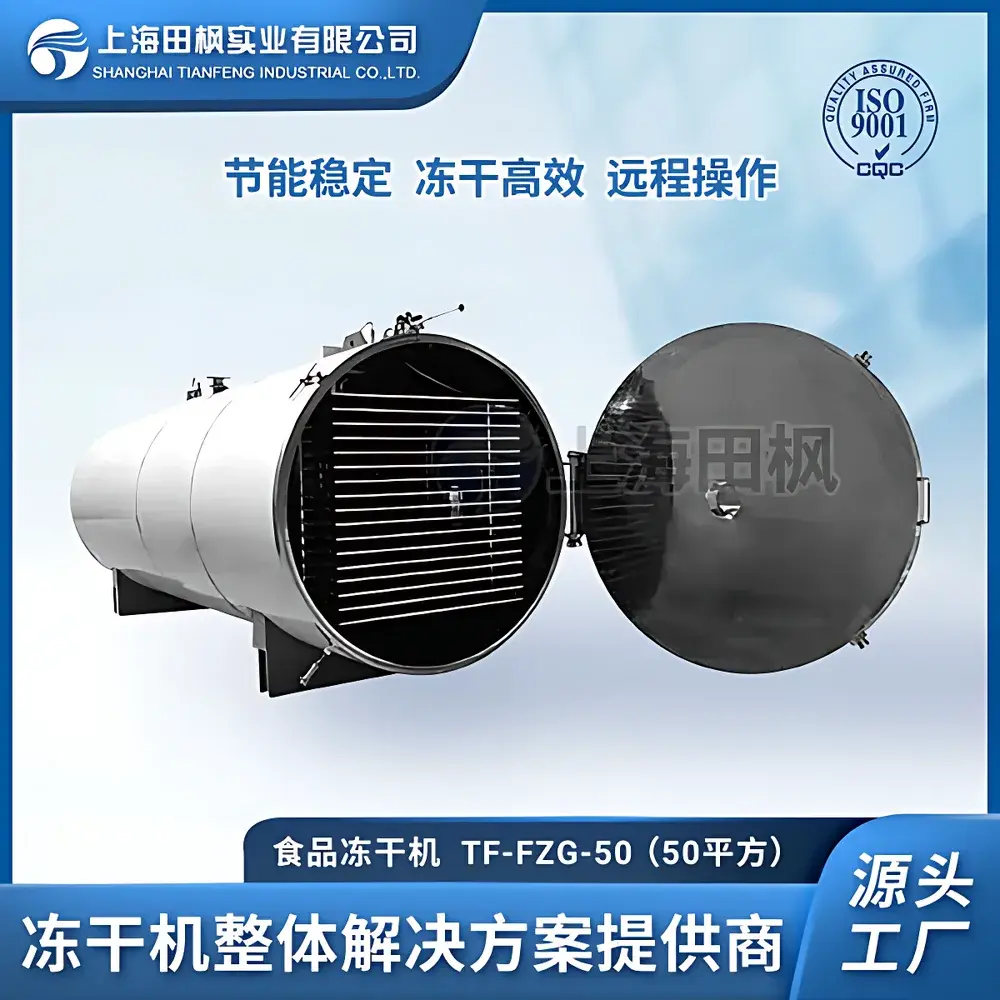
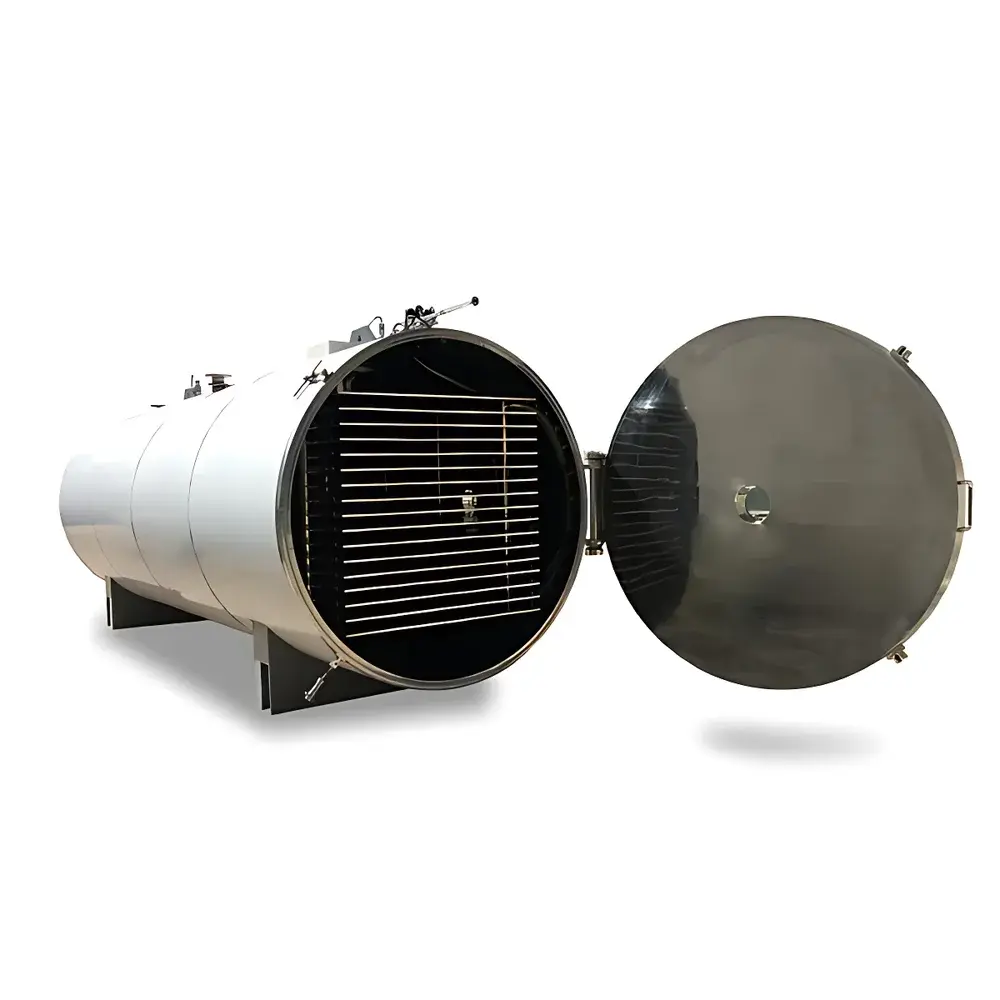
Tianfeng TF-FZG-50 Industrial-Scale Freeze Dryer for Flowers, Anthocyanins, and Wild Mushrooms
| Brand | Tianfeng |
|---|---|
| Origin | Shanghai, China |
| Manufacturer Type | Direct Manufacturer |
| Region Classification | Domestic (China) |
| Model | TF-FZG-50 |
| Instrument Type | Standard Shelf-Type Freeze Dryer |
| Application Scope | Production-Scale |
| Lyophilization Area | 50 m² |
| Ultimate Vacuum | 2.7 Pa |
| Condenser Temperature | ≤ −65 °C |
| Ice Capacity (24 h) | 800 kg |
| Chamber Dimensions | 60 m² floor area × 2.5 m height |
| Shelf Temperature Range | −45 to +70 °C |
| Shelf Configuration | 16+1 shelves, 1300 mm (W) × 2400 mm (D), spacing 65 mm |
| Load Capacity (Bulk Solution) | 500 L |
| Installed Power | 150 kW |
| Cooling Water Requirement | 50 m³/h |
| Unit Weight | 22 t |
| Compliance | ISO 9001:2000 certified design and manufacturing |
Overview
The Tianfeng TF-FZG-50 is an industrial-scale shelf-type freeze dryer engineered for the controlled lyophilization of heat-sensitive biological materials—including cut flowers, anthocyanin-rich botanical extracts, and wild edible or medicinal fungi. It operates on the fundamental principle of sublimation: samples are first frozen solid at cryogenic temperatures (≤ −65 °C condenser, −45 °C shelves), then subjected to high vacuum (≤ 2.7 Pa) to enable direct phase transition of ice to vapor without passing through the liquid state. This process preserves structural integrity, color fidelity, enzymatic activity, and phytochemical composition—critical for applications in horticultural preservation, nutraceutical processing, and natural product standardization. Unlike laboratory benchtop units, the TF-FZG-50 integrates production-grade thermal mass, robust vacuum architecture, and scalable shelf geometry to support continuous batch throughput under GMP-aligned operational conditions.
Key Features
- Large-format lyophilization chamber with 50 m² total shelf area and 16+1 adjustable stainless-steel shelves (1300 mm × 2400 mm per shelf, 65 mm spacing) for uniform heat transfer and maximal loading flexibility.
- High-capacity dual-stage refrigeration system achieving condenser temperatures ≤ −65 °C and shelf temperature control from −45 °C to +70 °C—enabling both deep freezing of delicate floral tissues and controlled secondary drying of polysaccharide-rich fungal biomass.
- Ultimate vacuum level of 2.7 Pa maintained via oil-lubricated rotary vane vacuum pump and optional cold trap integration—ensuring low residual moisture content (< 2 % w/w) and minimizing oxidative degradation during desorption.
- 150 kW installed power capacity with dedicated 50 m³/h cooling water circuit, designed for stable thermal load management across multi-day cycles typical of flower petal or mycelial matrix drying.
- Structural frame fabricated from 304 stainless steel; chamber door with hydraulic assist and silicone gasket sealing compliant with IP54 environmental protection standards.
- Integrated PLC-based control system with real-time monitoring of shelf temperature, chamber pressure, condenser temperature, and elapsed cycle time—data logged with timestamped CSV export capability.
Sample Compatibility & Compliance
The TF-FZG-50 accommodates heterogeneous sample formats including whole or segmented floral stems (roses, chrysanthemums, lavender), pressed petal layers, aqueous anthocyanin extracts (e.g., from black rice, purple sweet potato, or elderberry), and macroscopic wild mushroom specimens (e.g., Lentinula edodes, Grifola frondosa, Trametes versicolor). Its shelf temperature range supports both slow nucleation freezing (−40 °C to −20 °C ramp) for cell-wall preservation and elevated annealing (up to +5 °C) to optimize ice crystal morphology prior to primary drying. The system conforms to ISO 9001:2000 quality management requirements for design, fabrication, and factory acceptance testing. While not pre-certified for FDA 21 CFR Part 11, its data logging architecture supports audit-ready configuration—including user access levels, electronic signatures, and immutable event logs—facilitating alignment with GLP and GMP documentation practices in contract manufacturing and botanical ingredient qualification.
Software & Data Management
The embedded HMI interface provides intuitive cycle programming with up to 20 customizable drying protocols, each supporting multi-step ramp/soak sequences for shelf temperature and vacuum setpoints. All process variables—including actual shelf surface temperature (measured via Pt100 sensors embedded in each shelf), chamber absolute pressure (capacitance manometer), and condenser ice load (calculated from refrigerant saturation temperature)—are sampled at 1-second intervals. Raw data is stored locally on industrial-grade SD card and exportable via USB or Ethernet to third-party LIMS or MES platforms. Optional software add-ons include remote web-based supervision (HTTPS-secured), alarm escalation via SMTP/SMS, and automated report generation compliant with ISO/IEC 17025 traceability requirements.
Applications
- Horticultural post-harvest processing: Long-term stabilization of premium cut flowers for floristry, wedding décor, and herbal apothecary use—retaining shape, hue, and volatile bouquet profile after rehydration.
- Nutraceutical ingredient manufacturing: Stabilization of anthocyanin concentrates without thermal degradation, preserving antioxidant capacity (ORAC, FRAP) and pH-dependent chromatic stability for functional food and dietary supplement formulation.
- Wild mushroom valorization: Dehydration of rare or seasonally constrained species while maintaining β-glucan integrity, triterpenoid content, and immunomodulatory bioactivity—supporting clinical trial material preparation and extract standardization.
- Academic and pilot-scale research: Reproducible lyophilization parameter mapping (e.g., collapse temperature determination via DSC-correlated freeze-drying microscopy) for novel botanical matrices under controlled environmental conditions.
- Contract development and manufacturing: Scalable bridge from lab-scale (TF-FZG-5/10) to production (TF-FZG-50/80/100) with consistent shelf geometry, thermal response, and vacuum dynamics—reducing tech transfer risk.
FAQ
What types of flowers are most suitable for lyophilization using the TF-FZG-50?
Roses, peonies, hydrangeas, and lavender demonstrate optimal morphological retention due to their low sap content and dense petal structure; high-moisture blooms (e.g., tulips, lilies) require pre-treatment optimization to prevent collapse.
Can the system handle viscous anthocyanin solutions without splashing or foaming?
Yes—the 500 L bulk capacity and shallow shelf depth (2400 mm) allow for controlled layering; optional shelf pre-cooling to −40 °C minimizes boiling during primary drying onset.
Is the condenser capable of handling continuous 24-hour operation at full ice load?
The 800 kg/24 h ice capacity is validated under ISO 20515:2018 test conditions; sustained operation requires scheduled defrost cycles every 48–72 hours depending on initial moisture load and chamber leak rate.
Does the TF-FZG-50 support validation protocols such as IQ/OQ/PQ?
Full validation documentation packages—including sensor calibration certificates (NIST-traceable Pt100 and capacitance manometers), FAT/SAT reports, and protocol templates aligned with ASTM F2697-22—are available upon request.
What maintenance intervals are recommended for vacuum pump and refrigeration systems?
Rotary vane pump oil replacement every 500 operating hours; refrigerant circuit inspection and oil analysis annually; shelf gasket integrity verification during each chamber opening.



