
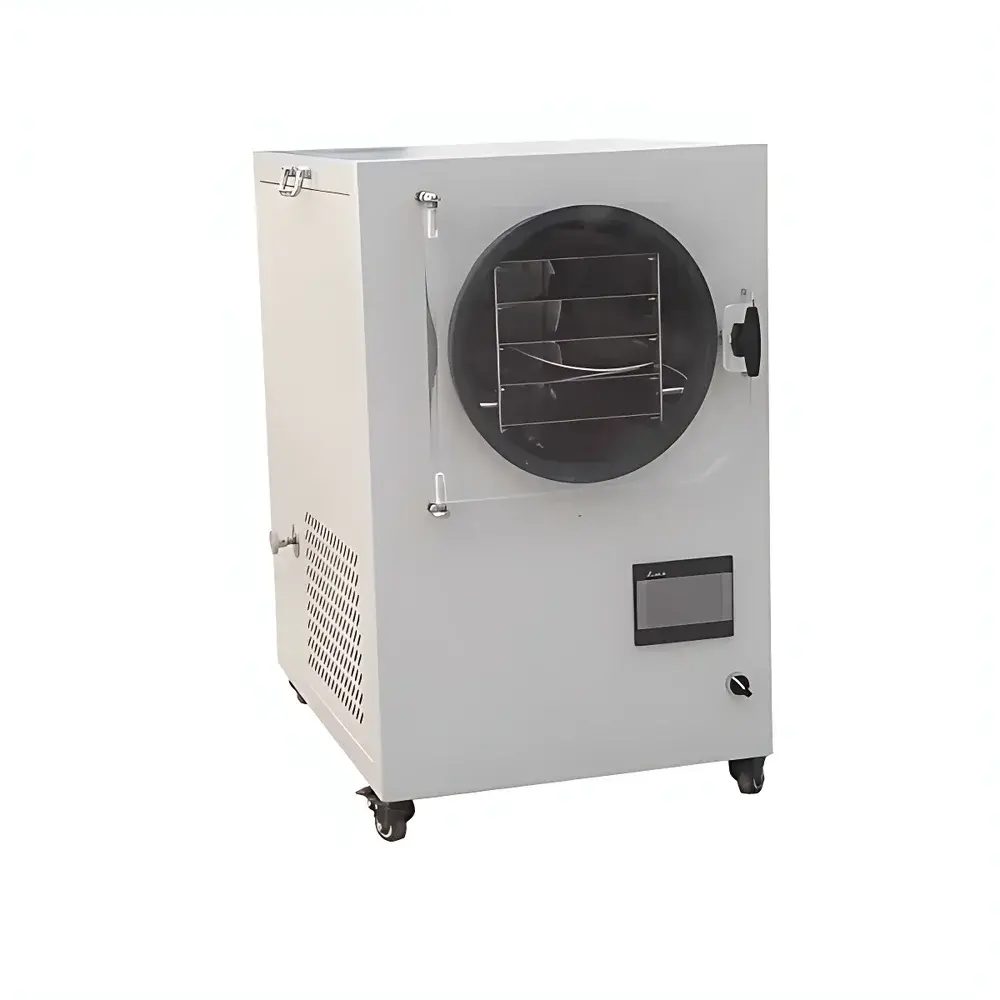
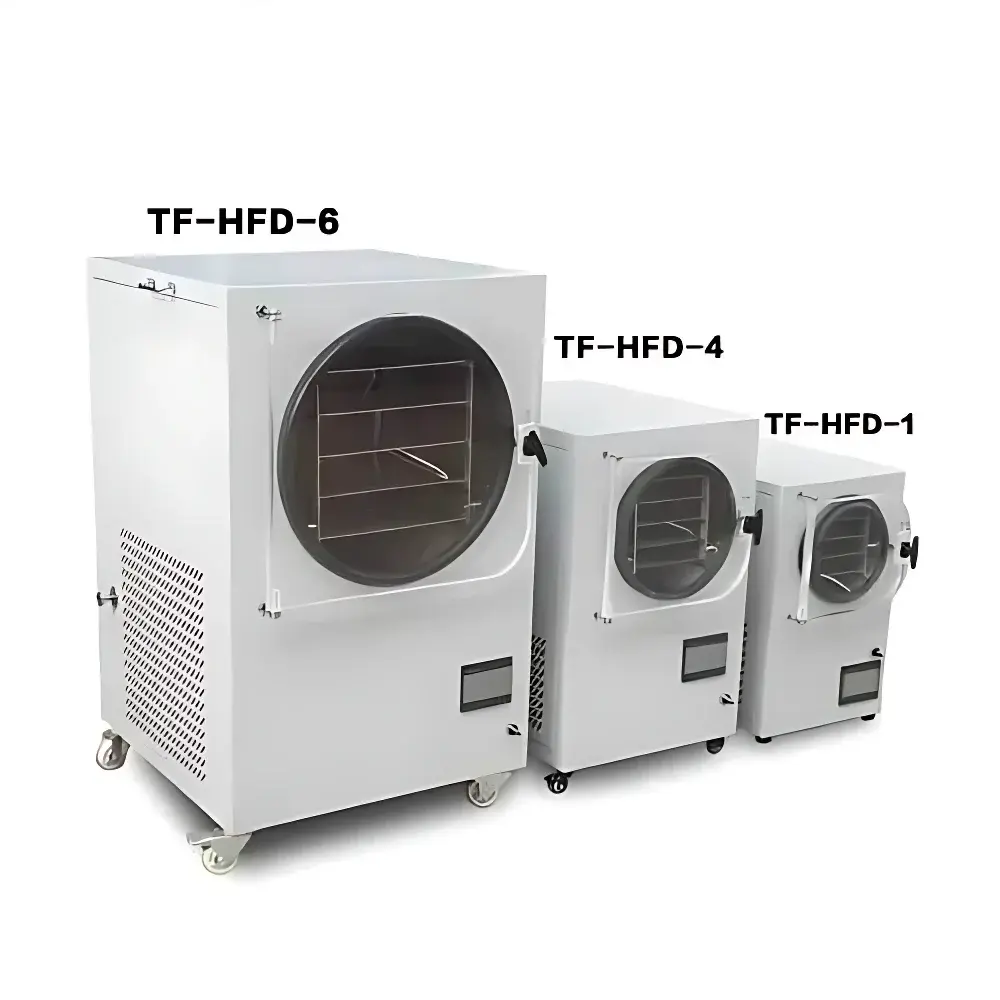
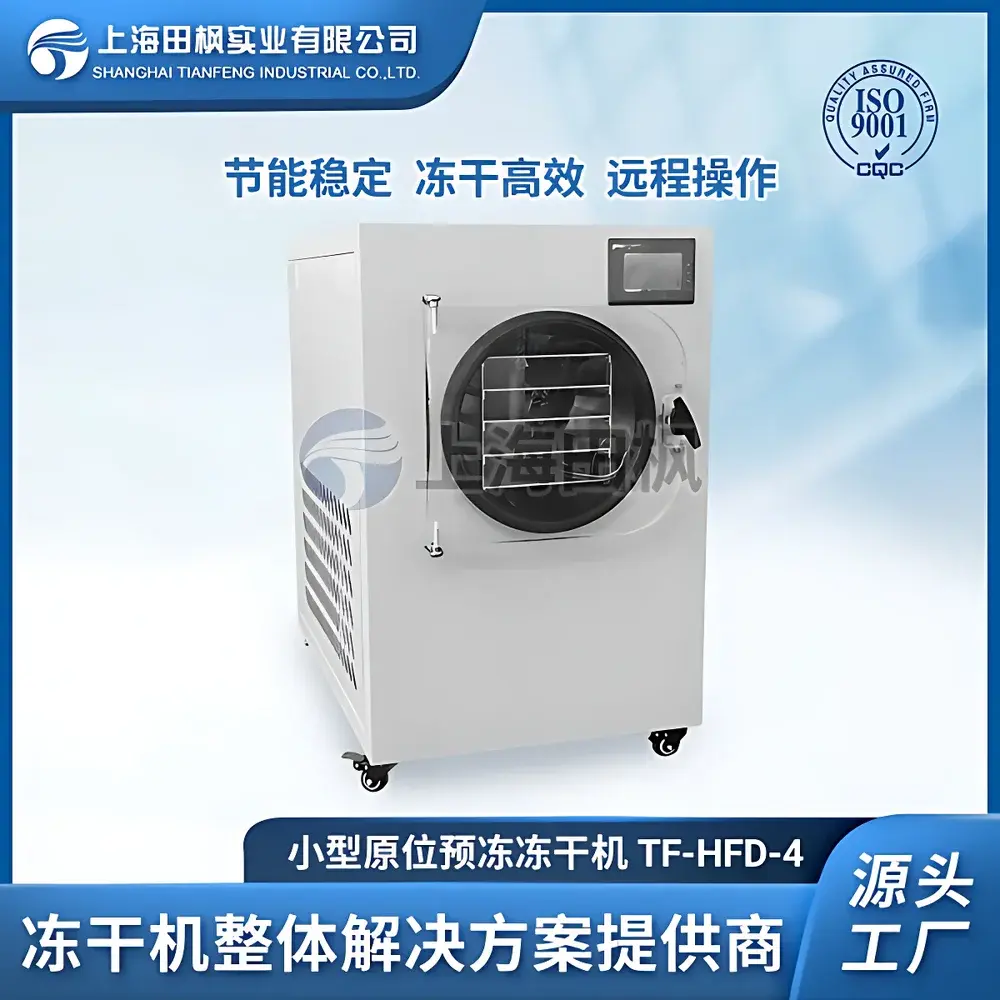
Tianfeng TF-HFD-41 Benchtop Freeze Dryer
| Brand | Tianfeng |
|---|---|
| Origin | Shanghai, China |
| Manufacturer Type | Direct Manufacturer |
| Country of Origin | China |
| Model | TF-HFD-41 |
| Instrument Type | Standard Shelf-Type Freeze Dryer |
| Application | Laboratory Use |
| Freeze-Drying Area | 0.4 m² |
| Ultimate Vacuum (Empty Chamber) | 10 Pa |
| Condenser Temperature | ≤ −40 °C |
| Condensate Capacity | 6 kg/24 h |
| Temperature Control Range | −35 °C to +60 °C |
| Tray Dimensions | 200 mm × 450 mm |
| Power Supply | 220 V, 50 Hz |
| Power Consumption | 1100 W |
| Overall Dimensions (W×D×H, excl. door/handle) | 510 mm × 700 mm × 850 mm |
| Construction | SUS304 Stainless Steel Chamber & Trays |
| Viewing Window | Transparent Acrylic Door |
| Control System | Touchscreen with Real-Time Shelf Temperature & Process Curve Display |
| Defrost Function | One-Touch Automatic Defrost |
| Safety Features | Over-Temperature Protection, Current Monitoring |
Overview
The Tianfeng TF-HFD-41 is a compact, benchtop shelf-type freeze dryer engineered for precision lyophilization in academic research laboratories, quality control environments, and small-scale pharmaceutical or nutraceutical development workflows. It operates on the fundamental principle of sublimation—removing water from frozen samples under deep vacuum while maintaining product integrity through controlled heat input and low-temperature condensation. Designed for primary drying of thermolabile biologicals, herbal extracts (e.g., Ophiocordyceps sinensis), environmental water samples, and reference standards, the system integrates a −40 °C condenser, 0.4 m² stainless steel shelf area, and programmable thermal profiles to ensure reproducible drying kinetics without collapse or eutectic melt. Its modular architecture supports both manual protocol execution and automated cycle initiation using preloaded process curves—eliminating empirical optimization for routine applications.
Key Features
- Integrated touchscreen HMI with real-time visualization of shelf temperature, chamber pressure, and condenser temperature—enabling dynamic monitoring of primary and secondary drying phases.
- Pre-validated, application-specific drying protocols—including a proprietary Cordyceps sinensis lyophilization curve developed over three years in collaboration with commercial cultivators—accessible with single-button activation.
- SUS304 stainless steel drying chamber and sample trays compliant with ISO 14644-1 Class 5 cleanroom-compatible handling; seamless welds and electropolished surfaces minimize particle retention.
- Transparent acrylic front door allows unobstructed visual inspection of sample morphology, ice crystal formation, and drying front progression without breaking vacuum or interrupting cycles.
- One-touch automatic defrost function reduces downtime between batches; condenser regeneration completes within ≤15 minutes under standard ambient conditions (25 °C, 60% RH).
- Low-noise scroll-type refrigeration compressor and optimized airflow design achieve stable condenser performance at ≤−40 °C with nominal power draw of 1100 W—suitable for continuous operation in shared lab spaces.
- Over-temperature cutoff, current surge detection, and vacuum loss alarms comply with IEC 61010-1 safety requirements for laboratory electrical equipment.
Sample Compatibility & Compliance
The TF-HFD-41 accommodates diverse sample formats including vials (up to 20 mL), Petri dishes, and custom trays (200 mm × 450 mm). It supports aqueous matrices common in environmental testing (e.g., filtered surface water, wastewater effluent), botanical extracts, microbial cultures, and protein solutions. All contact surfaces meet FDA-recommended material compatibility guidelines for non-sterile lyophilization. While not certified for GMP manufacturing, its data logging architecture—time-stamped temperature/pressure records with user ID tagging—supports GLP-compliant documentation per OECD 172 and USP . Audit trails are exportable via USB for regulatory review.
Software & Data Management
The embedded controller logs all critical parameters at 1-second intervals and stores ≥100 complete cycle histories onboard. Export formats include CSV and PDF reports containing shelf temperature ramps, hold durations, vacuum decay rates, and final condensate mass estimates. Optional Ethernet connectivity enables remote status polling and alarm notification via SNMP traps—facilitating integration into centralized lab infrastructure management systems. Data integrity safeguards include write-protection modes and password-protected parameter modification, aligning with ALCOA+ principles for raw data preservation.
Applications
- Stabilization of environmental water samples prior to trace metal analysis (EPA Method 200.8, ISO 17294-2).
- Lyophilization of fungal biomass and bioactive metabolites for pharmacognosy studies.
- Preparation of calibration standards for HPLC and ICP-MS requiring long-term matrix stability.
- Routine dehydration of QC reference materials used in food safety and herbal supplement verification.
- Method development for freeze-drying of monoclonal antibody formulations in early-stage bioprocess screening.
FAQ
What is the maximum batch volume supported by the 0.4 m² shelf area?
Typical loading capacity is 2–3 L of unfrozen aqueous solution, assuming 10–15 mm depth per tray layer. Actual throughput depends on solute concentration and eutectic temperature.
Does the system support validation protocols such as IQ/OQ?
Yes—factory-installed calibration certificates for PT100 shelf sensors and Pirani vacuum gauges are provided. Optional third-party qualification packages (including mapping studies) are available upon request.
Can users modify or upload custom drying programs?
Absolutely—the interface permits creation, saving, and versioning of multi-step programs with independent ramp/halt settings for shelf temperature and vacuum setpoints.
Is the condenser rated for organic solvent trapping?
No. The −40 °C condenser is optimized for water vapor only. Solvent-laden vapors require optional −80 °C cold trap add-ons.
What maintenance intervals are recommended for sustained performance?
Oil change for the vacuum pump every 300 operating hours; condenser coil cleaning quarterly; O-ring inspection biannually. Full service checklist included in operator manual.



