
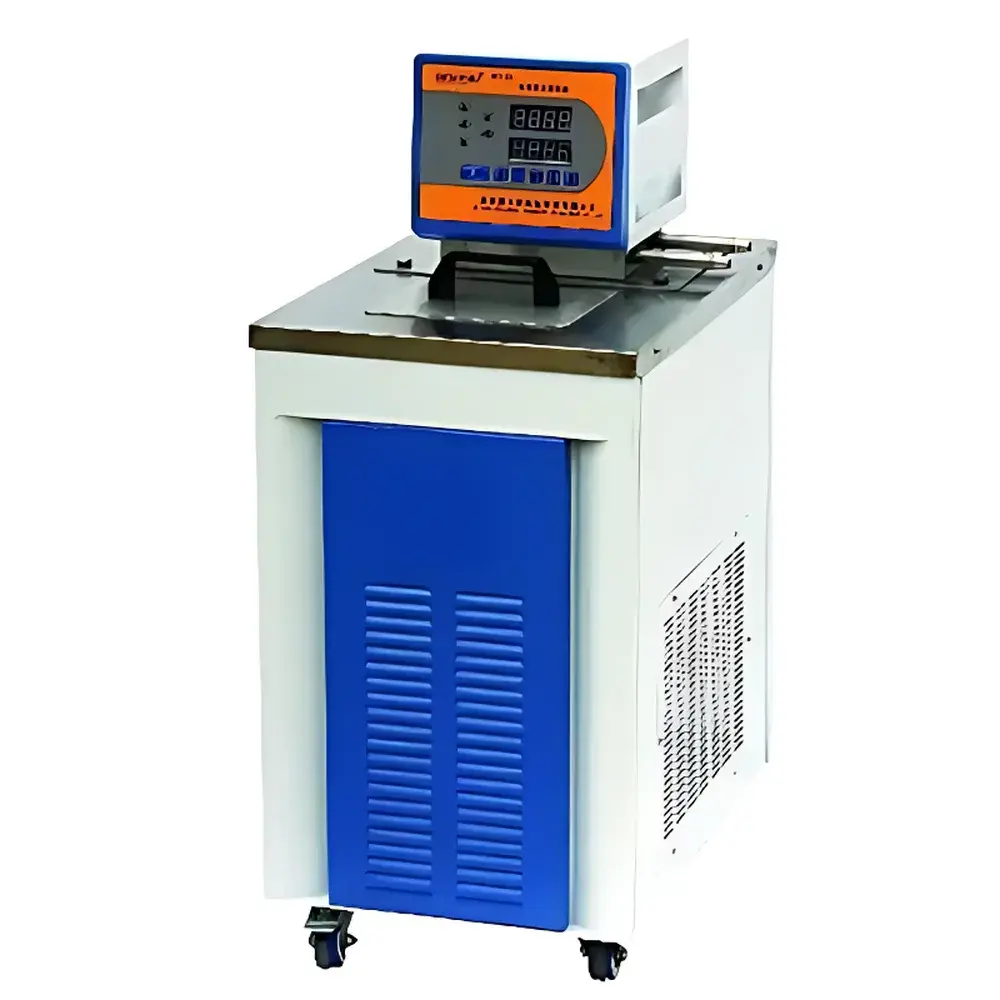
Tianfeng TF-HX-3B0 Precision Circulating Bath Chiller/Heater
| Brand | Tianfeng |
|---|---|
| Origin | Shanghai, China |
| Manufacturer Type | Direct Manufacturer |
| Product Category | Domestic |
| Model | TF-HX-3B0 |
| Instrument Type | Circulating Constant-Temperature Bath |
| Circulation Mode | Internal & External |
| Temperature Control | Refrigeration + Heating |
| Bath Volume | 30 L |
| Temperature Range | −20 °C to 99 °C |
| Temperature Stability | ±0.1 °C |
| Power Supply | 220 V / 50 Hz |
| Rated Power | 1400 W |
| External Dimensions (L×W×H) | 690 × 540 × 1070 mm |
| Operating Panel Dimensions (L×W×H) | 280 × 250 × 230 mm |
| Cooling System | Air-Cooled Hermetic Compressor (Imported) |
| Control Method | PID Algorithm with Touch-Sensitive Interface |
| Display | Dual Digital LED (Temperature & Timer) |
| Safety Features | Over-Temperature Alarm, Differential-Temperature Alarm, Auto Shut-Down |
Overview
The Tianfeng TF-HX-3B0 Precision Circulating Bath Chiller/Heater is a high-stability, dual-mode thermal management system engineered for laboratory environments requiring precise, reproducible temperature control across a broad operational range (−20 °C to 99 °C). Unlike passive water baths, this unit integrates a closed-loop refrigeration circuit with resistive heating and advanced PID-based digital regulation—enabling active thermoregulation via both cooling and heating within a single stainless-steel bath chamber. Its design follows the principles of forced-convection thermal equilibrium: an internal pump circulates heat-transfer fluid (water, ethanol/water mixtures, or silicone oil) at controlled flow rates, ensuring uniform temperature distribution throughout the 30 L working volume and enabling stable external temperature referencing via dual-path circulation. The system’s air-cooled, hermetically sealed compressor—sourced from internationally certified suppliers—delivers rapid cooldown without requiring external water drainage or chilled-water infrastructure, making it suitable for general-purpose labs with limited utility access.
Key Features
- High-precision temperature stability of ±0.1 °C at setpoint, verified under steady-state conditions per ISO 17025-aligned calibration protocols
- Dual-circulation architecture supporting both internal bath homogenization and external temperature transfer via flexible tubing (max. external flow rate: 12 L/min)
- Stainless-steel 304 inner tank with corrosion-resistant finish, compatible with aqueous, glycolic, and low-viscosity organic heat-transfer fluids
- Microprocessor-based PID controller with touch-sensitive soft-key interface and real-time digital display of bath temperature and timer status
- Programmable operation modes including scheduled start-up, delayed shutdown, and user-defined ramp-hold profiles
- Comprehensive safety suite: over-temperature cutoff, differential-temperature alarm (detects deviation between sensor reading and target), and automatic compressor lockout during fault conditions
- Compact footprint (690 × 540 × 1070 mm) optimized for benchtop integration alongside rotary evaporators, viscometers, electrophoresis units, and cryogenic accessories
Sample Compatibility & Compliance
The TF-HX-3B0 accommodates a wide range of sample vessels—including glass jacketed reactors (up to Ø200 mm), immersion probes, and external condensers—without compromising thermal uniformity. Its fluid compatibility extends to deionized water, 30–50% ethylene glycol solutions (for sub-zero operation), and silicone oils (for high-temperature applications up to 99 °C). All electrical components comply with IEC 61010-1:2010 for laboratory equipment safety. The unit meets CE marking requirements and is manufactured under an ISO 9001:2015-certified quality management system. While not inherently 21 CFR Part 11 compliant, audit-ready data logging (via optional RS485/USB interface) supports GLP/GMP workflows when integrated with validated third-party software platforms.
Software & Data Management
The base configuration includes local parameter setting and real-time monitoring via front-panel display. For traceable operation, an optional communication module enables serial (RS485) or USB connectivity to host PCs running custom LabVIEW, Python, or MATLAB scripts. Logged parameters include bath temperature (±0.05 °C resolution), setpoint history, compressor runtime, and alarm event timestamps. When paired with validated data acquisition systems, the unit supports electronic record retention aligned with ALCOA+ principles (Attributable, Legible, Contemporaneous, Original, Accurate, Complete, Consistent, Enduring, Available). Firmware updates are performed offline via USB drive to maintain system integrity in regulated environments.
Applications
- Thermal conditioning of samples prior to rheological, calorimetric, or spectroscopic analysis (e.g., DSC, FTIR, UV-Vis)
- Active cooling of high-power instrumentation: electron microscopes, vacuum pumps (diffusion/ion/molecular), RF generators, and laser diodes
- Temperature-controlled reaction support for rotary evaporation, reflux, crystallization, and polymerization studies
- Calibration reference source for thermometers, RTDs, and thermocouples per ASTM E74 and ISO/IEC 17025 guidelines
- Biomedical device testing: thermal validation of cold caps, hypothermia blankets, and cryopreservation modules
- Material property evaluation: coefficient of thermal expansion (CTE), glass transition (Tg), and viscosity-temperature profiling
FAQ
What types of heat-transfer fluids are recommended for operation below 0 °C?
Ethanol/water (30:70 v/v) or propylene glycol/water (40:60 v/v) mixtures are validated for use down to −20 °C. Silicone oils (e.g., DC200 series) are required above 80 °C.
Can the unit maintain temperature stability while delivering external flow?
Yes—stability of ±0.1 °C is guaranteed under full external circulation (≤12 L/min) at ambient temperatures ≤30 °C and relative humidity ≤70% RH.
Is remote monitoring supported out of the box?
No—remote capability requires optional communication hardware and host-side software configuration. No cloud connectivity or proprietary app is provided.
What maintenance intervals are recommended for long-term reliability?
Compressor oil and refrigerant levels should be verified annually by authorized service personnel; condenser coils require bi-monthly dust removal using compressed air.
Does the unit meet UL or CSA safety certification standards?
It carries CE marking per EN 61010-1 and complies with RoHS 2011/65/EU. UL/CSA certification is available upon request for OEM integration projects.
Related Products



