
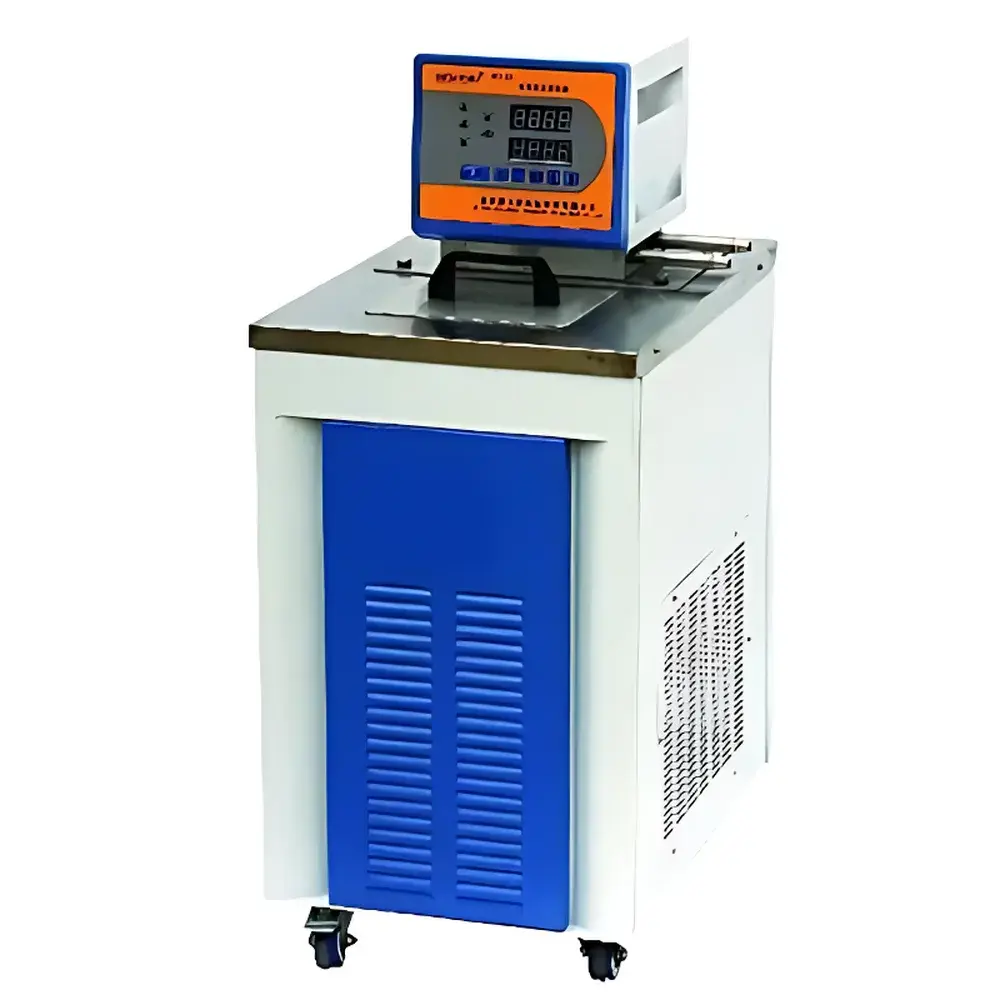
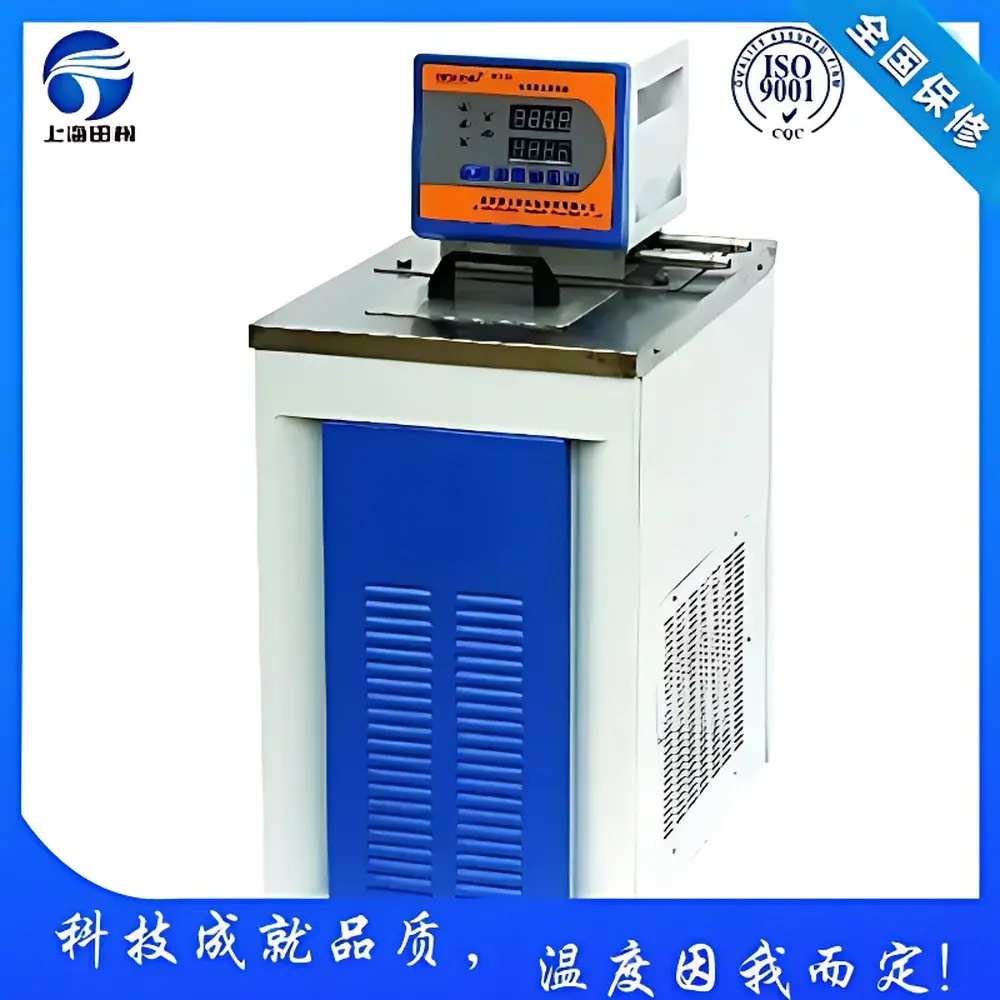
Tianfeng TF-HX-5A Precision Circulating Bath Chiller/Heater
| Brand | Tianfeng |
|---|---|
| Origin | Shanghai, China |
| Manufacturer Type | Direct Manufacturer |
| Product Category | Domestic |
| Model | TF-HX-5A |
| Instrument Type | Circulating Constant-Temperature Bath |
| Circulation Mode | Internal & External |
| Temperature Control | Refrigeration + Heating |
| Bath Volume | 5 L |
| Temperature Range | −10 °C to 99 °C |
| Temperature Stability | ±0.1 °C |
| Power Supply | 220 V / 50 Hz |
| Rated Power | 300 W |
| External Dimensions (L×W×H) | 430 × 285 × 575 mm |
| Operating Panel Dimensions (L×W×H) | 185 × 140 × 110 mm |
| Cooling System | Air-Cooled Hermetic Compressor |
| Control Method | PID Digital Control with Touch Interface |
| Safety Features | Over-Temperature & Differential-Temperature Alarm |
| Compliance | ISO 9001:2000 Certified |
Overview
The Tianfeng TF-HX-5A Precision Circulating Bath Chiller/Heater is a compact, self-contained temperature control system engineered for high-stability thermal regulation in laboratory and analytical applications. It operates on the principle of closed-loop liquid circulation—using a thermally conductive bath medium (water or silicone oil) to absorb, transfer, and dissipate heat via an integrated refrigeration and heating module. The unit employs a high-efficiency air-cooled hermetic compressor paired with an optimized evaporator design based on large-volume cooling dynamics, enabling rapid thermal equilibration and uniform temperature distribution across the 5 L stainless-steel bath chamber. Its dual-mode temperature control (−10 °C to 99 °C) supports both cryogenic and elevated-temperature experiments without external coolant or auxiliary chillers. Designed for integration into complex instrument ecosystems, the TF-HX-5A delivers stable thermal environments with ±0.1 °C stability—meeting baseline requirements for ASTM E2877 (Standard Guide for Thermal Stability Testing), ISO/IEC 17025 calibration traceability frameworks, and GLP-compliant thermal validation protocols.
Key Features
- Integrated refrigeration and heating system with imported air-cooled hermetic compressor for reliable long-term operation
- Dual-circulation capability: internal recirculation maintains bath homogeneity; external circulation enables remote temperature control of peripheral equipment
- PID-based digital temperature controller with touch-sensitive soft-key interface and real-time LED display of setpoint, actual temperature, and timer status
- Stainless-steel bath tank resistant to corrosion and thermal stress—compatible with water, ethanol, glycol-water mixtures, and low-viscosity silicone oils
- Programmable functions including scheduled startup, delayed shutdown, and configurable alarm thresholds for over-temperature and differential-temperature conditions
- Compact footprint (430 × 285 × 575 mm) suitable for benchtop deployment in space-constrained laboratories
- Compliance with ISO 9001:2000 quality management standards across design, manufacturing, testing, and service lifecycle phases
Sample Compatibility & Compliance
The TF-HX-5A accommodates a broad range of sample containers and external instrumentation via standardized 6–10 mm ID fluid ports. It supports immersion-based thermal conditioning of glassware (e.g., reaction flasks, cuvettes, electrophoresis tanks), as well as direct coupling to rotary evaporators, viscometers, spectrophotometer Peltier cells, and vacuum freeze-dryer condensers. For external circulation, compatible flow rates range from 0.5 to 3.0 L/min at ≤0.2 MPa backpressure—sufficient for cooling electron microscope cold traps, diffusion pumps, and RF ablation systems. All electrical components meet IEC 61010-1 safety standards for laboratory equipment. The device does not require hazardous refrigerants (R134a-free design) and conforms to RoHS Directive 2011/65/EU restrictions on heavy metals and flame retardants.
Software & Data Management
While the TF-HX-5A operates as a standalone instrument with embedded microcontroller logic, its analog voltage output (0–5 V or 4–20 mA, optional upon request) enables integration into SCADA, LabVIEW, or custom Python-based data acquisition systems for time-stamped temperature logging. The unit supports manual calibration offset adjustment per ISO/IEC 17025 Annex A.3.3, allowing users to correct for sensor drift against NIST-traceable reference thermometers. Audit trails for temperature setpoints, alarm events, and power cycles are retained in non-volatile memory for up to 30 days—supporting basic 21 CFR Part 11 compliance when used in conjunction with validated third-party software platforms. Firmware updates are performed via USB port under controlled engineering release procedures.
Applications
- Thermal stabilization of analytical instruments: UV-Vis spectrophotometers, HPLC column ovens, FTIR sample compartments
- Cooling support for high-power laser diodes, CCD detectors, and mass spectrometer ion sources
- Controlled-rate crystallization studies in pharmaceutical solid-state chemistry
- Calibration of thermocouples, RTDs, and infrared thermometers per ASTM E74
- Temperature-controlled enzymatic assays and cell culture incubation pre-conditioning
- Material property testing—including coefficient of thermal expansion (CTE), dynamic mechanical analysis (DMA) specimen conditioning, and polymer melt rheology prep
- Integration with rotary evaporation systems for solvent recovery at precise boiling points
FAQ
What fluids are compatible with the TF-HX-5A bath chamber?
Deionized water, 30% aqueous ethylene glycol, and low-viscosity silicone oils (≤50 cSt at 25 °C) are recommended. Avoid halogenated solvents, strong acids/bases, or fluids with flash points below 60 °C.
Can the unit maintain temperature while circulating externally at full flow?
Yes—the system sustains ±0.1 °C stability at external flow rates up to 2.5 L/min when properly insulated and matched to load thermal capacity.
Is the temperature sensor calibrated to NIST standards?
The factory-installed Pt100 sensor is calibrated against a NIST-traceable reference prior to shipment; calibration certificate available upon request.
Does the device support RS-232 or Ethernet communication?
No native serial or network interface is included; however, analog output signals (0–5 V) allow connection to third-party DAQ systems.
What maintenance intervals are recommended?
Compressor oil inspection every 12 months; bath fluid replacement every 6 months (or sooner if discoloration or particulate formation occurs); annual verification of temperature uniformity per ASTM E2877 Annex B.



