
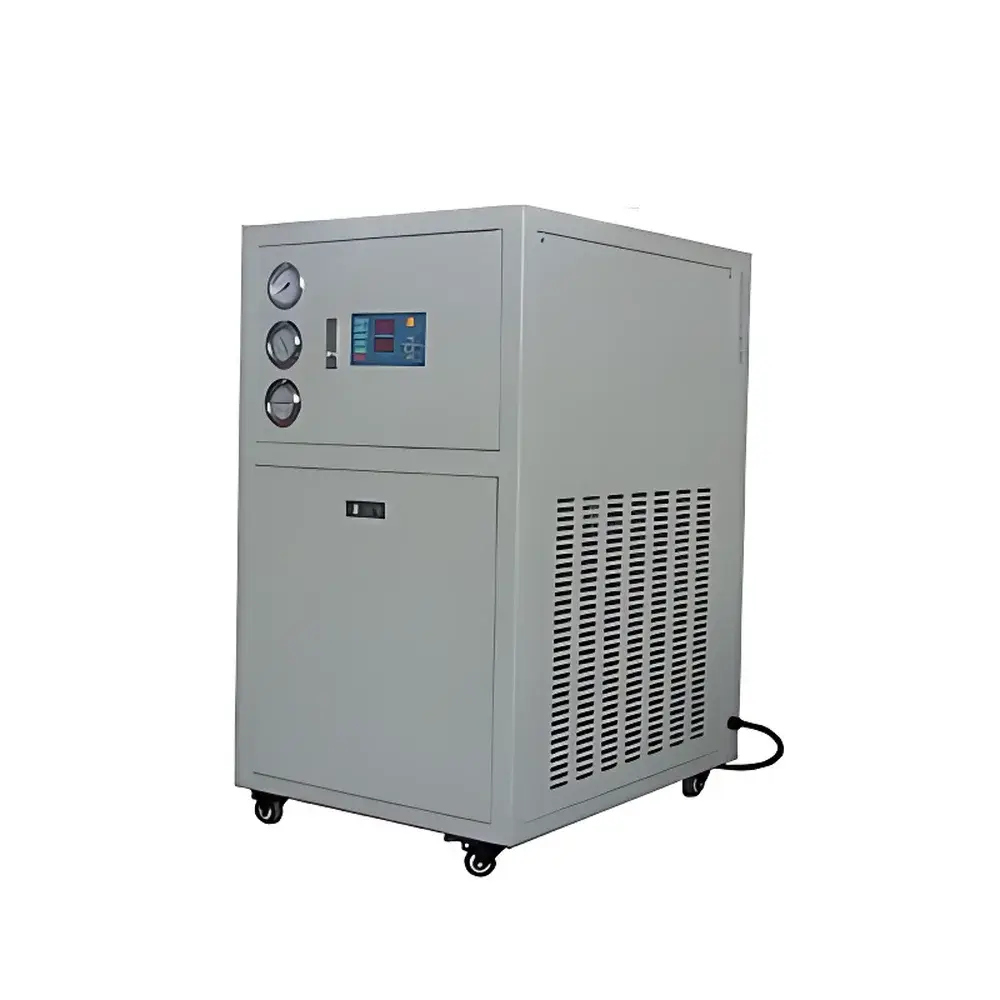
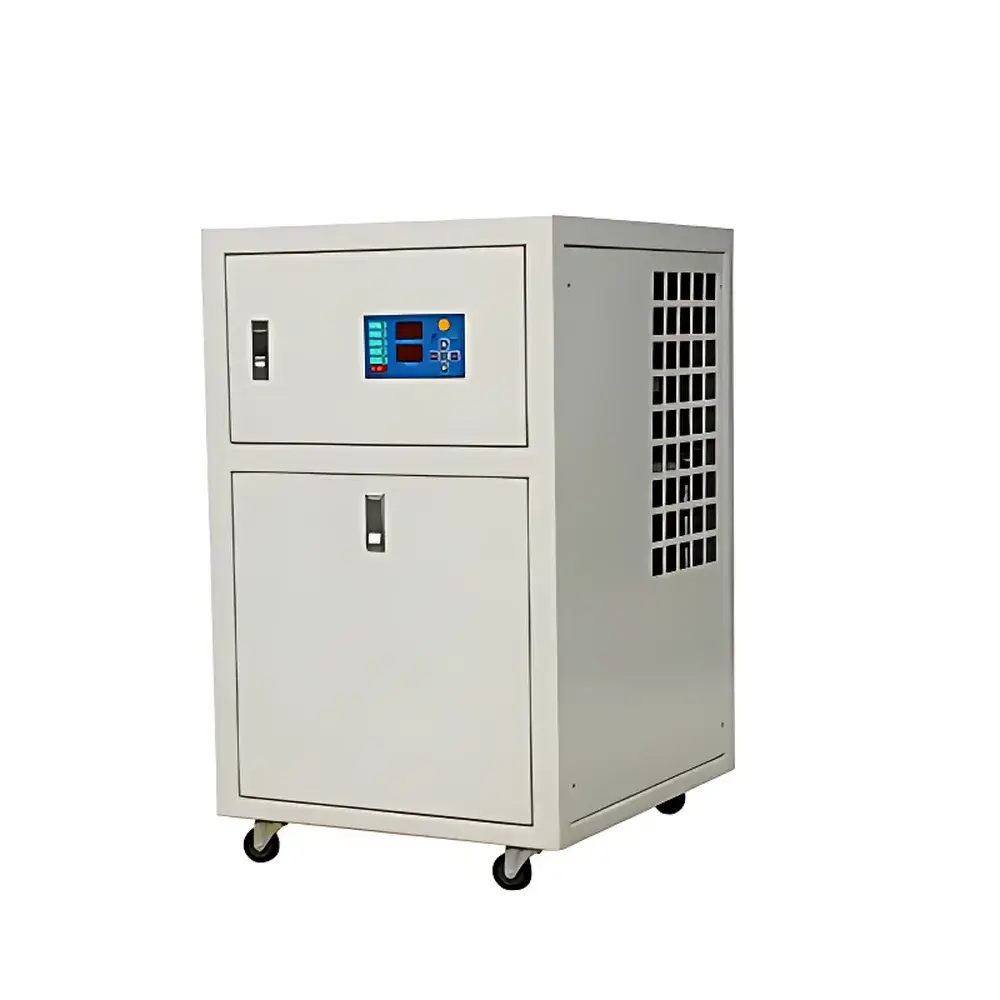
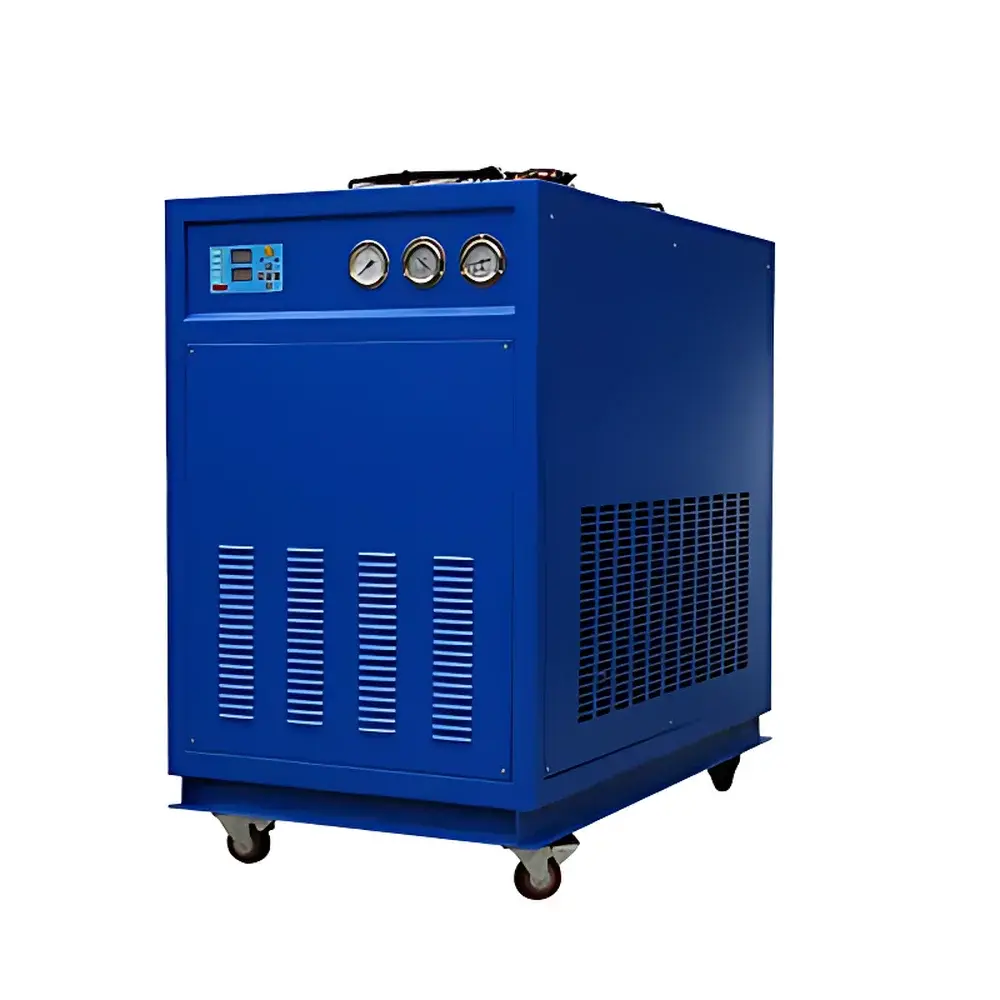
Tianfeng TF-LS-5HP Compact Air-Cooled Circulating Chiller
| Brand | Tianfeng |
|---|---|
| Origin | Shanghai, China |
| Manufacturer Type | Direct Manufacturer |
| Country of Origin | China |
| Model | TF-LS-5HP |
| Instrument Type | Integrated Unit |
| Cooling Method | Air-Cooled |
| Temperature Stability Range | 1 °C |
| Refrigeration Capacity | 15.9 kW (13,674 kcal/h) |
| Temperature Fluctuation | ±0.1 °C |
| Circulating Pump Pressure | 0–2 kgf/cm² |
| Circulating Pump Flow Rate | 0–60 L/min |
| Reservoir Volume | 110 L |
| Power Input | 6.2 kW |
| Supply Voltage | 220 V, 50 Hz |
| Dimensions (L×W×H) | 1350 × 750 × 1445 mm |
| Compressor Type | Scroll Compressor |
| Safety Protections | Compressor Overheat Protection, Overcurrent Protection, High/Low Pressure Switches, Overtemperature Alarm |
| Construction | Stainless Steel Reservoir & Pump |
| Control System | Digital PID Temperature Controller (Optional RKC Japan Controller) |
| Key Components | Imported Expansion Valve (Italy/Germany), Solenoid Valve, Electrical Components (Siemens/Schneider/Omron) |
| Operating Mode | Continuous Duty |
| Noise Level | Low |
| Certifications | CE-compliant design architecture |
Overview
The Tianfeng TF-LS-5HP Compact Air-Cooled Circulating Chiller is an integrated, continuous-duty thermal management system engineered for precision temperature control in laboratory and light industrial environments. It operates on the vapor-compression refrigeration cycle, utilizing a high-efficiency scroll compressor, copper-aluminum finned air-cooled condenser, and thermostatically regulated expansion valve to deliver stable chilled water output across a controlled range of 5–30 °C. Designed for compatibility with heat-sensitive analytical instruments—including graphite furnace atomic absorption spectrometers (GFAAS), inductively coupled plasma optical emission spectrometers (ICP-OES), ICP-mass spectrometers (ICP-MS), X-ray fluorescence (XRF) and X-ray diffraction (XRD) systems, scanning electron microscopes (SEM), and transmission electron microscopes (TEM)—this chiller maintains thermal equilibrium by removing waste heat from critical components such as RF generators, detectors, vacuum pumps, and high-power laser diodes. Its air-cooled architecture eliminates dependency on external cooling towers or facility water loops, enabling deployment in space-constrained laboratories without dedicated chilled-water infrastructure.
Key Features
- Stainless steel reservoir (110 L capacity) and pump housing ensure corrosion resistance and long-term fluid integrity under repeated thermal cycling.
- Digital PID temperature controller with ±0.1 °C stability over full operating range (5–30 °C); optional RKC (Japan) controller available for enhanced repeatability and protocol-based setpoint sequencing.
- Adjustable flow rate (0–60 L/min) and pressure (0–2 kgf/cm²) support variable thermal load profiles across multi-instrument configurations or serial cooling circuits.
- Comprehensive safety architecture includes dual-pressure switches, compressor overheat cutoff, overcurrent protection, and real-time overtemperature alarm with dry-contact fault signal output for integration into lab-wide monitoring systems.
- Low-noise operation (<68 dB(A) at 1 m) achieved via acoustic insulation, optimized fan blade geometry, and vibration-damped compressor mounting—critical for quiet-zone laboratories and ISO Class 5+ cleanrooms.
- Continuous-duty rating validated per IEC 60034-1 and EN 60335-1 standards; suitable for unattended 24/7 operation in GxP-regulated environments when paired with audit-trail-capable software (see Software & Data Management).
Sample Compatibility & Compliance
The TF-LS-5HP is compatible with deionized water, 30% ethylene glycol/water mixtures, and other non-corrosive heat-transfer fluids meeting ASTM D1384 specifications. Its stainless steel wetted parts comply with USP extractables testing requirements for pharmaceutical-grade coolant systems. While not certified to UL/CSA or ASME B31.9 directly, its electrical architecture conforms to IEC 61000-6-2 (immunity) and IEC 61000-6-4 (emissions), supporting integration into ISO/IEC 17025-accredited laboratories. The unit meets mechanical safety requirements outlined in EN 60204-1 and supports GLP-compliant operation through configurable logging intervals, user-accessible event history, and password-protected parameter modification—facilitating FDA 21 CFR Part 11 readiness when used with validated third-party data acquisition platforms.
Software & Data Management
The embedded controller provides local display of real-time outlet temperature, flow rate, compressor status, and fault codes. Optional RS485 Modbus RTU interface enables integration with LabVIEW, MATLAB, or enterprise SCADA systems for remote monitoring, automated setpoint adjustment, and time-stamped thermal log export (CSV format). When deployed in regulated environments, the chiller’s operational parameters—including start/stop timestamps, temperature deviations >±0.2 °C, and safety interlock activations—can be captured via external PLC or LIMS gateway to satisfy ALCOA+ data integrity principles. No proprietary cloud service is required; all data remains on-premise unless explicitly routed through customer-defined IT infrastructure.
Applications
- Elemental Analysis: Stabilizes graphite furnace temperatures in AAS and maintains plasma torch stability in ICP-OES/ICP-MS by regulating RF generator and nebulizer gas cooling.
- Materials Characterization: Controls detector and source temperatures in XRF/XRD systems to minimize thermal drift in peak position and intensity calibration.
- Electron Microscopy: Cools TEM/SEM filament assemblies, energy filters, and CCD detectors to reduce thermal noise and improve signal-to-noise ratio.
- Laser Systems: Manages thermal load in DPSS lasers, fiber lasers, and ultrafast oscillators used in spectroscopy and ablation applications.
- Pharmaceutical QC: Supports controlled-temperature dissolution testing (USP ) and maintains stability during HPLC column oven operation.
- Industrial R&D: Provides precise mold temperature control for polymer characterization rheometry and thermal aging studies under ISO 294-4 conditions.
FAQ
What is the maximum recommended return water temperature?
The unit is rated for continuous operation with inlet water temperature ≤40 °C. Exceeding this threshold increases compressor discharge pressure and reduces volumetric efficiency, potentially triggering high-pressure cutout. For optimal longevity, maintain return temperature ≤35 °C.
Can this chiller operate with glycol solutions?
Yes—up to 30% ethylene glycol by volume is supported. Viscosity increase must be compensated by adjusting flow setpoints to maintain minimum Reynolds number (>2300) in connected tubing. Glycol use requires periodic pH and inhibitor concentration verification per ASTM D1384.
Is the controller compliant with FDA 21 CFR Part 11?
The base controller does not include electronic signature or audit-trail functionality. However, its Modbus interface allows connection to validated third-party software platforms that provide Part 11–compliant user authentication, change control, and electronic record retention.
What maintenance intervals are recommended?
Condenser coil cleaning every 3 months in standard lab environments; annual inspection of refrigerant charge, electrical connections, and PID calibration traceability against NIST-traceable reference thermometers.
Does the unit support external temperature feedback control?
Yes—the controller accepts 0–10 V or 4–20 mA input from external process sensors, enabling cascade control where chiller setpoint is dynamically adjusted based on instrument-specific thermal demand signals.



