
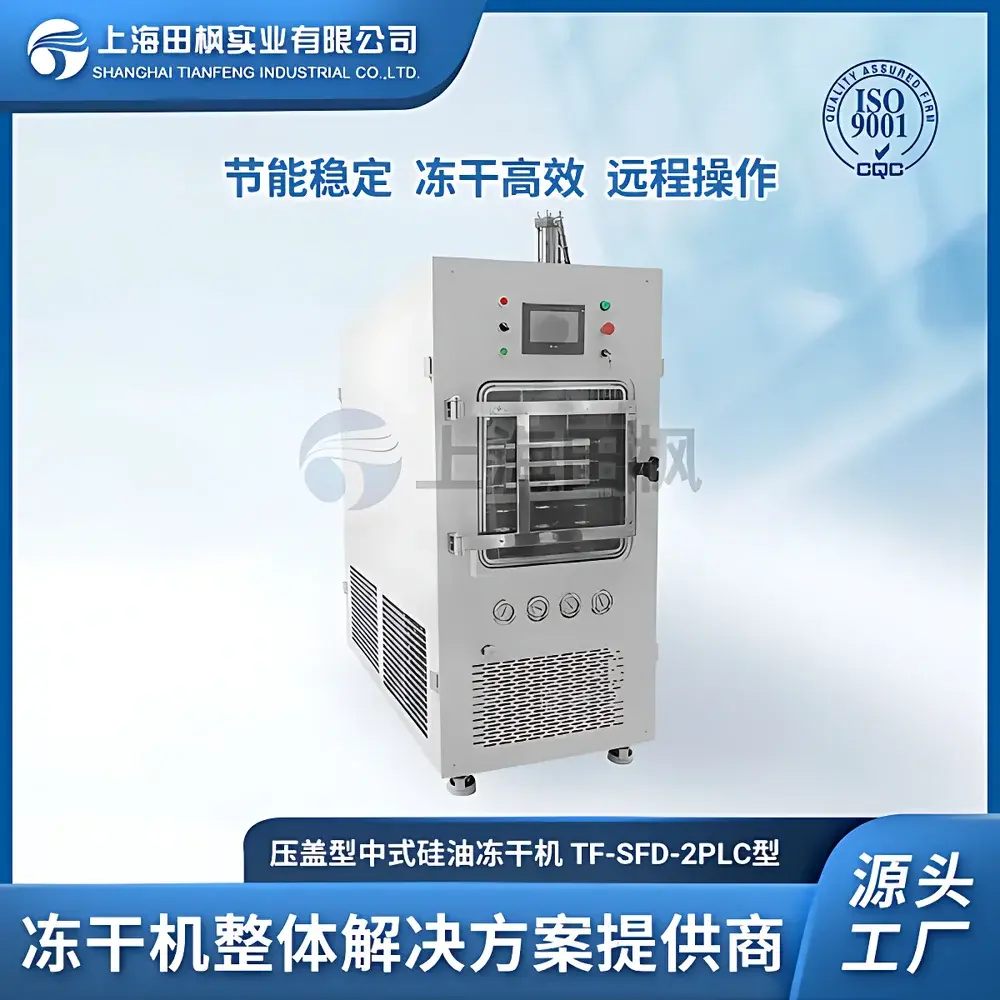
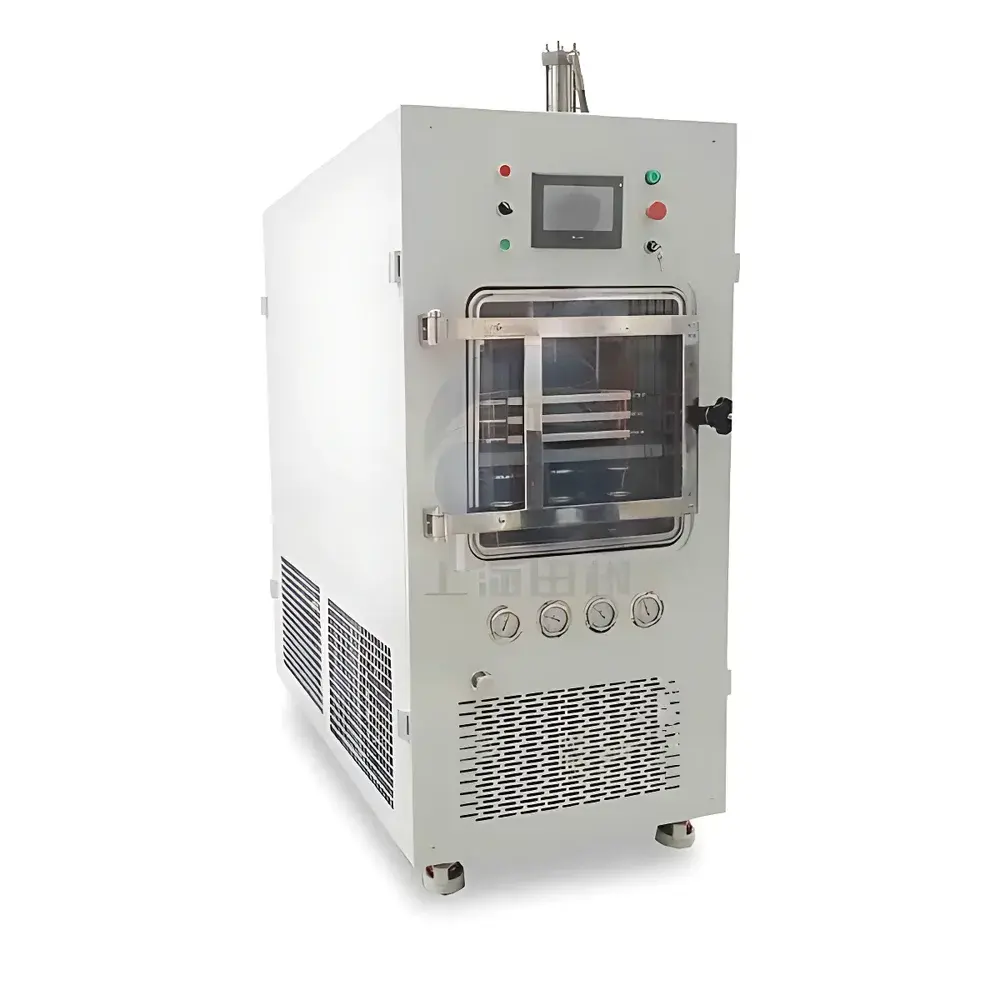
Tianfeng TF-SFD-2 PLC-Controlled Pilot-Scale Freeze Dryer with Hydraulic Stoppering
| Brand | Tianfeng |
|---|---|
| Origin | Shanghai, China |
| Manufacturer Type | OEM Manufacturer |
| Equipment Type | Standard Shelf-Type Freeze Dryer |
| Application Scope | Pilot-Scale Processing |
| Shelf Area | 0.2 m² |
| Ultimate Vacuum | ≤5 Pa (vacuum chamber, unloaded) |
| Condenser Capacity | 32 kg/24 h |
| Condenser Temperature | ≤−70 °C |
| Chamber Dimensions (W×H×D) | 800 × 1600 × 1700 mm |
| Power Supply | 220 VAC, 50 Hz |
| Installed Power | 5.5 kW |
| Ambient Operating Temperature | 5–25 °C |
| Weight | ~500 kg |
| Refrigeration Technology | Self-Recirculating Cascade System |
| Shelf Medium | Silicone Oil |
| Shelf Temp Range | −50 to +80 °C |
| Shelf Temp Uniformity | ≤±1 °C |
| Hydraulic Stoppering Force | 0–10 kN (adjustable) |
| Vial Capacity (approx.) | 810 × Ø16 mm or 410 × Ø22 mm |
| Max Liquid Load per Cycle | 3 L |
| Pre-freezing & Drying | In-situ |
| Control Interface | Touchscreen HMI with Manual/Automatic Mode |
| Data Logging | Batch-Indexed Curve + Numeric Recording |
| Compliance | Designed for GLP-compliant environments |
Overview
The Tianfeng TF-SFD-2 is a pilot-scale, in-situ freeze dryer engineered for reproducible, scalable lyophilization of thermolabile botanical and pharmaceutical materials. It operates on the fundamental principles of sublimation-based dehydration under high vacuum and deep-cold condensation—where ice is removed directly from the frozen matrix without passing through the liquid phase. This process preserves structural integrity, bioactivity, and chemical stability in sensitive herbal actives such as polysaccharides, saponins, alkaloids, and volatile oils found in traditional Chinese medicinal herbs—including Ophiocordyceps sinensis, Panax ginseng, Ganoderma lucidum, Lycium barbarum, and Gastrodia elata. The system integrates a self-recirculating cascade refrigeration architecture with dual-stage compressors, enabling rapid cooling of both shelves and condenser to −70 °C or lower—critical for achieving low residual moisture (<2% w/w) and maintaining eutectic point fidelity during primary drying.
Key Features
- In-situ pre-freezing and drying eliminates manual transfer, reducing contamination risk and ensuring process continuity.
- 0.2 m² stainless steel shelf area with silicone oil thermal medium ensures ±1 °C temperature uniformity across all shelves—essential for consistent drying kinetics and batch-to-batch comparability.
- Hydraulic stoppering unit (0–10 kN adjustable force) enables sterile, repeatable vial sealing under vacuum—ideal for clinical trial material preparation and GMP-aligned pilot batches.
- PLC-based control system (Tianfeng TF-HOS-V1) with touchscreen HMI supports full-cycle automation: pre-cooling, freezing, primary drying, secondary drying, and backfilling.
- “Recipe Management” function allows storage and recall of multiple lyophilization protocols—including ramp rates, hold times, pressure modulation, and shelf temperature profiles—with real-time deviation alerts.
- High-transparency acrylic chamber door and integrated observation window permit visual monitoring of cake formation, collapse onset, and desiccation progress without compromising vacuum integrity.
- Corrosion-resistant 304 stainless steel construction (chamber, condenser, shelves) complies with ISO 14644-1 Class 8 cleanroom compatibility requirements for non-sterile processing environments.
Sample Compatibility & Compliance
The TF-SFD-2 accommodates diverse sample formats: bulk trays (up to 3 L), standard serum vials (Ø16 mm, Ø22 mm), and custom containers compatible with hydraulic stoppering. Its design supports lyophilization of aqueous extracts, decoctions, fermented broths, and purified fractions derived from plant, fungal, and animal sources. All wetted surfaces meet FDA-recommended material standards for pharmaceutical contact (ASTM F899-22 compliant stainless steel). While the base configuration is intended for non-sterile pilot operations, optional upgrades—including HEPA-filtered nitrogen purge, calibrated thermocouple ports (per ASTM E2865), and co-located eutectic point measurement modules—enable alignment with ICH Q5C stability guidelines and USP lyophilization validation frameworks.
Software & Data Management
Data acquisition and traceability are implemented via embedded batch logging: each run is automatically assigned a unique identifier, with time-stamped records of shelf temperature, chamber pressure, condenser temperature, and elapsed time. Both numeric tables and graphical drying curves can be exported in CSV format for external analysis (e.g., MATLAB, JMP, or UNIFAC-based modeling). When paired with validated third-party software, the system supports electronic signatures, role-based access control, and audit trail generation meeting 21 CFR Part 11 requirements. Raw data files are stored locally on industrial-grade SD cards with write-protection switches to prevent accidental overwrites.
Applications
This freeze dryer serves laboratories engaged in formulation development, process optimization, and regulatory filing support for herbal injectables, granules, effervescent tablets, and inhalable powders. It is routinely deployed in university phytochemistry labs for metabolite stabilization prior to LC-MS/MS profiling; in contract development and manufacturing organizations (CDMOs) for tech transfer of TCM-derived APIs; and in quality control units verifying shelf-life extension of standardized herbal monographs (e.g., Chinese Pharmacopoeia 2020 Edition). Its robust thermal response (shelf cooldown from +20 °C to −40 °C in ≤60 min, condenser in ≤15 min) also supports rapid cycle development for novel biopolymer carriers and nanocellulose aerogels.
FAQ
What vacuum level does the chamber achieve under unloaded conditions?
The freeze drying chamber reaches ≤5 Pa at ultimate vacuum, verified using a calibrated Pirani/capacitance manometer.
Is the condenser capable of handling high-moisture botanical extracts?
Yes—the condenser provides 32 kg/24 h ice capacity and maintains ≤−70 °C surface temperature, suitable for viscous decoctions and polysaccharide-rich solutions.
Can the system be integrated into a GMP facility’s validation protocol?
With optional IQ/OQ documentation packages, calibrated sensors, and 21 CFR Part 11–enabled software, it supports formal qualification under Annex 15 and WHO TRS 986.
Does the hydraulic stoppering mechanism comply with ISO 8536-1 vial closure standards?
The system applies controlled, programmable force (0–10 kN) and is compatible with ISO-standard rubber stoppers; final seal integrity must be confirmed via helium leak testing per ASTM F2338.
What maintenance intervals are recommended for the cascade refrigeration system?
Compressor oil and filter replacement every 3,000 operating hours; annual calibration of vacuum and temperature sensors per ISO/IEC 17025 accredited procedures.



