
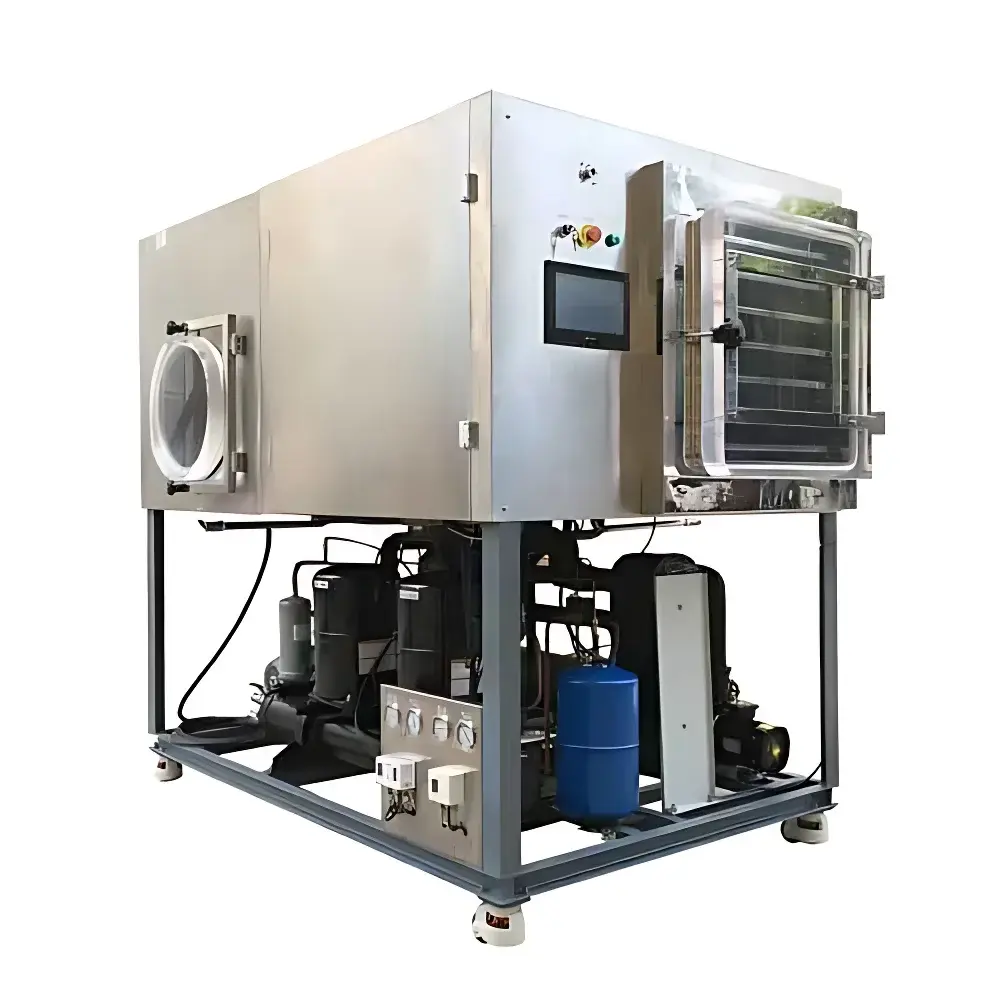
Tianfeng TF-SFD-20 Industrial-Scale Benchtop Freeze Dryer with 2 m² Shelf Area
| Brand | Tianfeng |
|---|---|
| Origin | Shanghai, China |
| Manufacturer Type | Direct Manufacturer |
| Product Category | Domestic |
| Model | TF-SFD-20 |
| Instrument Type | Standard Shelf-Type Freeze Dryer |
| Application Scope | Pilot & Small-Batch Production |
| Lyophilization Area | 2.16 m² (Effective) |
| Ultimate Vacuum | ≤5 Pa |
| Condenser Temperature | ≤−70 °C |
| Ice Capacity (24 h) | 30 kg |
| Condenser Cooling Rate (20 °C → −40 °C) | ≤15 min |
| Shelf Temperature Range | −55 °C to +80 °C |
| Shelf Cooling/Heating Rate (20 °C ↔ −40 °C, empty) | ≤60 min |
| Chamber Material | ANSI 304 Stainless Steel |
| Shelf Configuration | 6 usable shelves + 1 radiation shelf (450 × 800 × 20 mm, spacing 70 mm) |
| Surface Roughness | Ra ≤ 0.5 µm |
| Shelf Flatness | ≤ ±0.5 mm/m² |
| Door | 50 mm thick high-transparency acrylic |
| Control Interface | Touchscreen HMI with real-time drying curve & PID regulation |
| Refrigeration System | Cascade refrigeration with silicone oil as thermal medium (temperature uniformity ±1 °C) |
| Optional | Temperature data logger, eutectic point tester, automatic stoppering unit, inert gas backfill valve |
Overview
The Tianfeng TF-SFD-20 is an industrial-grade, in-situ freeze dryer engineered for reproducible, scalable lyophilization of heat-sensitive biologicals, botanical extracts, and functional food matrices—including premium tea leaves, peach-based hydrocolloid formulations, fish maw (fish bladder collagen), and other delicate natural products. It operates on the fundamental principle of sublimation: aqueous samples are first uniformly frozen at controlled low temperatures (≤−55 °C), then subjected to deep vacuum (≤5 Pa) while shelf heating enables primary drying via ice-phase water vapor removal, followed by secondary drying under elevated temperature and sustained vacuum to eliminate bound moisture. This process preserves labile phytochemicals (e.g., catechins, terpenoids, polysaccharides), enzymatic activity, structural porosity, and reconstitution fidelity—critical for pharmaceutical intermediates, nutraceutical powders, and research-grade reference materials.
Key Features
- In-situ pre-freezing capability eliminates manual transfer, minimizing contamination risk and thermal shock to samples.
- Six precision-machined 304 stainless steel shelves (450 × 800 mm, 70 mm spacing), fully welded with zero surface weld points, ensuring corrosion resistance, cleanability, and long-term dimensional stability.
- Cascade refrigeration system with silicone oil circulation delivers rapid condenser cooldown (≤15 min from 20 °C to −40 °C) and stable shelf temperature control (±1 °C uniformity), essential for consistent ice nucleation and drying kinetics.
- High-transparency 50 mm acrylic chamber door enables real-time visual monitoring without vacuum break; integrated LED lighting enhances observation of cake morphology and collapse onset.
- Intuitive touchscreen HMI supports three operational modes—manual, semi-automatic, and fully automatic—with one-touch sequencing, real-time drying curve overlay (shelf temp, chamber pressure, condenser temp), and configurable PID parameters.
- Optional compliance-enabling accessories include a validated temperature data logger (21 CFR Part 11 audit trail capable), eutectic point detection module for rational cycle design, and inert gas (N₂ or argon) backfill valve for oxygen-sensitive formulations.
Sample Compatibility & Compliance
The TF-SFD-20 accommodates diverse sample formats: vials (up to 7,656 × Ø16 mm or 4,032 × Ø22 mm), trays (max. 30 L liquid load), and bulk containers. Its design conforms to core engineering standards for GMP-aligned equipment: AISI 304 chamber construction meets FDA-recommended material requirements for pharmaceutical contact surfaces; surface roughness (Ra ≤ 0.5 µm) and flatness (≤ ±0.5 mm/m²) support effective cleaning validation per ISO 14644 and EU GMP Annex 1. While not certified for full cGMP production, the system supports GLP-compliant method development, stability studies, and pilot-scale batch qualification aligned with ICH Q5C, USP , and ISO 22081.
Software & Data Management
The embedded control software logs timestamped records of all critical process variables—shelf temperature, chamber pressure, condenser temperature, vacuum pump status, and elapsed time—at user-defined intervals (1–60 sec). Data export is supported via USB to CSV format for integration into LIMS or statistical process control platforms. Optional 21 CFR Part 11-compliant data loggers provide electronic signatures, audit trails, and role-based access control—enabling traceability required for regulatory submissions and internal quality audits. All firmware updates are performed offline via secure USB key to prevent network exposure.
Applications
This system is routinely deployed in academic labs and R&D centers for: stabilization of polyphenol-rich green/black tea extracts without aroma volatiles loss; lyophilization of hydrolyzed fish maw collagen for wound-healing biomaterials; production of reconstitutable peach puree powders retaining volatile lactones and esters; formulation development of diagnostic reagent kits (e.g., PCR master mixes, ELISA substrates); and preservation of microbial cultures, monoclonal antibodies, and mRNA-lipid nanoparticle intermediates. Its 2.16 m² effective area bridges the gap between benchtop feasibility studies and kilogram-scale process definition.
FAQ
What is the maximum batch size this freeze dryer can handle?
Up to 30 L of aqueous solution in tray format, or approximately 7,600 standard 10 mL vials—subject to cake height and thermal mass constraints.
Does the system support automated cycle optimization?
Yes—via optional eutectic point measurement and real-time pressure rise test (PRT) integration, enabling dynamic endpoint detection and adaptive ramping.
Can it be validated for GMP use?
The base configuration supports IQ/OQ documentation; PQ requires site-specific protocol development and third-party verification per ASTM F2476 and ISO 13408-1.
Is remote monitoring available?
Local Ethernet port allows LAN-based read-only access to live process data; full remote control requires on-site IT security review and firewall configuration.
What maintenance intervals are recommended?
Vacuum pump oil change every 500 operating hours; condenser coil inspection quarterly; silicone oil level and integrity check biannually; calibration of RTDs and pressure transducers annually.



