
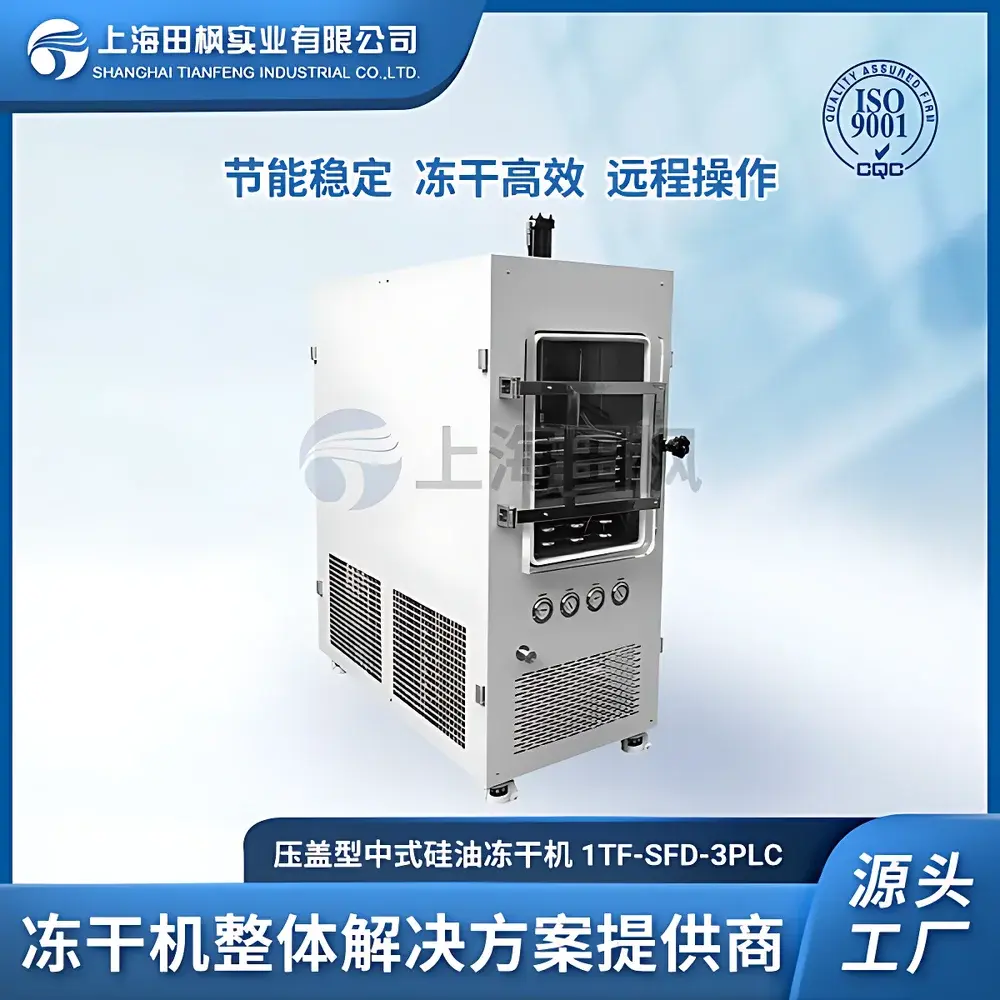
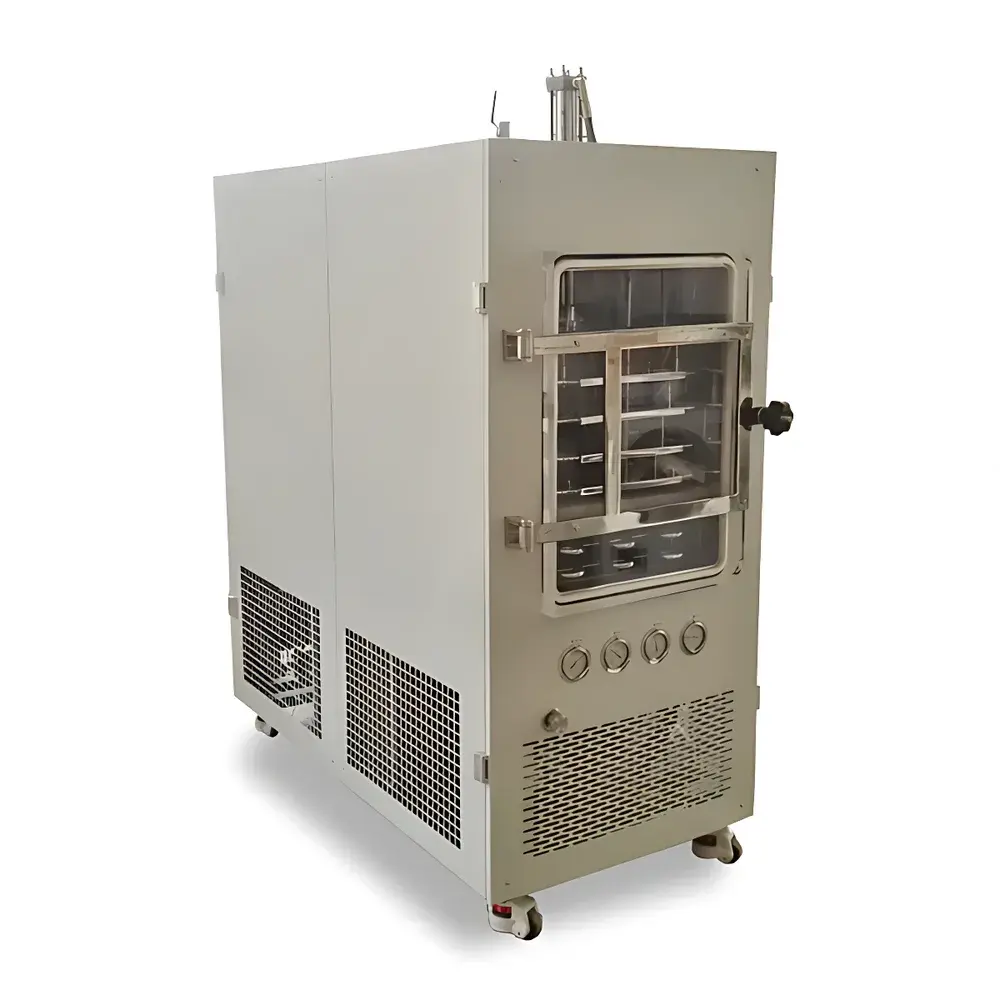
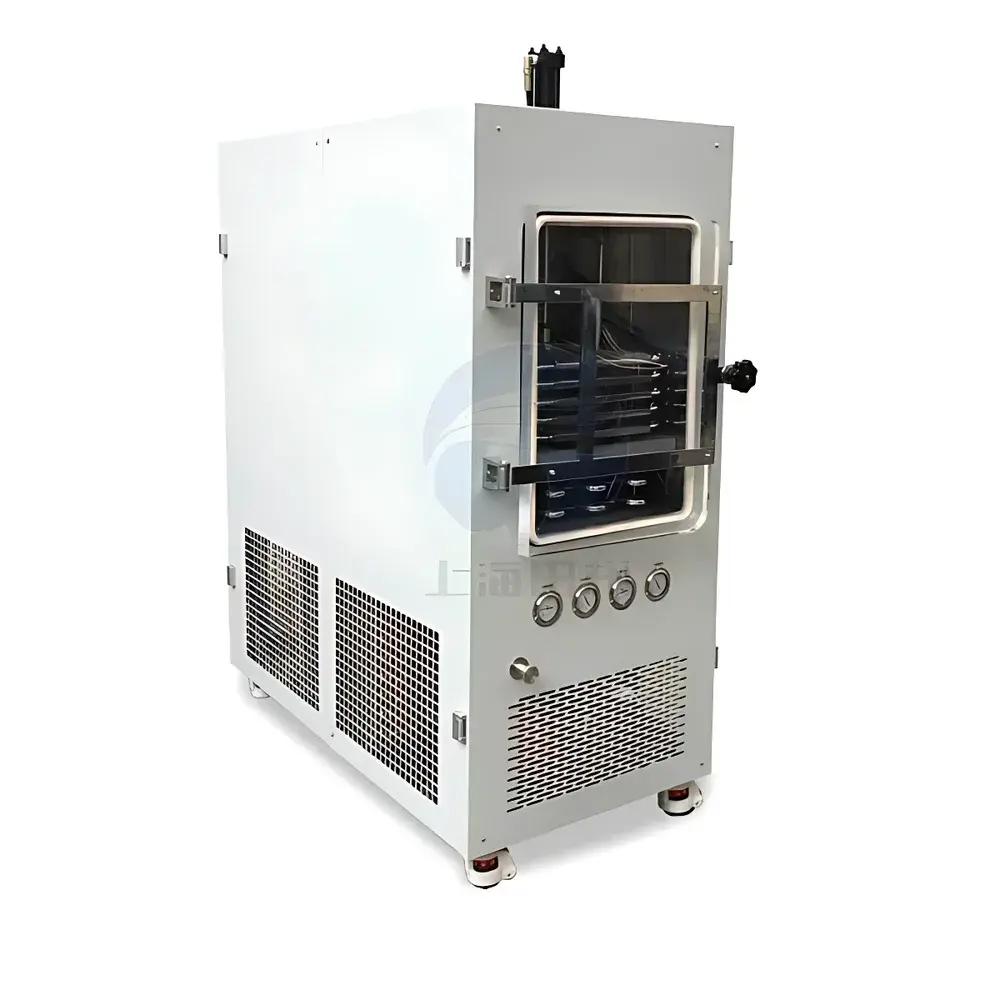
Tianfeng TF-SFD-3 Stoppering Freeze Dryer for Pharmaceutical Applications
| Brand | Tianfeng |
|---|---|
| Origin | Shanghai, China |
| Manufacturer Type | Direct Manufacturer |
| Product Category | Domestic |
| Model | TF-SFD-3 (Stoppering Type) |
| Instrument Type | In-situ Stoppering Freeze Dryer |
| Application Scope | Pilot-scale Pharmaceutical Processing |
| Shelf Area | 0.315–100 m² |
| Ultimate Vacuum | ≤5 Pa |
| Condenser Capacity (24 h) | 3–1000 kg/24 h |
| Condenser Temperature | ≤−70 °C |
| Main Unit Dimensions | 850 × 1000 × 1700 mm |
| Shelf Configuration | 3+1 stainless steel shelves (278 mm W × 380 mm L, 70 mm spacing) |
| Shelf Temperature Range | −50 °C to +80 °C |
| Max. Loading Capacity | 1287 vials (Φ16 mm) or 648 vials (Φ20 mm) |
| Max. Liquid Load | 4 L |
| Refrigeration System | Dual-stage cascade refrigeration with silicone oil as heat transfer medium |
| Control Interface | 7-inch color touchscreen with real-time drying curve & PID temperature control |
| Optional Features | Built-in inert gas purge valve, co-crystallization point tester, automatic stopper press system, GLP-compliant temperature data logger (21 CFR Part 11 ready) |
Overview
The Tianfeng TF-SFD-3 Stoppering Freeze Dryer is an in-situ pilot-scale lyophilization system engineered for pharmaceutical process development, formulation stability studies, and small-batch GMP-compliant production. It operates on the fundamental principle of sublimation-based dehydration: thermolabile substances—such as monoclonal antibodies, live-virus vaccines, recombinant proteins, and sterile injectables—are first frozen solid at controlled low temperatures, then subjected to high vacuum to enable direct phase transition of ice to vapor without passing through the liquid state. This preserves native conformation, biological activity, and structural integrity far more effectively than conventional thermal drying methods. The TF-SFD-3 integrates primary drying (sublimation) and secondary drying (desorption) within a single, fully enclosed stainless steel chamber, supporting full-cycle automation from pre-freezing through final stoppering—all performed under sterile-compatible conditions.
Key Features
- In-situ freezing and drying: Eliminates manual transfer between freezer and dryer, minimizing contamination risk and ensuring consistent nucleation behavior across batches.
- Stainless steel construction (AISI 304): Fully compliant with ISO 14644-1 Class 5 cleanroom compatibility; interior surfaces electropolished for enhanced cleanability and corrosion resistance.
- Silicone oil-heated shelves: ±1 °C uniformity across all shelf surfaces, enabling precise control of product interface temperature during both freezing and drying phases.
- Dual-stage cascade refrigeration: Achieves condenser temperatures ≤−70 °C, ensuring efficient water vapor capture even during high-load cycles; optimized for low noise emission (<65 dB(A)) and long-term reliability.
- Transparent acrylic drying chamber: High-optical-transmission door permits real-time visual monitoring of cake formation, collapse events, and moisture migration without compromising vacuum integrity.
- Integrated stoppering mechanism: Motor-driven hydraulic press applies calibrated force to seal rubber stoppers post-drying—critical for maintaining sterility and residual moisture control in vial-based dosage forms.
- Touchscreen HMI with embedded PID algorithm: Displays real-time shelf temperature, chamber pressure, condenser load, and drying curves; supports user-defined ramp/soak profiles and alarm-triggered event logging.
Sample Compatibility & Compliance
The TF-SFD-3 accommodates standard pharmaceutical primary packaging formats—including 10–30 mL serum vials (Φ16 mm and Φ20 mm), trays for bulk powder processing, and custom aluminum pans. Its design conforms to key regulatory expectations for early-phase process validation: shelf temperature mapping per ASTM E2297, vacuum leak rate testing per ISO 10012, and pressure sensor calibration traceable to NIST standards. While not certified for commercial manufacturing under EU Annex 1 or FDA 21 CFR Part 211 out-of-the-box, the system supports IQ/OQ documentation packages and can be qualified for use in GLP environments. Optional data loggers meet 21 CFR Part 11 requirements for electronic records and signatures when configured with audit trail, user access controls, and secure data export.
Software & Data Management
The embedded control software provides time-stamped, tamper-evident recording of all critical process parameters—including shelf setpoint vs. actual, chamber pressure (capacitance manometer), condenser temperature, and elapsed cycle time. Data are stored internally (≥100 cycles) and exportable via USB to CSV or PDF format. An optional Ethernet-enabled version supports Modbus TCP integration into centralized SCADA systems for lab-wide equipment monitoring. All firmware updates maintain backward compatibility with existing configuration files and historical datasets. For advanced analytics, raw time-series data can be imported into third-party platforms (e.g., MATLAB, Python pandas) for kinetic modeling of primary drying resistance or mass transfer coefficient estimation.
Applications
This system serves multiple stages of pharmaceutical development: formulation screening (lyoprotectant optimization, collapse temperature determination), cycle development (annealing protocol validation, endpoint detection via Pirani/baratron correlation), and clinical supply manufacturing (up to 1000 vials/batch). It is routinely deployed in QC labs for stability-indicating assays of freeze-dried reference standards, in R&D for biopolymer scaffold fabrication, and in academic settings for cryo-preservation of cell lines and tissue constructs. Beyond pharma, it supports lyophilization of diagnostic reagents (ELISA kits), enzyme immobilization matrices, and nanocellulose aerogels requiring pore structure preservation.
FAQ
What is the maximum batch size supported by the TF-SFD-3?
The system handles up to 1287 standard 10 mL vials (Φ16 mm) or 648 larger 20 mL vials (Φ20 mm) per cycle, depending on fill volume and shelf loading pattern.
Does the unit support automated cycle development?
Yes—via programmable multi-step profiles with independent ramp rates, hold durations, and pressure modulation; however, full adaptive control (e.g., PAT-integrated endpoint detection) requires optional sensors.
Can the system operate under inert gas backfill conditions?
Yes—an integrated nitrogen or argon purge valve allows controlled atmosphere restoration post-drying to prevent oxidation of sensitive APIs.
Is validation support provided for GMP environments?
Tianfeng supplies IQ/OQ templates and calibration certificates for core sensors; final PQ must be conducted by the end user’s qualified personnel per local regulatory guidelines.
What maintenance intervals are recommended for sustained performance?
Oil changes every 2000 operating hours, refrigerant leak checks semiannually, and O-ring replacement every 18 months—documented in the included maintenance logbook.



