
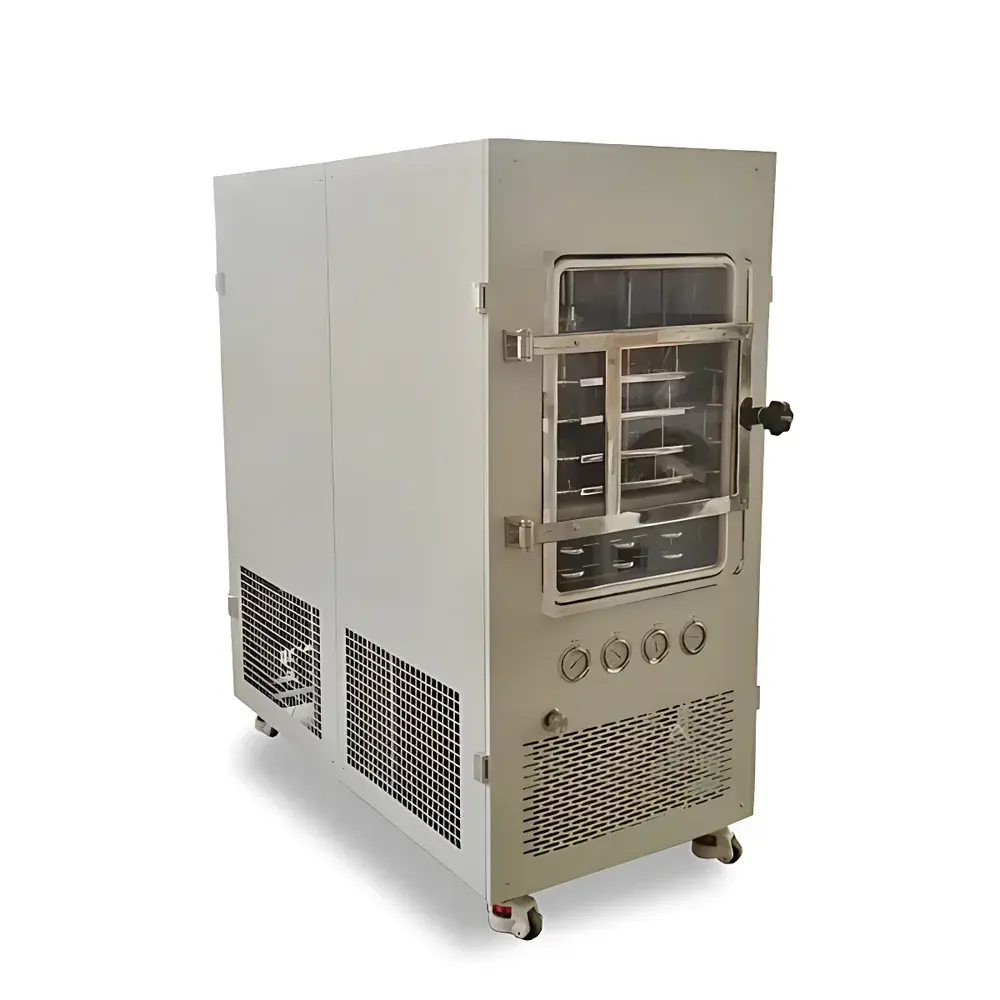
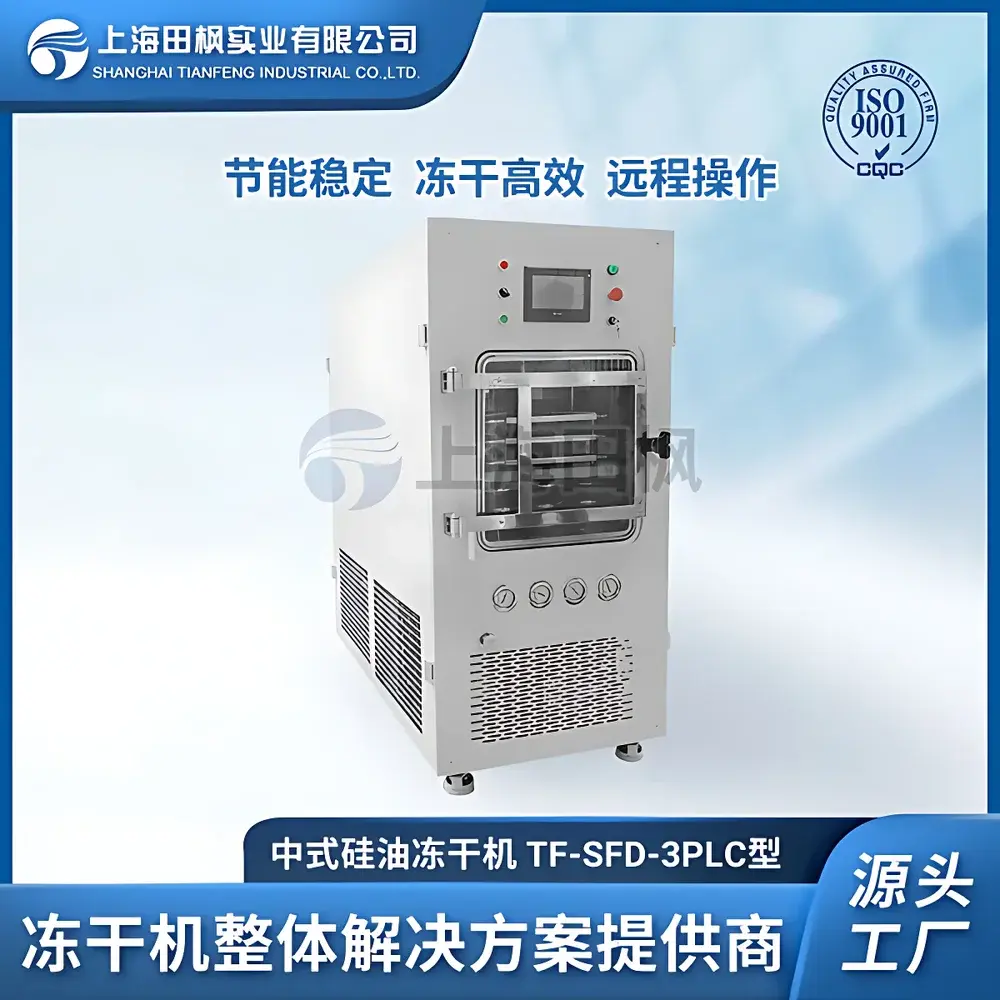
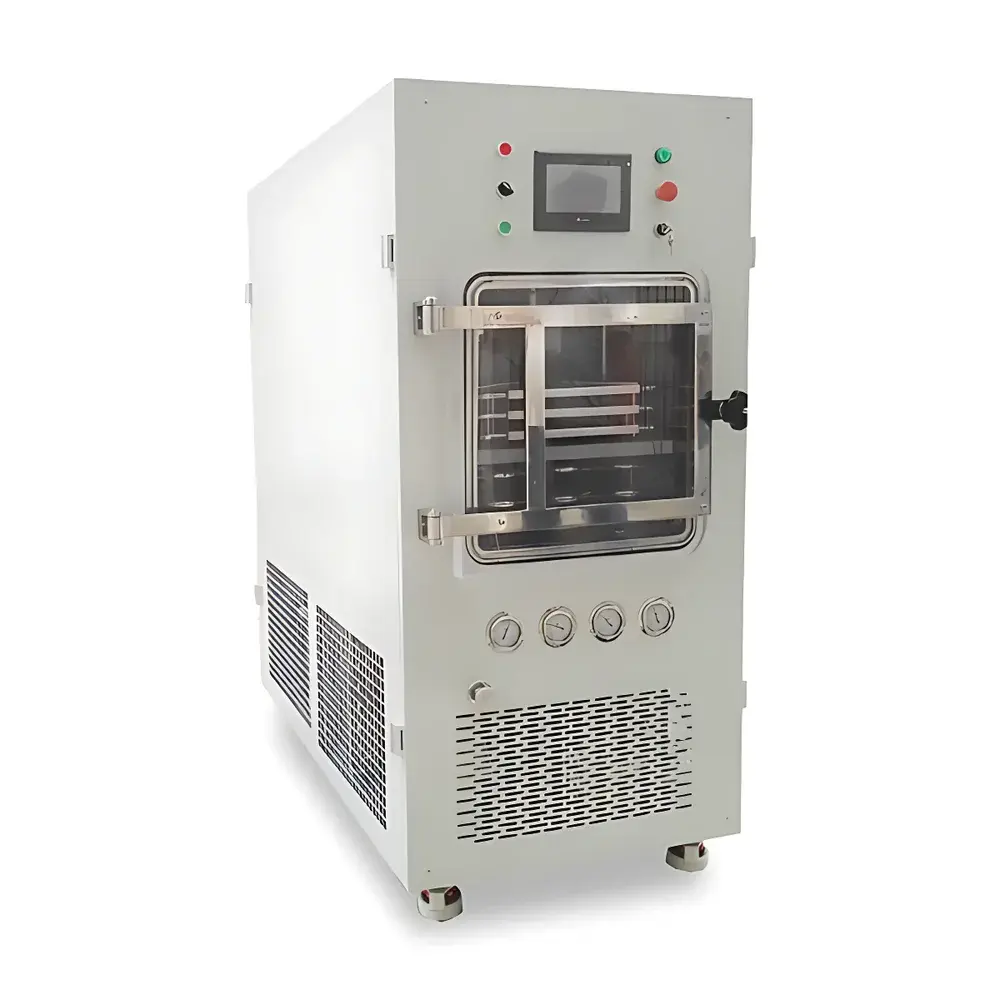
Tianfeng TF-SFD-3m² Benchtop Pilot-Scale Freeze Dryer
| Brand | Tianfeng |
|---|---|
| Origin | Shanghai, China |
| Manufacturer Type | Direct Manufacturer |
| Instrument Type | Shelf-Type Freeze Dryer |
| Application Scope | Pilot-Scale Production & Process Development |
| Lyophilization Area | 0.3 m² |
| Ultimate Vacuum | ≤5 Pa |
| Condenser Capacity (24 h) | 4 L |
| Condenser Temperature | ≤−70 °C |
| Chamber Dimensions (W×L) | 300×380 mm |
| Shelf Quantity | 3+1 |
| Shelf Temperature Range | −50 °C to +80 °C |
| Shelf Temperature Uniformity | ≤±1 °C |
| Power Consumption | 3.5 kW |
| Net Weight | 430 kg |
Overview
The Tianfeng TF-SFD-3m² Benchtop Pilot-Scale Freeze Dryer is an engineered solution for transitional process development between laboratory-scale feasibility studies and full-scale manufacturing. Designed according to the fundamental principles of lyophilization—comprising controlled freezing, primary drying under vacuum, and secondary drying via desorption—it delivers reproducible, scalable drying cycles for heat-sensitive biopharmaceuticals, diagnostics, enzymes, probiotics, and functional food ingredients. Its in-situ pre-freezing capability eliminates manual transfer risks, while silicon oil–heated shelves ensure precise thermal management across all three active shelves and one auxiliary shelf. The system operates within a validated pressure range down to ≤5 Pa and achieves condenser temperatures of ≤−70 °C—enabling efficient removal of both unbound and bound water from formulations with high solute concentration or low eutectic points.
Key Features
- In-situ freezing and drying in a single chamber, minimizing contamination risk and operational variability
- Silicon oil–circulated heating system with ±0.5 °C temperature control accuracy and inter-shelf uniformity ≤±1 °C
- Programmable logic controller (PLC) with 7-inch color touchscreen interface supporting up to five independent drying protocols, each configurable with up to 24 time–temperature–vacuum segments
- Real-time data acquisition: continuous logging of shelf temperature, chamber pressure, condenser temperature, and elapsed cycle time; all records timestamped and stored with user-accessible audit trail
- Optional integrated eutectic point detection module for empirical determination of collapse temperature during cycle development
- Gas backfilling valve compatible with nitrogen or argon for inert atmosphere reconstitution and oxygen-sensitive product handling
- Optically transparent acrylic door with anti-fog coating enables direct visual monitoring of cake formation, sublimation front progression, and structural integrity throughout drying
- Stainless steel 316L drying chamber and condenser housing compliant with ASME BPE surface finish standards (Ra ≤ 0.8 µm)
- Modular design supports future integration with environmental monitoring systems (e.g., Vaisala HUMICAP®) and SCADA-level network connectivity via Modbus TCP
Sample Compatibility & Compliance
The TF-SFD-3m² accommodates standard pharmaceutical vials (Φ16 mm: up to 1200 units/batch; Φ20 mm: up to 600 units/batch), serum bottles, and custom trays with maximum loading volume of 4 L per cycle. Its shelf geometry (300 mm × 380 mm × 70 mm spacing) ensures compatibility with ISO-standard lyophilization containers and facilitates GMP-aligned loading/unloading workflows. The unit conforms to ISO 9001:2015 quality management requirements and incorporates design elements aligned with FDA 21 CFR Part 11 for electronic record integrity—including password-protected operator access levels, immutable parameter change logs, and exportable CSV-formatted datasets. It supports IQ/OQ documentation packages and is routinely deployed in GLP-compliant R&D labs conducting stability studies per ICH Q5C and freeze-drying process validation per PDA Technical Report No. 36.
Software & Data Management
Embedded firmware provides full-cycle automation with real-time deviation alerts and automatic hold/resume functionality upon power recovery. All process parameters—including setpoints, actual values, alarms, and operator actions—are recorded at user-defined intervals (default: 10-second resolution) and retained onboard for ≥12 months. Data export is supported via USB 2.0 port in CSV format, compatible with Microsoft Excel, MATLAB, and commercial statistical process control (SPC) platforms such as Minitab or JMP. Optional software add-ons enable remote monitoring via Ethernet, automated report generation (PDF/HTML), and integration with LIMS environments using HL7 or ASTM E1384 messaging protocols. Audit trails meet ALCOA+ criteria (Attributable, Legible, Contemporaneous, Original, Accurate, Complete, Consistent, Enduring, Available).
Applications
- Development and optimization of lyophilization cycles for monoclonal antibodies, vaccines, and mRNA-LNPs
- Stability testing under accelerated and real-time storage conditions per ICH Q1A(R3)
- Process characterization studies including design space mapping via Quality by Design (QbD) frameworks
- Small-batch production of clinical trial materials (Phase I–II) requiring GMP-aligned documentation
- Drying of botanical extracts, probiotic cultures, and diagnostic enzyme conjugates where thermal degradation must be avoided
- Educational use in pharmaceutical engineering curricula for hands-on training in mass and heat transfer modeling during primary drying
FAQ
What regulatory standards does this freeze dryer support?
It supports compliance with ISO 9001:2015, aligns with core elements of FDA 21 CFR Part 11 for electronic records, and facilitates execution of IQ/OQ protocols consistent with EU Annex 15 and PDA TR 48.
Can the system be integrated into an existing facility SCADA network?
Yes—via optional Modbus TCP or Ethernet/IP communication modules, enabling centralized monitoring and alarm aggregation.
Is validation documentation provided with the instrument?
A basic IQ/OQ template package is included; full qualification support—including protocol drafting, execution oversight, and final report sign-off—is available as a professional services engagement.
What maintenance intervals are recommended for long-term reliability?
Vacuum pump oil replacement every 500 operating hours; condenser coil inspection quarterly; silicone oil top-up and calibration verification annually.
Does the system support automated recipe transfer between instruments?
Yes—drying programs can be exported/imported via USB drive in encrypted binary format, preserving all segment logic and conditional branching rules.



