
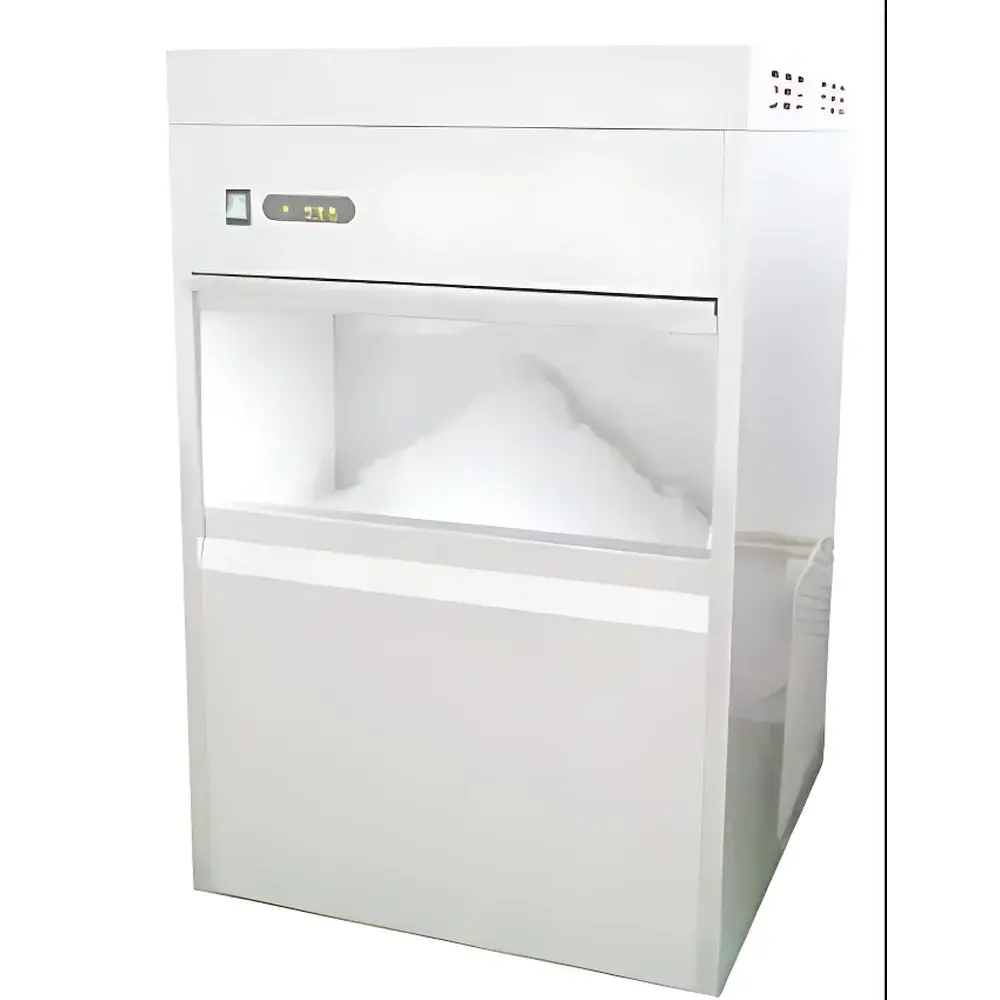
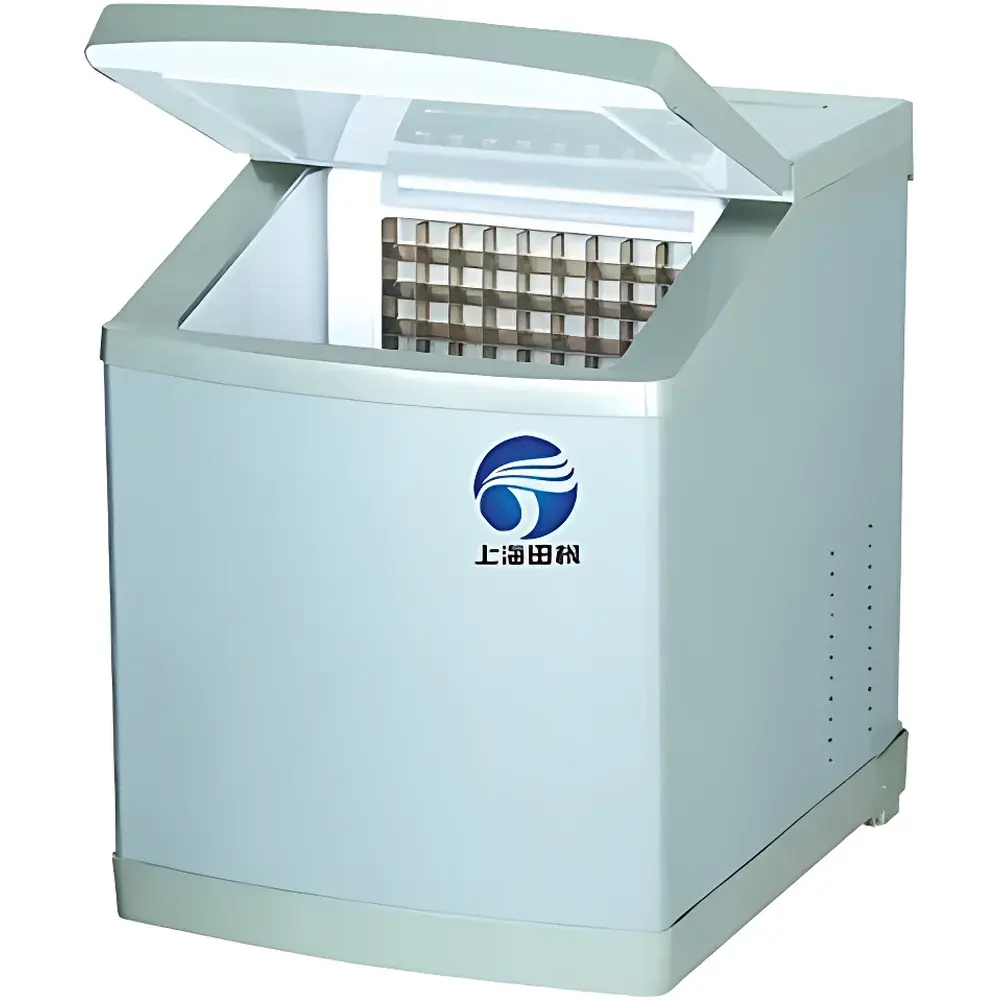
Tianfeng TF-ZBJ-23 Laboratory Flake Ice Machine
| Brand | Tianfeng |
|---|---|
| Origin | Shanghai, China |
| Manufacturer Type | Direct Manufacturer |
| Region Category | Domestic (China) |
| Model | TF-ZBJ-23 |
| Product Type | Flake Ice Machine |
| Ice Production Method | Screw-Extrusion Flake Ice Generation |
| Construction | Stainless Steel Housing (AISI 304) |
| Cooling System | Forced-Air Cooled, R134a-Compatible Hermetic Compressor |
| Control System | Microprocessor-Based Fuzzy Logic Controller |
| Safety Features | IPX4-Rated Enclosure, Built-in Earth Leakage Circuit Breaker (ELCB), Auto-Recovery After Power/Water Interruption |
| Hygiene System | Patented Residual Water Drainage Mechanism, Scheduled Auto-Clean Cycle |
| Insulation | Polyurethane Foam (≥45 mm Thickness) |
| Ambient Operating Range | 5–32°C |
| Storage Bin Capacity | Approx. 12 kg (typical for ZBJ-23 class) |
| Ice Output Rate | ~23 kg/24h (nominal, per manufacturer specification) |
Overview
The Tianfeng TF-ZBJ-23 Laboratory Flake Ice Machine is a purpose-built refrigeration system engineered for scientific laboratories requiring consistent, high-purity flake ice for temperature-sensitive sample preparation, enzymatic assays, electrophoresis cooling, chromatography column conditioning, and cold-chain sample transport validation. Unlike cubed or nugget ice machines, this unit employs a continuous screw-extrusion freezing mechanism—where potable water is distributed over a vertically oriented, refrigerated stainless steel drum surface. As the drum rotates, thin layers of water freeze and are mechanically scraped off in irregular, dendritic flakes (typically 1–3 mm thick, 5–15 mm diameter). This morphology provides maximal surface-area-to-volume ratio, enabling rapid thermal transfer and uniform bath immersion—even in narrow-necked vessels or microcentrifuge tube racks. The system operates on a closed-loop refrigeration cycle using R134a refrigerant and a hermetically sealed, low-vibration compressor optimized for stable operation under variable ambient conditions (5–32°C). Its compact footprint (W×D×H ≈ 320 × 450 × 620 mm) aligns with ISO/IEC 17025-compliant lab spatial planning standards.
Key Features
- Stainless steel (AISI 304) construction throughout—bin, drum, housing, and water reservoir—ensuring corrosion resistance and compliance with GLP cleaning protocols.
- Fuzzy logic microcontroller managing real-time adaptation of water feed timing, freezing duration, and scraper actuation based on ambient temperature and load history.
- Patented residual water drainage architecture: fully evacuates standing water from the evaporator sump after each cycle, eliminating biofilm formation risk and meeting USP sterility assurance prerequisites for ancillary lab equipment.
- Auto-recovery function: resumes operation from last known process state following power loss or water supply interruption—no manual reset required; maintains audit trail integrity per FDA 21 CFR Part 11 Annex 11 expectations.
- Integrated ELCB (30 mA trip threshold) and grounded chassis design conforming to IEC 61010-1:2010 safety requirements for laboratory electrical equipment.
- Forced-air condenser with aluminum-fin copper tubing and thermostatically regulated fan speed—minimizes heat rejection into lab environment while sustaining COP > 2.4 under nominal load.
Sample Compatibility & Compliance
The TF-ZBJ-23 produces non-agglomerating, low-density flake ice suitable for direct contact with biological samples, reagents, and calibration standards. Ice purity is maintained via NSF/ANSI 12-2023-compliant water filtration (integrated 5-micron sediment + activated carbon pre-filter, user-replaceable). The machine meets CE marking requirements under Directive 2014/30/EU (EMC) and 2014/35/EU (LVD), and its control firmware supports configurable event logging (start/stop, fault codes, clean cycle activation) traceable to ISO 9001:2015 Clause 8.5.2. It is validated for use in environments governed by CLSI GP26-A4 (Laboratory Refrigeration Equipment) and ASTM F2697-22 (Standard Practice for Validation of Ice Machines Used in Clinical Laboratories).
Software & Data Management
No external software is required for basic operation; all controls and diagnostics are accessible via a front-panel LCD with tactile membrane keys. Event logs—including ice production timestamps, compressor runtime, fault code history (e.g., E01 = low water, E03 = high head pressure), and auto-clean cycle execution—are stored in non-volatile memory for ≥12 months. Optional RS-485 Modbus RTU interface (add-on module) enables integration into centralized lab infrastructure monitoring systems (e.g., Siemens Desigo, Schneider EcoStruxure) for predictive maintenance scheduling and electronic record retention aligned with ALCOA+ principles.
Applications
- Cold preservation of tissue biopsies during histopathology specimen processing.
- Temperature stabilization of PCR master mixes and restriction enzyme reactions prior to thermal cycling.
- Calibration verification of digital thermometers and IR pyrometers using ice-point reference baths (ITS-90 compliant).
- Controlled-rate cooling of protein crystallization trials in hanging-drop plates.
- Pre-chilling of HPLC mobile phase solvents to reduce baseline drift in UV-Vis detection.
- Supporting ISO 15189-accredited clinical labs in maintaining cold chain integrity for point-of-care testing reagents.
FAQ
What water quality specifications are required for optimal ice clarity and system longevity?
Potable water with ≤500 ppm total dissolved solids (TDS), ≤0.1 ppm free chlorine, and pH 6.5–7.5 is recommended. A dedicated point-of-use deionization or reverse osmosis unit is advised for applications demanding ultra-low conductivity ice (e.g., electrophysiology).
Can the TF-ZBJ-23 be installed in an enclosed cabinet or under a bench?
Yes—provided minimum rear clearance of 100 mm and top clearance of 150 mm are maintained for condenser airflow; ambient temperature must remain within 5–32°C with relative humidity ≤80% non-condensing.
Is the ice output rate adjustable?
No—the unit operates at fixed nominal capacity (23 kg/24h); however, ice density and flake size distribution are inherently stabilized by the extrusion geometry and drum surface temperature (-18°C ±1°C), ensuring batch-to-batch reproducibility without manual intervention.
How often should the auto-clean cycle be performed?
Tianfeng recommends initiating the 25-minute thermal disinfection cycle every 7 days when used continuously; frequency may increase to every 3–4 days in high-humidity environments or where water hardness exceeds 120 ppm.
Does the machine comply with energy efficiency regulations for EU laboratories?
Yes—it meets EU Ecodesign Directive (EU) 2019/2023 Tier 2 requirements for refrigerated ice makers, achieving an Energy Efficiency Index (EEI) of 112 (≤120 threshold for Class A).



