
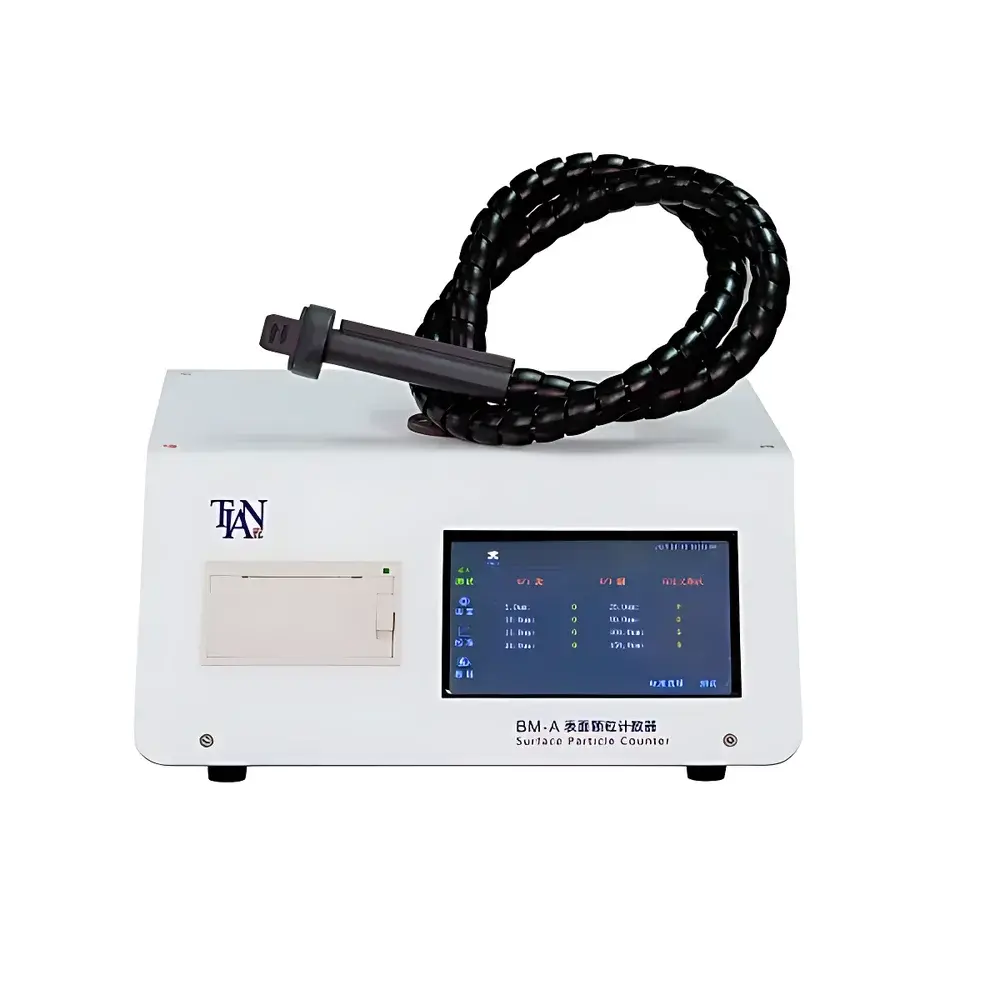
Tianhe BM-A Optical Surface Particle Counter
| Brand | Tianhe |
|---|---|
| Origin | Tianjin, China |
| Model | BM-A |
| Instrument Type | Optical Surface Particle Counter |
| Measurement Range | 0.1–5 µm, 0.3–10 µm, 5–150 µm, 20–500 µm |
| Number of Channels | 8 |
| Channel Resolution | 0.1 µm |
| Sampling Area | 10 cm² (configurable) |
| Sampling Duration | 5–59 s (user-defined) |
| Accuracy | ≤ ±20% |
| Relative Standard Deviation (RSD) | ≤ 5% |
| Count Capacity | 0–9,999,999 particles |
| Reporting Units | cm², m², sq.in, sq.ft |
| Operating Temperature | 10–40 °C |
| Power Supply | AC 220 V ±10%, 50 Hz, ≤100 W |
| Sampling Flow Rate | 1.0 CFM (28.3 L/min) |
| Interface | RS232, USB port for U-disk storage |
| Display & Control | Color capacitive touchscreen |
| Data Output | Built-in thermal printer, auto-storage, GLP-compliant audit trail (timestamped, user-ID logged) |
Overview
The Tianhe BM-A Optical Surface Particle Counter is a benchtop, non-destructive surface contamination monitoring instrument engineered for high-reliability quantitative analysis of particulate contamination on flat or planar substrates. It operates on the principle of laser light scattering detection: a collimated He-Ne or diode-based laser beam illuminates the sample surface at a controlled incident angle; scattered photons from particles within defined size thresholds are collected by a high-sensitivity photodetector array and converted into pulse-height signals. These signals are digitized and classified in real time across eight user-selectable size channels—spanning four complementary dynamic ranges (0.1–5 µm, 0.3–10 µm, 5–150 µm, and 20–500 µm)—to support multi-scale contamination profiling required in cleanroom-controlled manufacturing environments. Designed specifically for electronics, semiconductor wafer handling, lithium-ion battery electrode inspection, optical component QC, and advanced material R&D labs, the BM-A delivers trace-level particle enumeration without solvent contact, vacuum adhesion, or surface modification—ensuring measurement integrity for sensitive coatings, thin films, and lithography-ready surfaces.
Key Features
- Laser-based optical detection with 0.1 µm channel resolution, enabling discrimination of sub-micron defects critical in front-end semiconductor processes.
- Modular sampling head with adaptive height adjustment mechanism—automatically compensates for sample thickness variations from 0.1 mm to 50 mm—maintaining optimal focal distance and signal-to-noise ratio.
- Integrated clean-air delivery system: a low-pulsation 1.0 CFM (28.3 L/min) vacuum pump paired with a HEPA + activated carbon dual-stage filtration unit ensures laminar, particle-free airflow over the measurement zone, minimizing background interference.
- Configurable sampling protocol: user-defined area (default 10 cm², scalable via software), dwell time (5–59 s), and counting mode (standard ISO 14644-1, USP , or custom threshold logic).
- Onboard calibration management: factory-loaded NIST-traceable reference curves stored in non-volatile memory; automatic curve interpolation during measurement eliminates manual recalibration between runs.
- Full-featured embedded OS with 7-inch color capacitive touchscreen, bilingual (English/Chinese) UI, role-based access control (administrator/operator/auditor tiers), and encrypted local database with timestamped audit logs compliant with FDA 21 CFR Part 11 Annex 11 requirements.
Sample Compatibility & Compliance
The BM-A accommodates rigid and semi-rigid planar samples up to 300 × 300 mm, including silicon wafers (200 mm / 300 mm), glass substrates (display panels, photomasks), metal foils (cathode/anode current collectors), polymer films (separator membranes), and ceramic substrates (MLCCs). Its non-contact, dry measurement methodology avoids electrostatic disturbance, solvent residue, or mechanical abrasion—preserving sample integrity for downstream metrology (e.g., SEM, AFM) or functional testing. The instrument conforms to ISO 14644-1:2015 (cleanroom classification), ISO 14644-10:2016 (surface cleanliness), and supports data export formats compatible with JMP, Minitab, and LabWare LIMS. Optional IQ/OQ documentation packages are available for GMP-regulated facilities requiring validation per ASTM E2928-22 and EU GMP Annex 1.
Software & Data Management
Firmware v3.2 includes Tianhe ParticleSuite™—a Windows-compatible desktop application for remote configuration, trend analysis, SPC charting (X̄-R, CUSUM), and report generation (PDF/CSV/XLSX). All measurements are tagged with operator ID, timestamp, instrument serial number, environmental conditions (temperature/humidity via optional external sensor input), and calibration status. Data encryption (AES-256) and write-once-read-many (WORM) archive mode ensure forensic-grade data integrity. RS232 and USB host interfaces enable direct integration into MES or SCADA platforms; U-disk storage supports >100,000 test records with metadata indexing. Audit trails record every parameter change, user login/logout, and print/export event—fully traceable for internal audits or regulatory inspections.
Applications
- Semiconductor fabrication: post-etch/post-CMP particle verification on wafers prior to lithography; qualification of FOUPs and SMIF pods.
- Battery manufacturing: quantification of metallic debris on anode/cathode coatings and separator films—correlating particle density with short-circuit risk.
- Optoelectronics: inspection of AR-coated lenses, OLED encapsulation barriers, and laser diode facets for process-induced contamination.
- Medical device packaging: validation of cleanliness levels on Tyvek® lids and thermoformed trays per ISO 11607-1.
- Advanced materials R&D: in-process monitoring of nanocomposite film uniformity, catalyst layer deposition, and additive manufacturing substrate prep.
FAQ
What standards does the BM-A support out-of-the-box?
ISO 14644-1 (airborne), ISO 14644-10 (surface), USP (injectables), and JIS B 9921 (cleanroom monitoring). Custom threshold tables can be imported via CSV.
Can the BM-A measure particles on curved or textured surfaces?
No—it is optimized for flat, optically reflective or diffusive planar substrates. Curved, porous, or highly absorptive surfaces require alternative techniques (e.g., tape-lift + microscopy).
Is external environmental monitoring integrated?
Yes—via optional RS485-enabled温湿度 sensor module (model TH-ENV1), which feeds real-time ambient data into each measurement record.
How is calibration verified between scheduled services?
The system performs daily self-diagnostic checks on laser power stability, detector gain, and flow rate consistency; deviation alerts trigger automated recalibration prompts.
Does the instrument meet cybersecurity requirements for networked lab environments?
Firmware supports TLS 1.2 encrypted communication, disabled default credentials, and configurable firewall rules—validated against IEC 62443-3-3 SL2 requirements.
Related Products



