

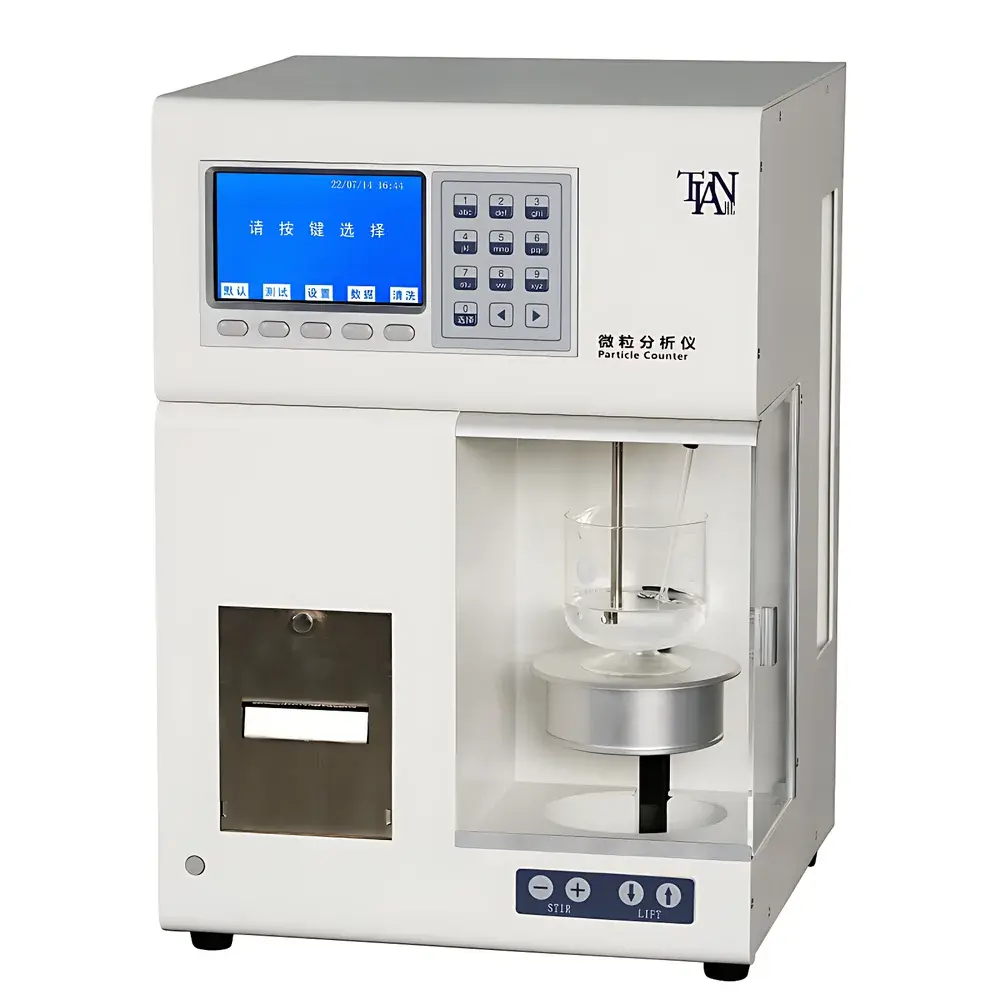
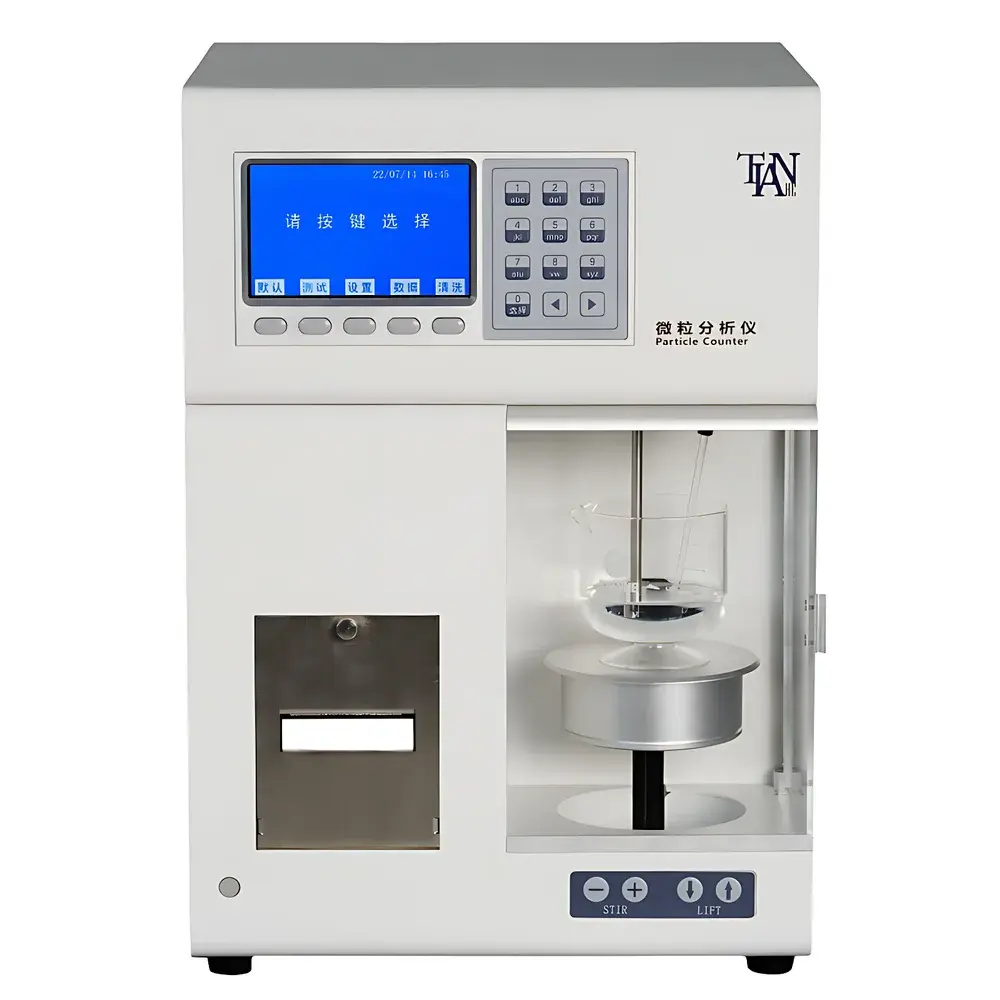
Tianhe GWF-6JA Insoluble Particle Analyzer for Pharmaceutical Applications
| Brand | Tianhe |
|---|---|
| Origin | Tianjin, China |
| Model | GWF-6JA |
| Particle Detection Principle | Laser Light Obscuration (LO) |
| Measurement Channels | 20 µm, 15–25 µm, ≥25 µm, 25–50 µm, 51–100 µm, >100 µm |
| Sizing Range | 5–200 µm |
| Count Range | 0–65,535 particles per sample |
| Sample Volumes | 5 mL, 100 mL, 475 mL, 500 mL, or full-volume aspiration |
| Accuracy | ±10% of specified value |
| Relative Standard Deviation (RSD) | ≤2% (for standard latex particles ≥1500 particles/mL) |
| Power Supply | AC 220 V ±10%, 50 Hz, ≤45 W |
| Stirring Speed | 0–2000 rpm, paddle-type, non-contact |
| Operating Temperature | 10–40 °C |
| Dimensions | 325 × 320 × 460 mm |
| Weight | 22 kg |
| Compliance | Designed to meet Chinese Pharmacopoeia (ChP) General Chapter 0903, USP <788>, and ISO 8573-1 (particulate contamination in compressed gases—adapted for liquid-phase validation) |
Overview
The Tianhe GWF-6JA Insoluble Particle Analyzer is a dedicated laser light obscuration (LO)-based instrument engineered for quantitative analysis of insoluble particulate matter in parenteral pharmaceutical preparations—including large-volume infusions, small-volume injections, and filtration devices such as IV sets and sterile filters. It operates on the principle that suspended particles passing through a precisely defined flow cell interrupt a collimated laser beam; the magnitude of signal attenuation correlates directly with particle cross-sectional area, enabling size-classified counting without reliance on optical transparency or solvent washout. Unlike traditional membrane filtration methods requiring saline elution and microscopy, the GWF-6JA enables direct, real-time detection of opaque, colored, or turbid samples—eliminating procedural bias from filter clogging, incomplete particle recovery, or operator-dependent interpretation. Its architecture adheres to core metrological requirements for pharmaceutical particulate testing: high reproducibility, low carryover, minimal user intervention, and traceable calibration against NIST-traceable polystyrene latex (PSL) standards.
Key Features
- Laser-based light obscuration sensor with six independent size channels: 20 µm, 15–25 µm, ≥25 µm, 25–50 µm, 51–100 µm, and >100 µm—supporting both ChP 0903 and USP reporting formats.
- Programmable high-precision syringe pump system enabling accurate volumetric aspiration across discrete modes: 5 mL, 100 mL, 475 mL, 500 mL, or full-bag sampling—critical for evaluating filter retention efficiency and infusion bag integrity.
- Integrated anti-clogging design featuring an automated slit-flush function using compatible cleaning fluids (e.g., filtered water or isopropyl alcohol), maintaining optical path integrity between runs.
- Motorized vertical sample stage with adjustable non-contact stirring (0–2000 rpm, paddle-type), preventing mechanical abrasion-induced artifact particles during suspension homogenization.
- Embedded microprocessor control with automatic data averaging, statistical summary, and thermal printer output—ensuring audit-ready documentation compliant with GLP/GMP record-keeping expectations.
- Low power consumption (<45 W) and compact footprint (325 × 320 × 460 mm) facilitate integration into QC laboratories with space constraints or shared utility infrastructure.
Sample Compatibility & Compliance
The GWF-6JA accommodates a broad range of pharmaceutical liquid matrices: aqueous solutions, oil-based injectables, suspensions, and even viscous formulations—provided viscosity remains below 20 mPa·s to ensure laminar flow through the sensing zone. It is validated for use with single-use infusion sets, terminal sterilized filters, and pre-filled syringes per ChP 0903 Annex II and ISO 11608-2 (needle-based drug delivery systems). While not certified to FDA 21 CFR Part 11 out-of-the-box, its firmware supports timestamped, user-ID-tagged result logs suitable for retrospective validation under internal SOPs aligned with Annex 11 (EU GMP) and ALCOA+ data integrity principles. Calibration verification follows ISO/IEC 17025–recommended practices using certified reference materials (CRM) traceable to NIST SRM 1963 or equivalent.
Software & Data Management
The analyzer incorporates embedded firmware—not external PC software—minimizing cybersecurity exposure and eliminating driver compatibility issues. All measurement parameters (volume, channel thresholds, stir speed, flush cycles) are stored in non-volatile memory. Raw count data, mean particle concentration (particles per mL), and RSD values are printed immediately post-analysis. For enterprise-level integration, ASCII-formatted export via RS-232 serial interface allows ingestion into LIMS platforms supporting ASTM E1382-compliant data exchange protocols. Audit trails include date/time stamps, operator ID input, and calibration status flags—enabling alignment with FDA’s expectations for electronic records under 21 CFR Part 11 when paired with appropriate procedural controls.
Applications
- Quantitative evaluation of particulate load in finished injectable products prior to release (ChP 0903, USP , EP 2.9.19).
- Determination of filter retention efficiency (beta ratio) for sterilizing-grade membranes used in aseptic processing.
- Verification of container-closure integrity for glass vials, plastic ampoules, and flexible bags exposed to mechanical stress or aging.
- Stability-indicating assessment of protein aggregates and silicone oil droplets in biologics formulations.
- Root cause analysis of visible particle incidents in manufacturing environments—distinguishing intrinsic (process-generated) vs. extrinsic (environmental or packaging-derived) contamination.
FAQ
Does the GWF-6JA require calibration with certified reference particles before each use?
No—daily calibration verification using a single-point check standard (e.g., 25 µm PSL at 1000 ± 200 particles/mL) is sufficient per ChP 0903 guidance; full multi-point calibration is recommended weekly or after maintenance.
Can the instrument detect sub-visible particles smaller than 10 µm?
No—the lower detection limit is 5 µm, but reliable quantification begins at ≥10 µm per pharmacopoeial acceptance criteria; particles below 10 µm fall outside regulatory reporting scope for injectables.
Is the syringe pump compatible with aggressive solvents like DMSO or ethanol?
Only if chemically inert tubing (e.g., fluoropolymer-lined) is installed; standard silicone tubing is incompatible with organic solvents and must be replaced per manufacturer’s chemical resistance chart.
How is carryover minimized between high-load samples?
Through sequential automated rinses: post-run flush of the flow cell and injection path with ultrapure water, followed by air purge and optional solvent rinse—configurable in method settings.
Does the device support 21 CFR Part 11 compliance natively?
It provides foundational elements (electronic signatures, audit trail logging), but formal Part 11 compliance requires site-specific validation, including role-based access control implementation and third-party digital signature integration—beyond the instrument’s embedded capabilities.






