
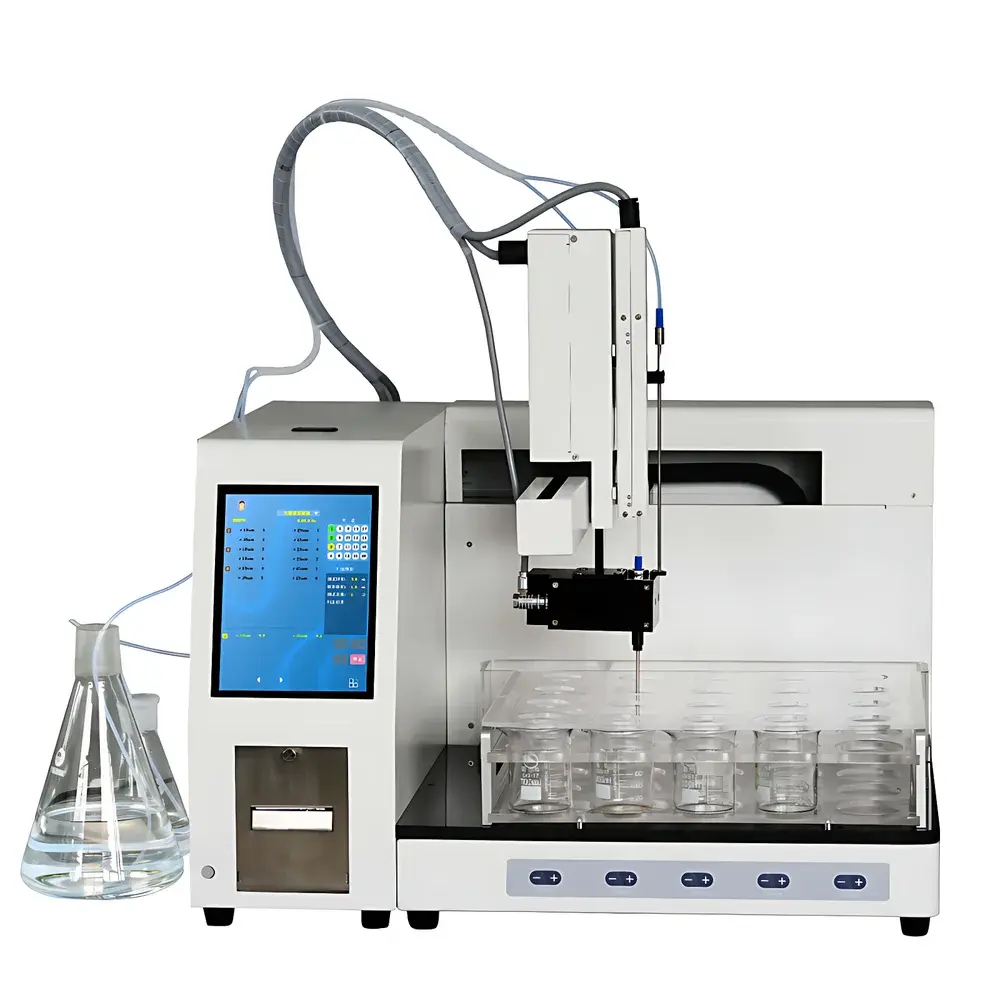
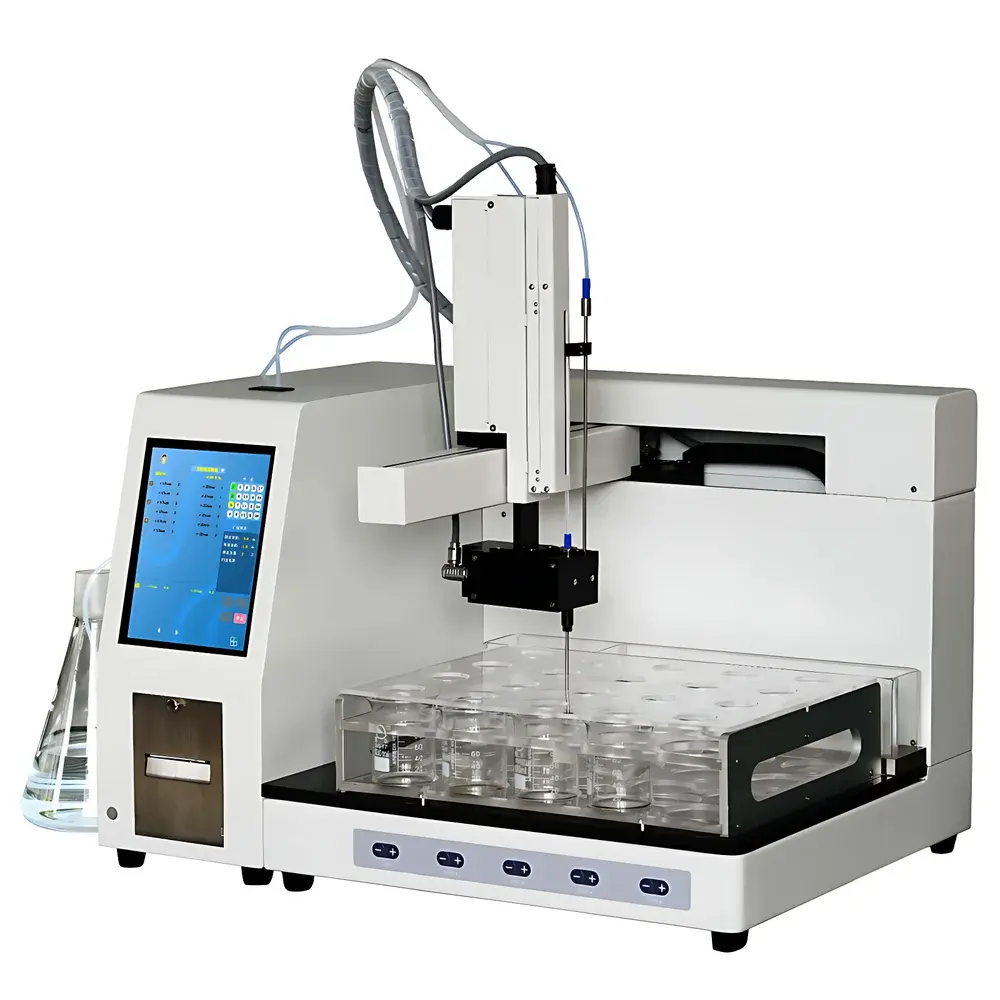
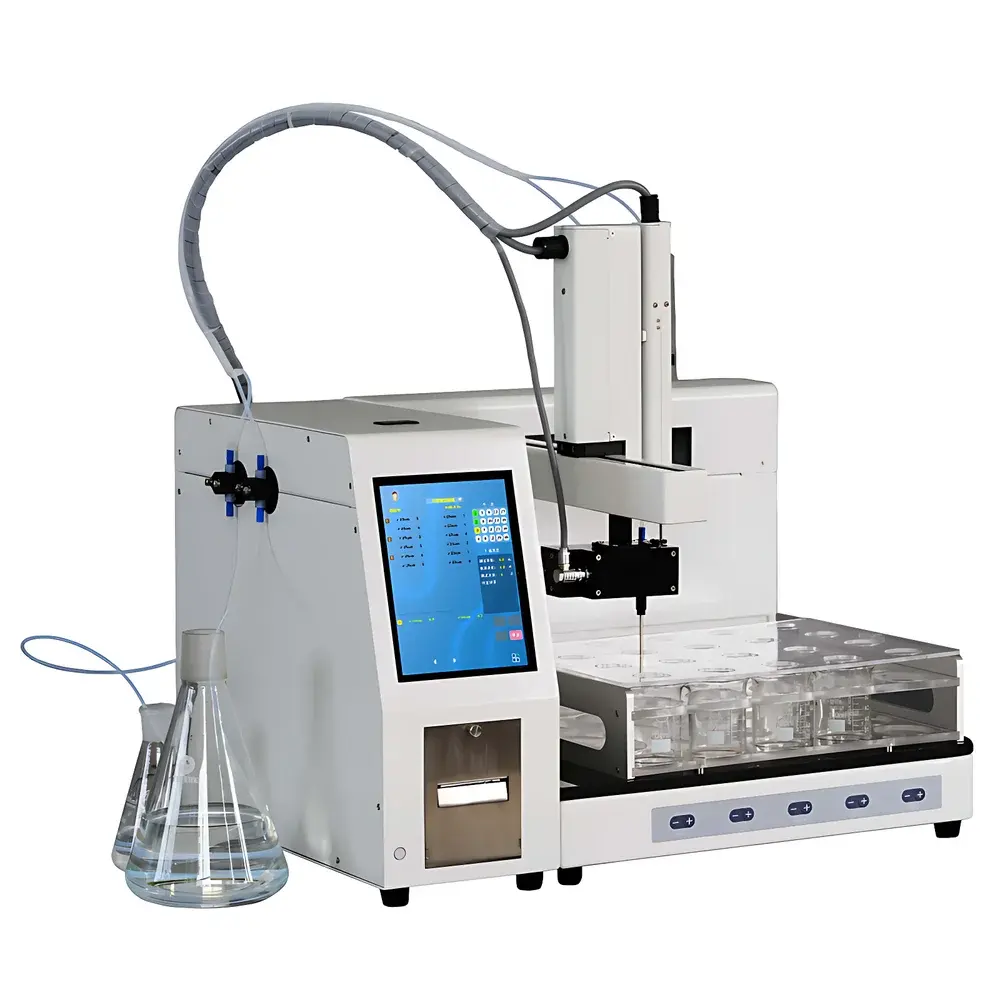
Tianhe GWF-9D Optical Particle Counter for Insoluble Particulate Matter Analysis
| Brand | Tianhe |
|---|---|
| Origin | Tianjin, China |
| Manufacturer Type | Authorized Distributor |
| Region of Manufacture | Domestic (China) |
| Model | GWF-9D |
| Instrument Type | Optical Particle Counter |
| Price | Upon Request |
| Key Specifications | Particle Size Range: 1–500 µm |
| Counting Channels | 64 displayed (customizable up to thousands, resolution 0.01 µm) |
| Sample Volume | 0.2–6500 mL (±0.5% accuracy) |
| Flow Rate | 5–80 mL/min |
| Counting Accuracy | ±5% of specified value |
| Channel Resolution | >95% |
| RSD | <1.5% (for standard particles ≥1000 particles/mL) |
| Max Detection Concentration | 18,000 particles/mL |
| Sample Capacity | 1–20 vials |
| Stirring Speed | 0–1000 rpm (step-adjustable) |
| Operating Temperature | 10–40 °C |
| Power | 100–240 VAC, 50/60 Hz, <80 W |
| Data Output | Dot-matrix printer, RS232, USB storage |
Overview
The Tianhe GWF-9D Optical Particle Counter is a fully automated, high-throughput instrument engineered for quantitative detection and sizing of insoluble particulate matter in parenteral pharmaceuticals, biologics, ophthalmic solutions, injectables, and medical device rinsates. It operates on the principle of light obscuration (also known as single-particle optical sensing, SPOS), where particles suspended in a liquid medium pass through a precisely defined laser beam; each particle generates a pulse proportional to its cross-sectional area, enabling real-time enumeration and classification across 64 standardized or user-defined size channels (down to 0.01 µm resolution). Designed to meet stringent regulatory expectations for quality control laboratories, the GWF-9D delivers traceable, auditable, and reproducible results aligned with pharmacopoeial requirements—including the upcoming 2025 edition of the Chinese Pharmacopoeia (ChP), United States Pharmacopeia (USP , , ), European Pharmacopoeia (Ph. Eur. 2.9.19), Japanese Pharmacopoeia (JP XVII), British Pharmacopoeia (BP), ISO 21510:2018, and GB 8368–2018 for infusion devices.
Key Features
- Fully automated sample handling via precision 3-axis robotic arm—enables unattended analysis of up to 20 vials per batch with zero manual intervention between runs.
- Dual high-accuracy syringe pumps and flow-controlled aspiration system ensure volumetric precision of ±0.5% across the full 0.2–6500 mL range, critical for compliance with USP volume tolerance criteria.
- Optimized optical path featuring stabilized laser diode and dynamic light-energy compensation circuitry—maintains consistent signal-to-noise ratio for both colorless and highly pigmented, viscous, or turbid formulations (e.g., lipid emulsions, oil-based carriers).
- Chemically inert fluidic pathway constructed from imported 316L stainless steel and PTFE—validated for compatibility with organic solvents (e.g., ethanol, isopropanol), weak acids/bases, and aggressive excipients without leaching or carryover.
- Onboard calibration management supporting multi-point verification against NIST-traceable polystyrene latex (PSL) standards per ISO 21501-4 and ChP 2025 Annex VI; auto-recall of calibration history with timestamped audit trail.
- Integrated cleaning cycle with programmable rinse volume, dwell time, and flow rate—reduces residual contamination risk and supports GLP/GMP-compliant revalidation protocols.
- Role-based access control (RBAC) with password-protected user tiers (Operator, Supervisor, Administrator)—ensures data integrity and aligns with FDA 21 CFR Part 11 electronic record/electronic signature (ERES) readiness.
Sample Compatibility & Compliance
The GWF-9D accommodates a broad spectrum of sample matrices relevant to pharmaceutical manufacturing and packaging validation: aqueous buffers, saline solutions, dextrose infusions, monoclonal antibody formulations, vaccine suspensions, silicone oil-lubricated syringes, and polymeric device leachates. Its modular stirrer assembly (0–1000 rpm, step-adjustable) ensures homogeneous particle suspension without cavitation or shear-induced degradation. All hardware and firmware comply with IEC 61010-1 safety standards and electromagnetic compatibility (EMC) directives. The instrument supports full audit trail generation—including user actions, parameter changes, calibration events, and result exports—meeting ALCOA+ principles (Attributable, Legible, Contemporaneous, Original, Accurate, Complete, Consistent, Enduring, Available) required under GMP Annex 11 and WHO TRS 991.
Software & Data Management
The embedded Windows-based software provides comprehensive instrument control, real-time visualization of particle histograms and cumulative distributions, and configurable reporting templates compliant with ChP 2025 Chapter 0903 and USP . Data export options include CSV, PDF, and XML formats compatible with LIMS integration. RS232 and USB interfaces support secure transfer to validated laboratory information systems, while optional barcode scanner integration enables automatic sample ID logging—eliminating transcription errors and reinforcing chain-of-custody integrity. All electronic records retain immutable timestamps, digital signatures, and change history logs, satisfying FDA 21 CFR Part 11 and EU Annex 11 requirements for computerized system validation.
Applications
- Final container testing of sterile injectables per USP and ChP 2025 Section 0903.
- Particulate evaluation of prefilled syringes, autoinjectors, and IV bags following ISO 11608-1 and GB 8368.
- Extractables and leachables assessment from primary packaging components (e.g., rubber stoppers, glass vials, polymer tubing).
- Process monitoring during filtration validation and hold-time studies.
- Stability-indicating assay for aggregation onset in protein therapeutics.
- Quality release testing of ophthalmic solutions per USP .
FAQ
Does the GWF-9D support 21 CFR Part 11 compliance?
Yes—the system implements role-based authentication, electronic signatures, and an immutable audit trail for all critical operations, meeting core technical controls outlined in FDA 21 CFR Part 11.
Can it analyze samples containing organic solvents?
Yes—its fluidic path uses 316L stainless steel and PTFE components, validated for repeated exposure to common pharmaceutical solvents including ethanol, propylene glycol, and castor oil derivatives.
How is calibration traceability maintained?
Calibration is performed using NIST-traceable PSL standards; all calibration parameters, dates, operators, and deviation reports are stored locally and exportable in PDF or CSV format.
Is dilution functionality built-in or optional?
Automatic dilution is available as a factory-installed option, supporting programmable 1:2 to 1:1000 serial dilutions with integrated mixing and post-dilution reanalysis.
What regulatory standards does the software report generator cover?
Preconfigured report templates align with ChP 2025, USP /, Ph. Eur. 2.9.19, and ISO 21510:2018, including mandatory fields for sample ID, analyst, instrument ID, calibration status, and pass/fail determination against acceptance criteria.



