
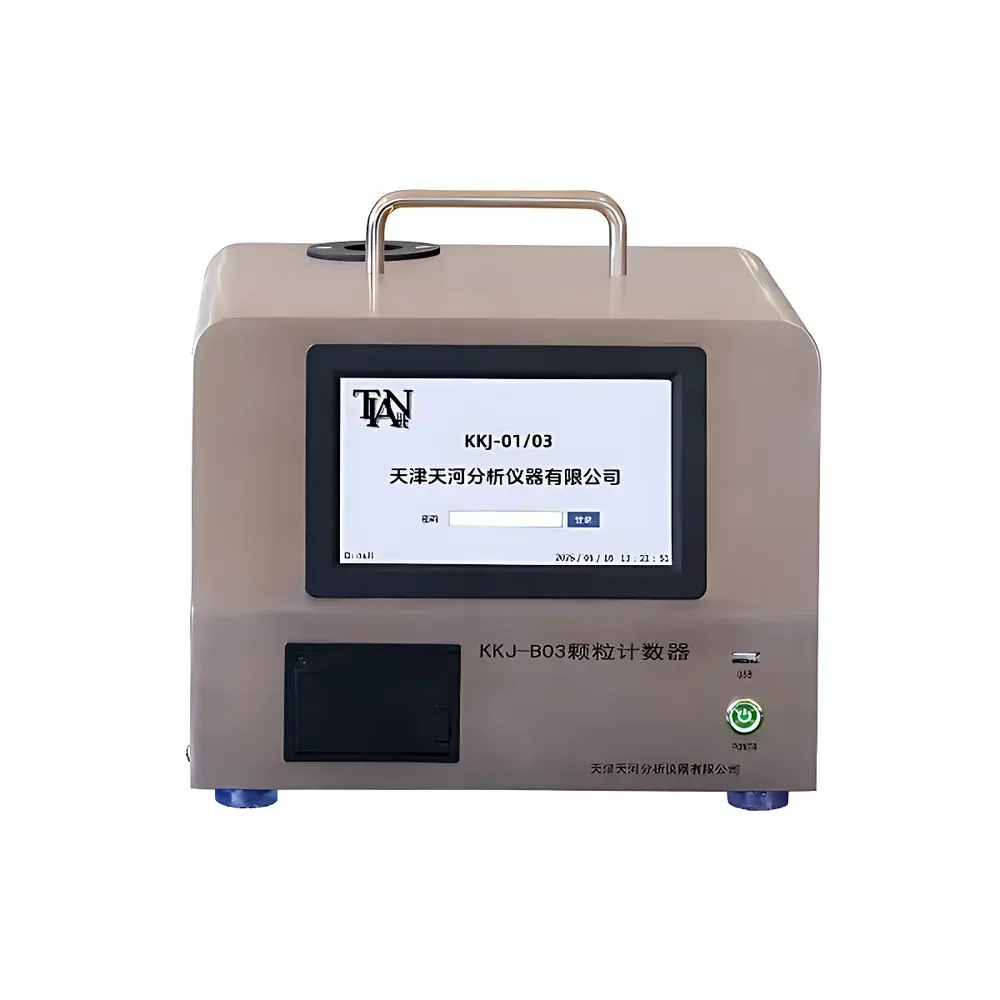
Tianhe KKJ-01/03 Optical Airborne Particle Counter
| Brand | Tianhe |
|---|---|
| Origin | Tianjin, China |
| Model | KKJ-01/03 |
| Instrument Type | Optical Particle Counter |
| Measurement Range | 0.1–5 μm or 0.3–10 μm |
| Channel Count | 8 |
| Maximum Sample Concentration | 100,000 particles/L |
| Counting Efficiency | 50±20% at 0.1 μm |
| Repeatability | ≤10% |
| Size Distribution Error | ≤±30% at 0.5 μm and 5 μm |
| Timing Accuracy | ≤1 s over 6 min |
| Particle Concentration Indication Error | ≤30% at 0.5 μm |
| Clean-up Time | ≤10 min (three consecutive zero counts with 95% confidence) |
| Sampling Flow Rate | 1.0 CFM (28.3 L/min) |
| Power Supply | AC 220 V ±10%, 50 Hz, ≤120 W |
| Interfaces | Ethernet, RS232 |
| Internal Data Storage | 3,000 sample records |
| Dimensions | 305 × 315 × 385 mm |
| Operating Environment | 0–35 °C, 10–90% RH |
| Display | 7-inch IPS touchscreen |
| Compliance | JJF 1190–2008, ISO 21501-4 / GB/T 29024.4 |
Overview
The Tianhe KKJ-01/03 Optical Airborne Particle Counter is a precision-engineered instrument designed for real-time monitoring and quantitative analysis of airborne particulate contamination in controlled environments. It operates on the principle of single-particle light scattering—where aerosol particles pass through a focused laser beam and generate scattered light pulses proportional to their size. These pulses are detected by a high-sensitivity photodetector and classified into eight discrete size channels using calibrated pulse-height analysis. The device is specifically optimized for applications demanding strict adherence to cleanroom classification standards—including ISO 14644-1, EU GMP Annex 1, and semiconductor manufacturing protocols defined by SEMI F29. Its dual-range optical configuration (0.1–5 μm and 0.3–10 μm) enables flexible deployment across electronics fabrication, battery dry rooms, pharmaceutical isolators, and advanced materials R&D laboratories.
Key Features
- Stable, low-noise laser diode source ensuring consistent signal-to-noise ratio and long-term measurement reproducibility.
- Dual counting modes: cumulative (total counts ≥ threshold size) and differential (counts per size bin), supporting both compliance reporting and granular particle distribution analysis.
- 7-inch industrial-grade IPS touchscreen with wide viewing angle and intuitive icon-driven interface—designed for glove-compatible operation in cleanroom gowning zones.
- Integrated sampling pump with precise volumetric flow control (28.3 L/min ±2.5%), actively monitored and compensated for pressure and temperature drift.
- Onboard data logging capacity of 3,000 complete sampling records, expandable via USB 2.0 flash storage for long-duration unattended monitoring.
- Standard Ethernet (RJ45) and RS232 interfaces enabling seamless integration into centralized environmental monitoring systems (EMS) or SCADA platforms.
- Self-validation protocol including automated clean-up time verification (<10 min to background level with 95% statistical confidence), supporting routine operational qualification (OQ).
Sample Compatibility & Compliance
The KKJ-01/03 is validated for use with ambient air, compressed gases (N₂, dry air, CO₂), and inert process atmospheres—provided gas dew point remains below −20 °C to prevent condensation-induced false counts. It meets metrological requirements specified in JJF 1190–2008 (Chinese national calibration specification for airborne particle counters) and ISO 21501-4:2018 (determination of particle size distribution by light scattering—airborne instruments). Calibration traceability is maintained to NIST-traceable PSL (polystyrene latex) reference standards. The instrument supports audit-ready operation under GLP and GMP frameworks, with optional timestamped event logs compatible with 21 CFR Part 11-compliant data management software (when paired with Tianhe’s T-EMS Suite).
Software & Data Management
Raw count data and metadata (timestamp, flow rate, temperature, humidity, operator ID) are stored in CSV-compatible structured format. The embedded firmware supports Modbus TCP and TCP/IP socket protocols for direct telemetry to third-party LIMS or MES systems. Optional PC-based software provides histogram generation, trend plotting, alarm threshold configuration (per channel or total count), and automated report export compliant with ISO 14644-2 Annex B. All data transfers—whether via USB or network—are non-proprietary and do not require vendor-specific drivers.
Applications
- Semiconductor front-end fabs: monitoring Class 1–100 cleanrooms during photolithography, etch, and deposition tool maintenance cycles.
- Lithium-ion battery electrode coating rooms: detecting sub-micron metallic debris from slurry mixing and calendering processes.
- Pharmaceutical aseptic processing: verifying HEPA filter integrity and room classification prior to batch release.
- Advanced materials synthesis labs: characterizing nanoparticle agglomeration dynamics during CVD or sol-gel processing.
- HEPA/ULPA filter testing: serving as a reference counter in challenge tests per ISO 14644-3 and IEST-RP-CC001.
- Research on atmospheric aerosols: portable deployment for indoor air quality (IAQ) studies where mobility and battery-free AC operation are advantageous.
FAQ
What calibration standards are supported for field verification?
The KKJ-01/03 accepts NIST-traceable PSL suspensions (e.g., 0.1, 0.3, 0.5, 1.0, 5.0 μm) for user-performed channel verification per ISO 21501-4 Annex D.
Can the instrument operate continuously for 24/7 monitoring?
Yes—the thermal design and fan-cooled optics architecture support uninterrupted operation up to 72 hours without performance degradation, provided ambient temperature remains within 0–35 °C and relative humidity stays below 90% non-condensing.
Is remote firmware update capability available?
Firmware updates are performed via USB stick using signed binary files; network-based OTA updates are not implemented to maintain system integrity in regulated environments.
How is flow rate accuracy maintained over time?
The integrated mass flow sensor performs automatic zero-offset compensation before each sampling cycle, and flow calibration is recommended annually against a primary standard (e.g., bubble flowmeter or critical orifice).
Does the device meet FDA requirements for electronic records?
When used with Tianhe’s optional T-EMS Suite (v3.2+), the system supports audit trails, electronic signatures, and role-based access control aligned with 21 CFR Part 11 Subpart B. Standalone instrument operation does not include electronic signature functionality.



