
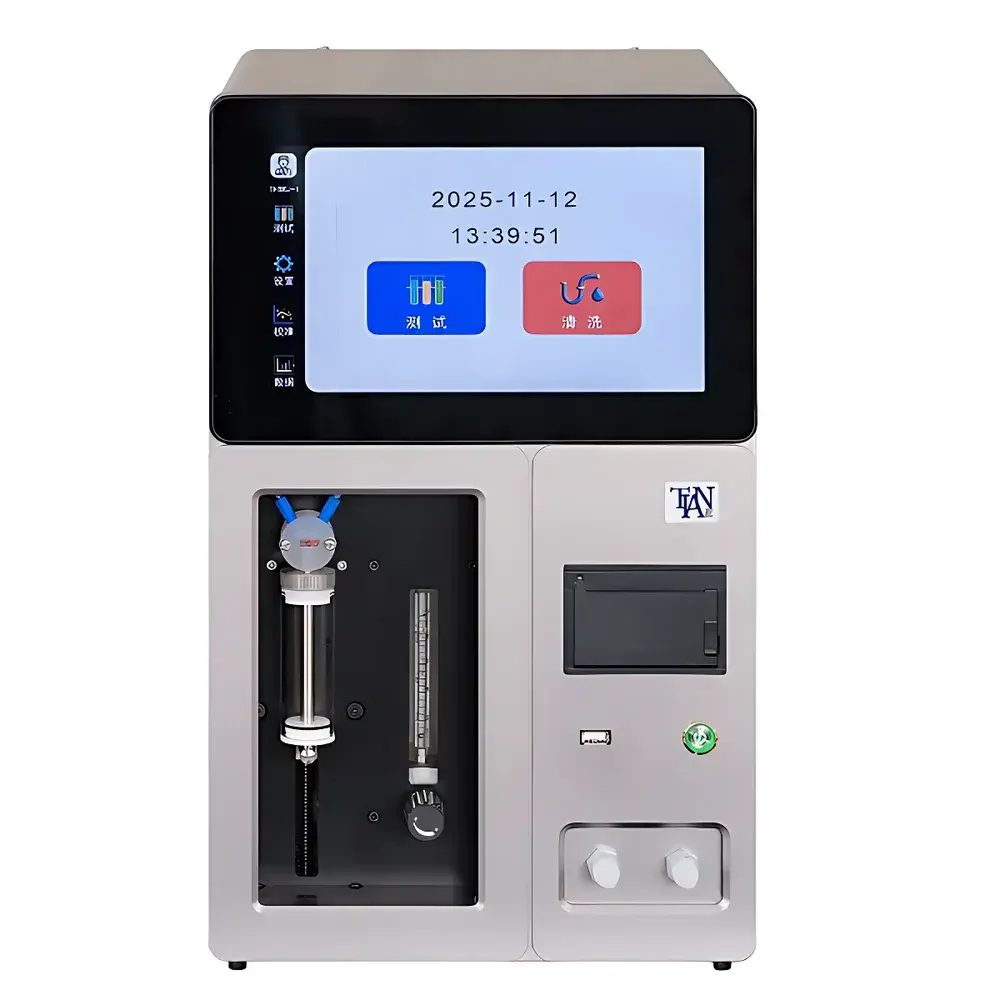
Tianhe SKJ-Q1 Optical Liquid Particle Counter
| Brand | Tianhe |
|---|---|
| Origin | Tianjin, China |
| Manufacturer Type | Authorized Distributor |
| Region of Manufacture | Domestic (China) |
| Model | SKJ-Q1 |
| Instrument Type | Optical Particle Counter |
| Particle Size Range | 0.1–1 µm and 0.2–3 µm |
| Number of Channels | 8 (user-configurable) |
| Sample Flow Rate | 10–100 mL/min |
| Sample Temperature Range | 0–80 °C |
| Minimum Test Volume | ≥2 mL |
| Online Test Duration | 1–9999 s |
| Offline Test Volume | 0.2–6550 mL |
| Maximum Particle Concentration | 20,000 particles/mL |
| Maximum Operating Pressure | 0.5 MPa |
| Connector Options | 1/4-28 UNF, 1/4" PFA Flare |
| Internal Memory Capacity | 32,000 measurement records |
| Display | 10.1-inch touchscreen |
| Dimensions (L×W×H, excluding protrusions) | 276 × 337 × 460 mm |
| Weight | 12 kg |
| Power Supply | AC 220 V, ≤50 W |
| Electrostatic Discharge Protection | ≥2 kV |
| Operating Temperature | 10–50 °C |
| Operating Humidity | 10–90% RH (non-condensing) |
| Interface Options | USB, TCP/IP, RS-232 |
| Compliance Features | Dual-language UI (English/Chinese), user account permission management, real-time data logging with timestamped audit trail, alarm triggers for fluid leakage, system fault, and out-of-spec particle counts |
Overview
The Tianhe SKJ-Q1 Optical Liquid Particle Counter is an ISO 21501-4-compliant instrument engineered for high-precision quantification of suspended particulate contamination in ultrapure process liquids. It operates on the principle of light extinction (obscuration), where individual particles passing through a focused laser beam attenuate incident light proportionally to their cross-sectional area. This enables robust, calibration-traceable counting and sizing across two configurable size ranges: 0.1–1 µm and 0.2–3 µm — critical for monitoring submicron contaminants in semiconductor wafer rinse solutions, photolithography chemicals, battery electrolytes, and high-purity solvents used in advanced material synthesis. Its fully fluorinated fluidic path—constructed from perfluoroalkoxy (PFA) and perfluoroelastomer (FFKM) components—ensures chemical inertness against aggressive acids (e.g., HF, HNO₃), bases (e.g., TMAH), and organic solvents (e.g., NMP, PGMEA), eliminating leaching or surface adsorption artifacts that compromise data integrity.
Key Features
- Chemically resistant all-fluoropolymer wetted path compatible with Class 1 cleanroom-compatible fluids and aggressive process chemistries
- Dual-mode operation: cumulative and differential particle counting with real-time histogram generation and channel-wise concentration reporting
- 10.1-inch capacitive touchscreen interface supporting both English and Chinese languages, optimized for gloved operation in controlled environments
- Configurable 8-channel detection matrix with user-defined threshold settings aligned to industry-specific cleanliness standards (e.g., SEMI F57, ISO 14644-1 Class 5)
- Integrated alarm system with visual, audible, and relay-triggered outputs for fluid leak detection, pressure deviation (>0.5 MPa limit), temperature excursion (0–80 °C operational range), and concentration exceedance
- Comprehensive cybersecurity architecture including role-based user authentication (administrator/operator/guest), encrypted local storage (32,000 timestamped records), and tamper-evident audit logs compliant with GLP/GMP documentation requirements
- Flexible deployment: supports both online inline monitoring (via 1/4″ PFA flare or UNF threaded ports) and offline batch analysis with programmable sample volume (0.2–6550 mL) and test duration (1–9999 s)
Sample Compatibility & Compliance
The SKJ-Q1 accommodates a broad spectrum of low-conductivity and high-viscosity liquids common in electronics and energy manufacturing, including deionized water, hydrogen peroxide solutions, lithium-ion battery electrolytes (LiPF₆ in EC/DMC), photoresist developers, and CMP slurries. Its pressure-rated flow cell (max. 0.5 MPa) and thermal stabilization design ensure stable performance across dynamic process conditions. The instrument meets key regulatory and industry benchmarks: ISO 21501-4 (calibration and verification of liquid-borne particle counters), ASTM F3234 (standard guide for particle counting in semiconductor process chemicals), and SEMI C1 (specifications for particle counters used in microelectronics). Data output formats support traceability under FDA 21 CFR Part 11 when integrated with validated PC software.
Software & Data Management
The bundled Tianhe Particle Analysis Suite (TPAS) provides remote configuration, real-time dashboard visualization, historical trend analysis, and automated report generation (PDF/CSV/XLSX). All communication—whether via USB, RS-232 serial, or TCP/IP Ethernet—is packet-verified and time-synchronized using NTP. Data integrity is preserved through write-once internal flash memory with cyclic redundancy checking (CRC-32), and external export options include direct U-disk transfer or secure FTP upload. Audit trails record operator ID, parameter changes, calibration events, and alarm activations—each cryptographically signed and non-editable post-generation.
Applications
- Semiconductor front-end: monitoring particle levels in ultra-pure rinse water (UPW), etchants, and developer solutions per SEMI F57 specifications
- Lithium-ion battery production: quantifying metallic particulates in cathode/anode slurries and electrolyte formulations to prevent dendrite-induced short circuits
- Photovoltaic manufacturing: verifying cleanliness of texturing and passivation solutions for silicon wafers
- Advanced materials R&D: characterizing nanoparticle dispersion stability in colloidal suspensions for catalysts, quantum dots, and conductive inks
- Pharmaceutical excipient QC: assessing subvisible particle load in sterile filtration validation studies (aligned with USP and )
FAQ
What calibration standards are supported?
The SKJ-Q1 accepts NIST-traceable polystyrene latex (PSL) microsphere suspensions for size calibration across its dual detection ranges; certificate of calibration is provided with each instrument.
Can the instrument be integrated into a SCADA or MES system?
Yes—via Modbus TCP or custom OPC UA drivers enabled through the optional Industrial Communication Module (ICM), supporting seamless integration with factory automation platforms.
Is cleaning validation supported for multi-product use?
The system includes a built-in flush protocol with programmable solvent sequence, flow rate, and dwell time, and records all cleaning cycles in the audit log with operator signature.
How is data security ensured during remote access?
TPAS implements TLS 1.2 encryption for web-based remote sessions, mandatory two-factor authentication for administrator-level access, and automatic session timeout after 15 minutes of inactivity.



