
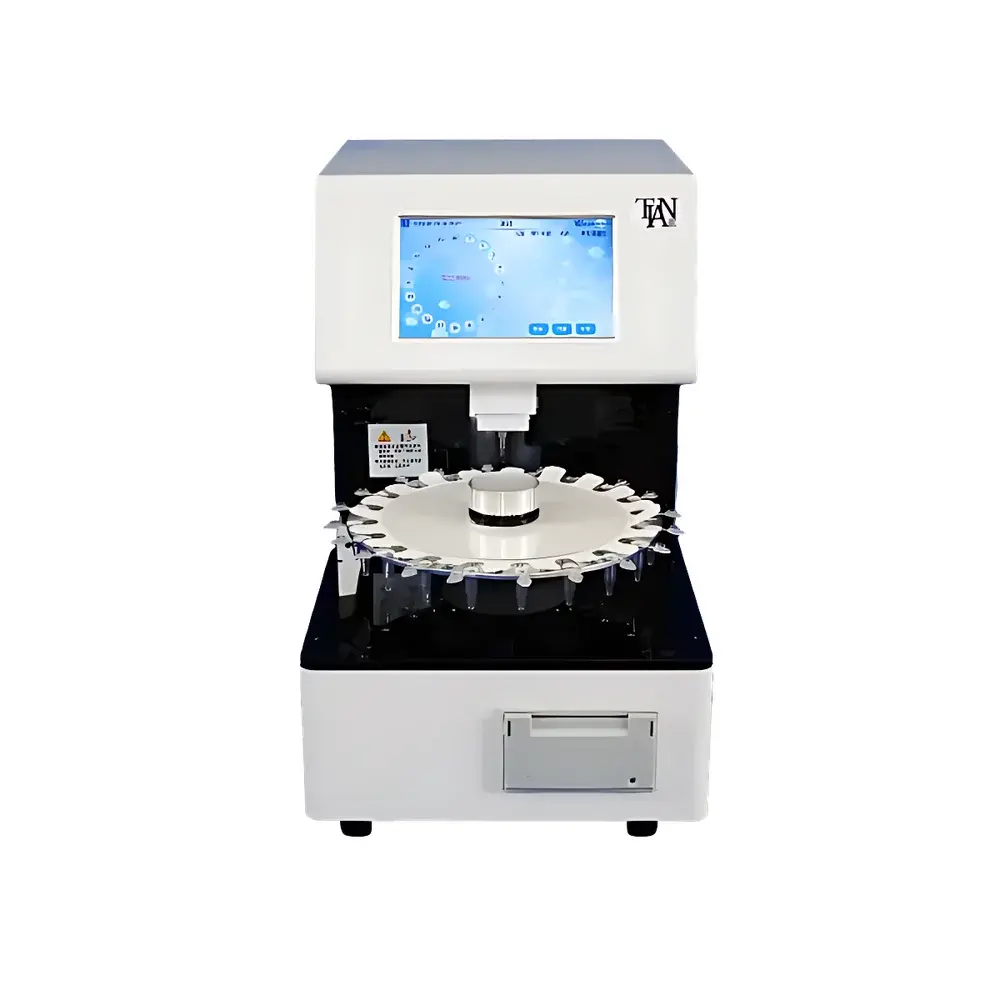
Tianhe SMC 30FD Freezing Point Depression Osmometer
| Brand | Tianhe |
|---|---|
| Origin | Tianjin, China |
| Model | SMC 30FD |
| Measurement Range | 0–3000 mOsmol/kg H₂O |
| Sample Capacity | 1–20 positions |
| Sample Volume | 60 µL (50–100 µL typical) |
| Test Time | < 1.5 min per sample |
| Pre-cooling Time | ≤ 3 min |
| Resolution | 1 mOsmol/kg |
| Repeatability | RSD ≤ ±1% at 300 mOsmol/kg |
| Accuracy | ±2 mOsmol/kg (≤400 mOsmol/kg) |
| Linearity | < 1% deviation from linear fit |
| Operating Environment | 5–35°C, 5–80% RH |
| Power Supply | AC 220 V ±10%, 50 Hz, <80 W |
| Dimensions | 280 × 443 × 434 mm |
| Language Support | English & Chinese |
| Connectivity | RS232, USB, Barcode Scanner Interface |
| Compliance | Designed to support pharmacopeial testing per Chinese Pharmacopoeia (ChP) requirements |
Overview
The Tianhe SMC 30FD is a fully automated freezing point depression osmometer engineered for high-throughput, regulatory-compliant osmolality measurement in pharmaceutical quality control laboratories. Based on the thermodynamic principle of freezing point depression—where solute concentration is quantitatively determined by measuring the temperature difference between the freezing point of pure water and that of the sample—the instrument delivers traceable, reproducible results across the full clinical and pharmaceutical range (0–3000 mOsmol/kg H₂O). Its dual-stage refrigeration system eliminates reliance on heat-transfer fluids, reducing thermal drift and enabling rapid thermal stabilization (<3 min pre-cool time), while the motorized rotating sample carousel with auto-lifting probe ensures unattended sequential analysis of up to 20 samples without manual intervention. The embedded Android-based interface provides intuitive touchscreen navigation, real-time status monitoring, and integrated pharmacopeial reference data—including over 300 injectable drug entries from the Chinese Pharmacopoeia (ChP)—to streamline method setup and sample identification.
Key Features
- Freezing point depression detection with 1 mOsmol/kg resolution and calibrated accuracy of ±2 mOsmol/kg below 400 mOsmol/kg and ±1% above.
- Dual-stage solid-state cooling architecture—no liquid coolant required—ensuring long-term thermal stability and minimal maintenance.
- Automated 20-position turntable with programmable probe lift mechanism for walk-away operation and batch processing.
- Low-volume analysis capability: as little as 60 µL per test (50–100 µL recommended), conserving precious biopharmaceutical or clinical specimens.
- Onboard calibration flexibility: user-defined multi-point calibration curves using standards of arbitrary concentration to optimize fit across nonlinear regions.
- Full audit trail support: role-based access control (administrator, analyst, reviewer), electronic signatures, and timestamped operation logs compliant with ALCOA+ principles.
- Integrated barcode scanner for rapid, error-resistant sample registration and metadata association.
Sample Compatibility & Compliance
The SMC 30FD is validated for aqueous solutions commonly encountered in parenteral drug development and release testing—including saline formulations, monoclonal antibody buffers, lyophilized reconstitution solutions, ophthalmic preparations, and cell culture media. It supports ChP General Chapter 0411 (Osmolality Determination) and aligns with fundamental expectations of USP , EP 2.2.35, and ISO 11348-3 for freezing point-based osmometry. While not certified to FDA 21 CFR Part 11 out-of-the-box, its software architecture—featuring encrypted local storage, user authentication, and immutable data export—provides a foundation for laboratory-specific Part 11 validation. All stored data retain original acquisition timestamps, operator IDs, and instrument configuration parameters, facilitating GLP/GMP audit readiness.
Software & Data Management
The Android-powered operating system hosts a dedicated osmometry application with bilingual UI (English/Chinese), configurable report templates, and native USB file export in CSV, PDF, or XML formats. Data are stored locally on internal flash memory with no cloud dependency; users may define retention policies and perform periodic backup via USB mass storage mode. RS232 serial output enables integration with LIMS or ELN platforms using standard ASCII protocol framing. Audit logs record every critical action—including calibration events, method changes, user logins, and result overrides—with cryptographic integrity verification. Exported files include embedded metadata: sample ID, lot number, operator, date/time, instrument serial number, and raw thermogram traces (optional).
Applications
- Final container release testing of injectables, infusions, and ophthalmic solutions per pharmacopeial monographs.
- Formulation development support: buffer optimization, excipient screening, and stability-indicating assessment of concentration-dependent aggregation onset.
- Biologics process monitoring: cell culture harvest osmolality profiling, diafiltration endpoint determination, and ultrafiltration/diafiltration (UF/DF) buffer exchange verification.
- Clinical research labs: serum, urine, and cerebrospinal fluid osmolality quantification for metabolic and renal function studies.
- Contract testing organizations (CTOs): high-volume QC workflows requiring robust data governance and cross-shift traceability.
FAQ
What osmotic principle does the SMC 30FD employ?
It uses freezing point depression, a colligative property directly proportional to total solute particle concentration in aqueous solution.
Is the instrument suitable for non-aqueous or viscous samples?
No—it is designed exclusively for aqueous-based pharmaceutical and biological samples; organic solvents, oils, or highly viscous suspensions fall outside its validated scope.
Can calibration be performed with custom standards?
Yes—users may input arbitrary concentrations for multi-point calibration, and the system applies weighted least-squares regression to generate optimized measurement curves.
Does the device meet 21 CFR Part 11 requirements?
It provides foundational controls (audit trail, electronic signature, access roles); formal Part 11 compliance requires site-specific validation documentation and procedural SOPs.
How is data integrity ensured during power interruption?
All measurements are written to non-volatile memory incrementally; partial tests resume from last stable state upon reboot, and no acquired data are lost.





