
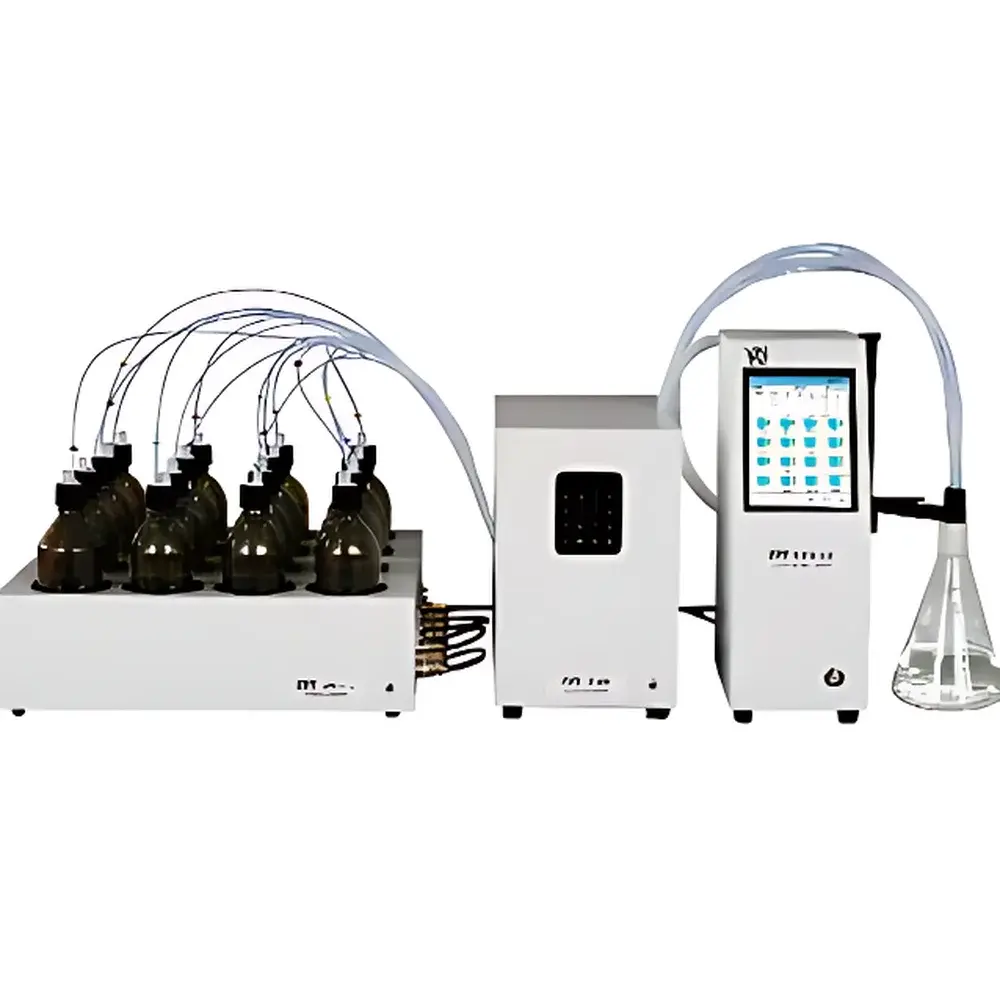
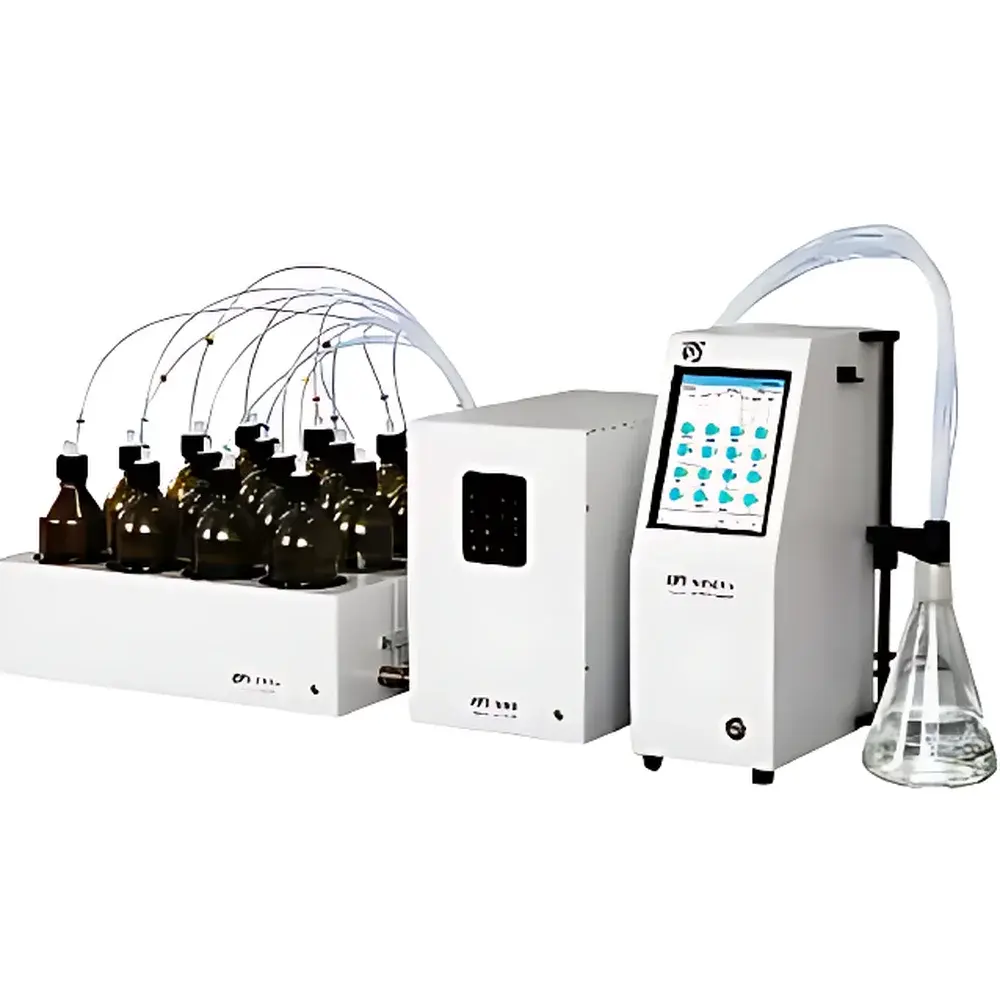
Tianhe ZPY-16 Intelligent Liquid Dispensing Platform
| Brand | Tianhe |
|---|---|
| Origin | Tianjin, China |
| Manufacturer Type | Authorized Distributor |
| Country of Origin | China |
| Model | ZPY-16 |
| Plate Positions | 16 |
| Pipetting Accuracy | 0.1 mL |
| Pipetting Range | 0.1–999 mL |
| Sample Throughput | 16 samples |
| Pipetting Error | <1% at 5 mL |
| Dispensing Volume Range | 0.1–8000 mL |
| Flow Rate | 5–80 mL/min |
| Power Supply | 100–240 VAC, 50–60 Hz, 75 W |
| Operating System | Android-based HMI |
Overview
The Tianhe ZPY-16 Intelligent Liquid Dispensing Platform is a programmable, multi-channel liquid handling workstation engineered for precision volumetric dispensing and automated reagent formulation in regulated laboratory environments. It operates on positive displacement pumping principles using peristaltic or syringe-based metering mechanisms—configured to deliver repeatable, low-volume to high-volume transfers (0.1 mL to 8 L total batch volume) with sub-milliliter resolution. Designed for routine QC testing, clinical assay preparation, environmental sample dilution, and pharmaceutical standard solution generation, the ZPY-16 supports walk-away automation of complex multi-step dilution, blending, and spiking protocols without manual pipetting intervention. Its sealed architecture and independent fluidic paths ensure operator safety during handling of volatile, cytotoxic, or corrosive reagents—aligning with OSHA hazard communication standards and ISO 15195:2018 requirements for calibration laboratory infrastructure.
Key Features
- 16 independent dispensing channels with dedicated fluid paths—eliminating cross-contamination between reagents
- Perfluoroalkoxy (PFA) and polytetrafluoroethylene (PTFE)-lined tubing compatible with aggressive solvents, strong acids, bases, and organic media
- Integrated anti-volatilization cap detection and automatic line purge function to minimize vapor exposure and residual carryover
- Real-time liquid level monitoring with low-volume alerts and empty-bottle auto-detection to prevent air aspiration and process interruption
- Android-powered human-machine interface (HMI) with touchscreen navigation, intuitive workflow builder, and on-device recipe management
- Preloaded capacity for up to 50,000 user-defined protocols—including ratio-based mixing, time-triggered additions, sequential dilutions, and volume-weighted blending
- Modular channel configuration allows flexible assignment of source reservoirs and destination vessels across 16 plate positions
- Compliance-ready audit trail logging (timestamped actions, user ID, parameter changes) supporting GLP/GMP documentation practices
Sample Compatibility & Compliance
The ZPY-16 accommodates standard 10–1000 mL reagent bottles, vials, and deep-well plates via adjustable deck fixtures. Its chemically inert fluid path—comprising PFA tubing, ceramic pump heads, and fluoropolymer valves—ensures compatibility with acetonitrile, hydrochloric acid (up to 37%), sodium hydroxide (up to 50%), ethanol, DMSO, and aqueous buffers. The system meets IEC 61000-6-2/6-4 electromagnetic compatibility standards and conforms to CE marking directives for laboratory equipment. While not FDA 510(k)-cleared, its operational logs, parameter locking, and electronic signature support align with FDA 21 CFR Part 11 expectations for electronic records in non-clinical laboratory settings. It is routinely deployed in CNAS-accredited testing labs where ISO/IEC 17025:2017 clause 7.2.2 (method validation) and clause 7.7 (equipment verification) apply.
Software & Data Management
The embedded Android OS hosts a proprietary control application enabling offline protocol design, real-time progress visualization, and post-run report export (CSV/PDF). All dispensing events—including volume dispensed, channel used, timestamp, operator ID, and error codes—are recorded in an immutable local database. USB export and optional Wi-Fi connectivity facilitate integration with LIMS or ELN platforms via standardized CSV templates. Version-controlled recipe backups can be synchronized to network drives; firmware updates are performed via signed OTA packages to maintain system integrity. Audit trail entries include digital timestamps traceable to NTP servers and support role-based access control (admin/operator/guest) with password protection.
Applications
- Preparation of calibration standards and QC reference materials for HPLC, GC, and ICP-MS analysis
- Automated dilution series for microbiological susceptibility testing (e.g., CLSI M07-A10)
- Formulation of multi-analyte spike solutions in environmental water testing (EPA Method 500/600 series)
- Reconstitution and serial dilution of monoclonal antibodies and ELISA reagents
- Batch-wise preparation of cell culture media supplements under aseptic hood integration
- Standardized buffer blending for electrophoresis and chromatography system priming
FAQ
What is the minimum and maximum dispensing volume per channel?
The ZPY-16 supports single-step dispensing from 0.1 mL to 999 mL per channel, with cumulative batch volumes up to 8000 mL.
Does the system support gravimetric verification or calibration traceability?
Yes—users may perform in-situ volumetric verification using certified Class A glassware and NIST-traceable balances; calibration certificates for flow sensors are available upon request.
Can the platform integrate with third-party lab automation systems?
It offers RS-232 and TCP/IP interfaces for basic command-driven control (SCPI-like syntax); full robotic integration requires custom middleware development.
Is remote monitoring or cloud-based data backup supported?
Local data export is standard; cloud synchronization requires on-premise IT policy approval and secure VPN configuration—no direct vendor cloud service is provided.
What maintenance intervals are recommended for tubing and pump components?
PFA tubing should be replaced every 6 months under continuous operation; pump rollers require inspection every 3 months and replacement annually or after 10,000 cycles.



